


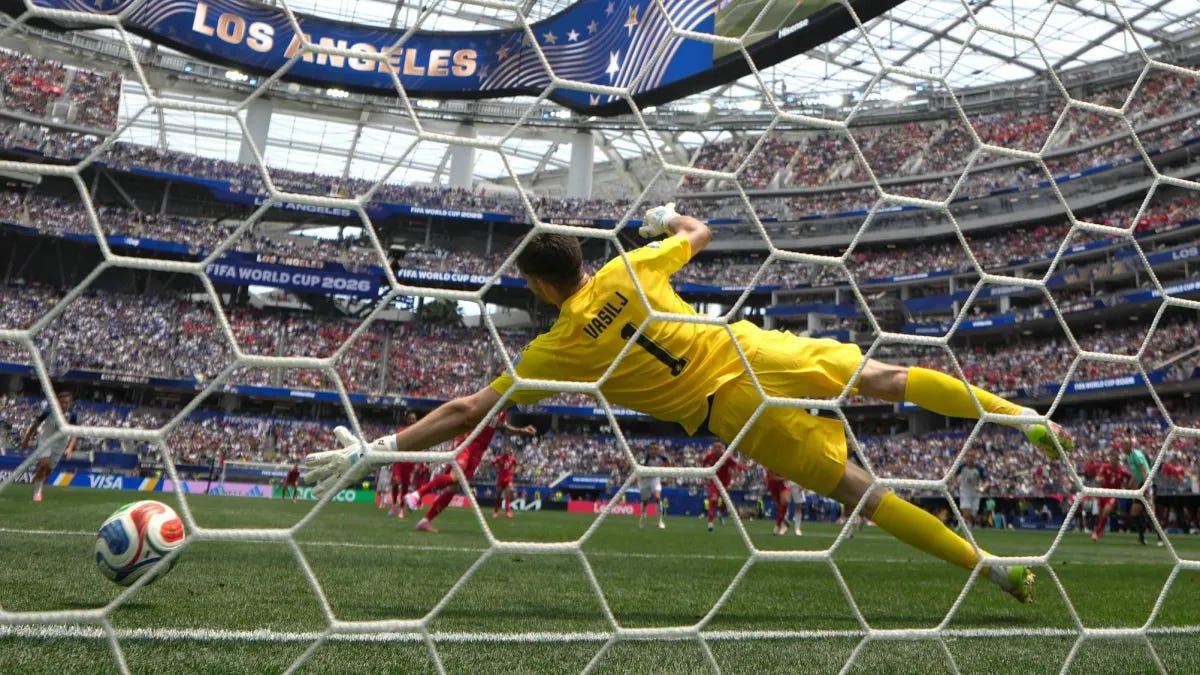
The final whistle blows, and your heart sinks a little as you realize the game will be decided by penalty kicks. You’ve just watched two hours of a back-and-forth match come down to a handful of well-placed shots.
The kicker spots the ball, twelve yards from a professional goalkeeper who has spent their entire adult life doing exactly one job. Last week, we talked about where a kicker should aim if they only had one shot and wanted to maximize their odds of scoring.
Today’s question is simpler: do you think you’d score in that situation?
Of course, we could have flipped the question and asked about the other side of the kick. If we put you in the net as the goalkeeper, could you stop a penalty kick against a professional striker? The numbers come back similarly bold on both sides. A lot of people, watching from their couches, are convinced they’d be fine out there.
A recent YouGov America survey found that roughly 1 in 4 Americans believe they could score a penalty kick against a professional goalkeeper. It stood out because penalty kicks are uniquely high-pressure moments in sports with intense individual scrutiny and a high-stakes outcome. And yet a lot of people don’t seem fazed by any of that.
We’ll see how our own reader poll stacks up against that. For now, here are the results of that survey:
But I’m different…
I told myself I wouldn’t write another soccer story, but it was hard to pass on these findings. That was a representative survey of U.S. adults. We’re talking about people with no special training in the sport and who have likely never done anything in front of 80,000 people. And still, they’re sure they could do it.
Of course, this isn’t really a story about soccer. It’s a story about economics.
This hubris can be found in a variety of scenarios. Nearly half of all men say that in an emergency, they could land a commercial airplane with an air traffic controller talking them through it on the radio. A notable share of people say they could win a fight against a gorilla. And a majority of people say they could perform CPR on an adult whose heart has stopped, even though only one in six actually know the recommended technique for bystander CPR is chest compressions alone, no rescue breaths.
Notice how wide the contexts are? We’ve got airplane cockpits, wildlife enclosures, cardiac emergencies, and penalty kicks. The stakes are wildly different, yet a suspicious number of people believe they’d clear a hard, objective bar even without knowing what the bar actually requires.
There’s a name for this in behavioral economics: overconfidence bias. It’s the tendency to overestimate our own abilities, our odds of success, and our control over outcomes. It’s one of the most replicated findings in all of behavioral economics, tested across education, dating, investing, health, parenting, you name it. It holds up nearly everywhere researchers look.
Okay, so what?
These are fun surveys, but they’re also all things most of us will never actually be tested on. You’re probably never taking a World Cup penalty kick or landing a commercial plane, and you’re (hopefully) not fighting a gorilla. So why should any of this matter to you?
Stop looking at the examples and start looking at the behavior underneath them. The specific scenario isn’t the point. It’s the belief that you could handle something hard, with no real basis for thinking so. That reflex doesn’t stay contained to hypothetical emergencies you’ll never face. It shows up in decisions you’re actually making, with actual money, right now.

Take investors. Overconfident traders are convinced their read on a stock is sharper than everyone else’s, so they trade more often than cautious ones do. That seems reasonable enough since people who are right more often should act more often. Except the data runs the other way. Studies find that the more actively individual investors trade, the worse their returns tend to be.
Or look at the explosion of sports betting and prediction markets, especially among young men. Over half of American men ages 18 to 49 now have an active sportsbook account, and bettors overwhelmingly say they believe they can make money doing it. And yet only 3 in 10 say they’ve actually come out ahead. The participants in these markets skew younger, more educated, and male. It’s the same group that tends to be more overconfident in plenty of other contexts, too.
There’s nothing inherently wrong with believing in yourself. The issue is that we’re misjudging ourselves in ways that can actually cost us financially (or physically in a fight against a gorilla). These findings aren’t just random noise with some people guessing high and some guessing low until it all washes out. It’s a systematic bias, and one that entire industries are built to profit from.

Final Thoughts
If you didn’t already know it, you now have a name for the flicker of confidence you felt when you read the opening of this article. The real question was never really “would you score?” It’s why you think you would.
That flicker is the same one sitting inside the investor placing one more trade, and the bettor certain this is the pick that finally pays off. It’s not stupidity or even arrogance. It’s something closer to a factory setting in the human mind, running in the background while you’re watching the penalty-kick shootout or logging into your brokerage account.
We could write an entire separate article on prediction markets alone given how fast they’re growing, but that’s a story of its own that we’ll come back to another day. For now, the takeaway is simpler than that. The next time you feel completely sure about something, it might be worth pausing for half a second to ask what that certainty could cost you.
Liked learning why we’re all a little overconfident? Subscribe for more economics hiding in plain sight, and share this one with someone sure they could beat the market or one of the keepers in this year’s World Cup.
Players in the 2026 World Cup have converted just 32 of 49 penalties (65.3%) so far, the lowest since 1966 [Yahoo! Sports]
90% of U.S. adults express confidence in their ability to detect and prevent financial scams, yet more than 27% report falling victim at some point [Citi Group]
12% of Americans between 18 and 24 years old said they have placed a prediction-market wager, an identical finding for those who were between 25 and 34 years old [Politico]
In a survey of over 1,200 bettors, nearly a quarter believe they win 75% of the time, even though the break-even threshold in sports betting is around 52.4% [Sports Betting Report]
Today, 47% of men under 30 say legal sports betting is a bad thing for society, up from 22% who said this in 2022 [Pew Research Center]
That "41% of men under 30..." stat made me laugh out loud! Also, I love your description of a cognitive bias like overconfidence as a "factory setting in the human mind." Thanks, Jadrian! This one led to a lot of discussion at Econiful :)
The difference between confidence and overconfidence can be lethal and lead to massive market failures and real world calamities. It’s a big reason why we are so bad at prediction.
I also like to present this data against what “experts” say ie. What share of professional soccer players say they can make a free kick