


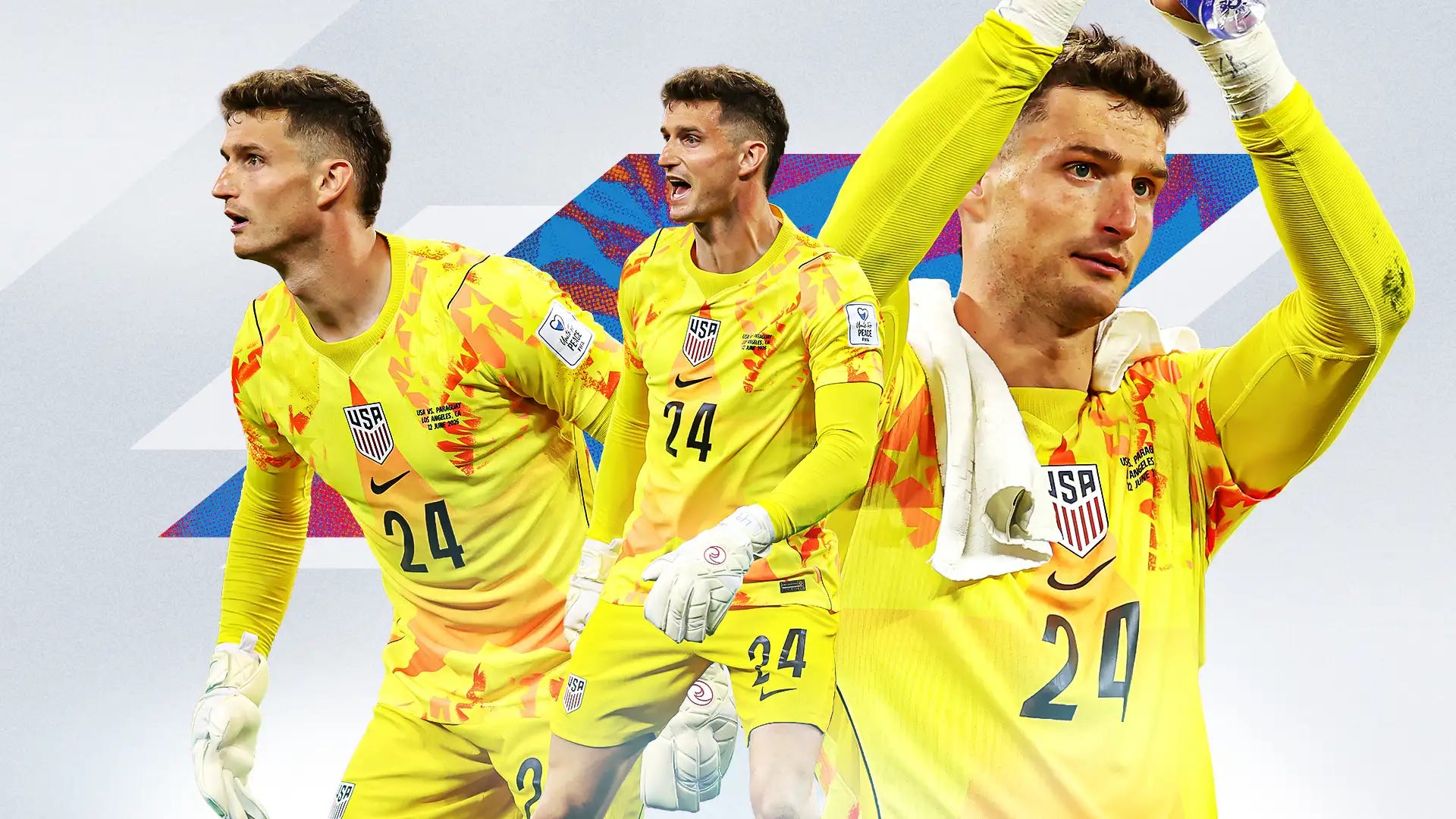
Growing up, Matt Freese wanted to be a professional athlete. He’d played obsessively since childhood and was good enough to earn a scholarship to play Division 1 soccer. He could have played college soccer just about anywhere, but he picked Harvard. It was the kind of thing that makes a family proud.
But after just a few semesters in Cambridge, his dream opportunity arrived when a professional team came calling. Plenty of people drop out of college, and the reasons vary from chasing a dream to realizing school isn’t the right fit. This was squarely the former. He did what a lot of people would do in his shoes and left campus to take the chance.
Most people who leave school for a job let the degree go quietly after that. But Matt Freese is a little different. He made good use of the free time afforded to professional soccer players by auditing graduate-level sports business classes and cold-emailing professors to see if he could sit in on class. It didn’t take long for him to realize he wanted his degree, so he decided to finish it by taking classes online between practices. In 2022, he graduated from Harvard with a degree in economics.
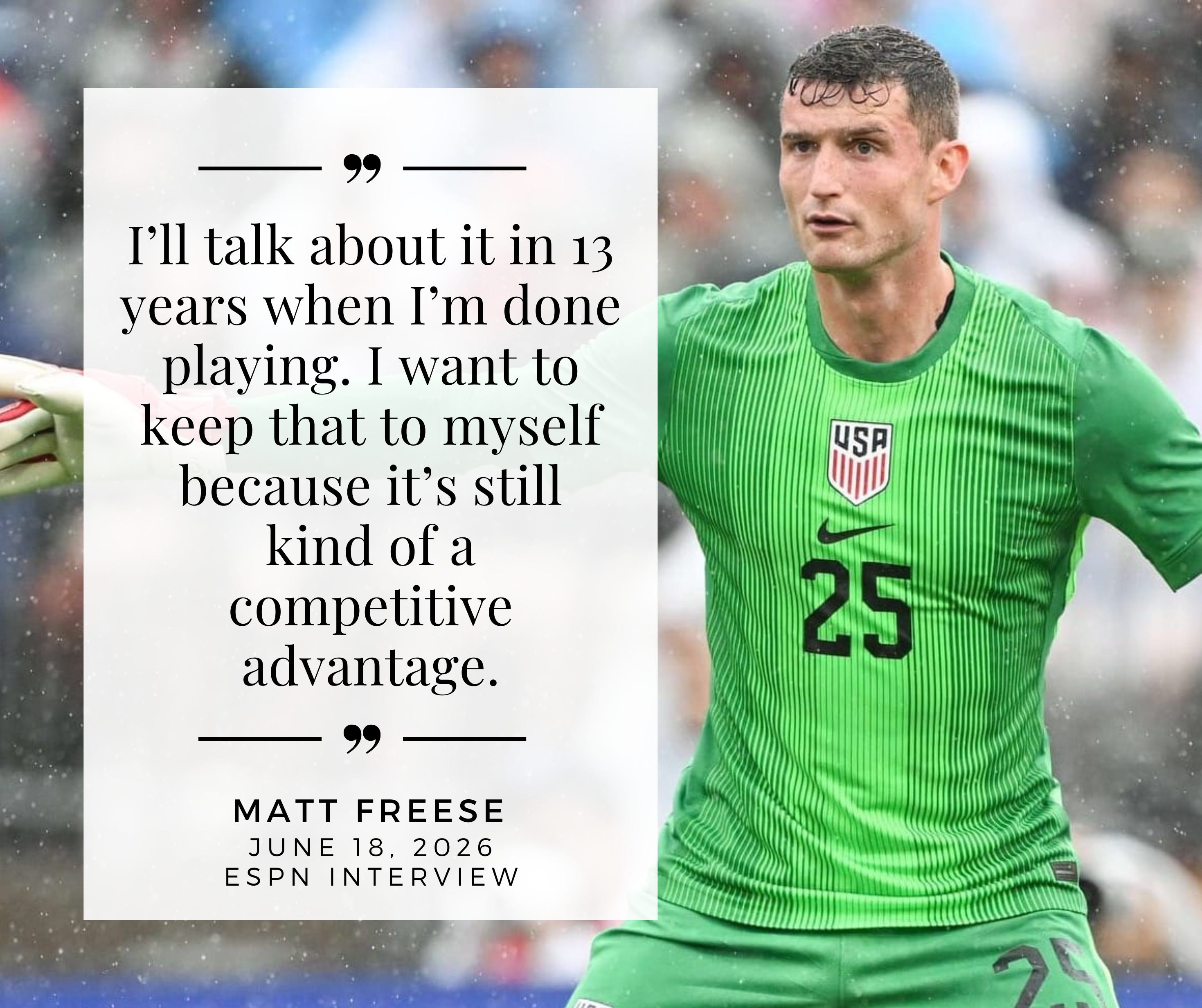
Somewhere along the way, he wrote a research paper on a rare but consequential moment inside his sport: the penalty kick. He studied the statistical signatures of what a player is about to do before he’s even fully decided to do it himself. That’s all we really know about it, because he hasn’t shared the results with anyone. Asked about it directly, his answer has stayed the same. He’ll talk about it when he’s done playing.
If you don’t know by now, Matt Freese is currently the starting goalkeeper for the United States at the 2026 World Cup. His training in Philadelphia and New York helped build him physically, but what he learned in his economics classrooms has prepared him mentally for the moment that could decide his team’s World Cup.
Twelve Yards, Two Minds
Goalkeepers aren’t the only people obsessed with penalty kicks. Kickers, coaches, and now a small industry of sports scientists all study the same twelve yards, for good reason: a penalty is about as close to a guaranteed goal as soccer gets. Roughly four out of five penalties go in. Once the whistle blows, the math favors the kicker so heavily that the goalkeeper’s job barely resembles goalkeeping at all.
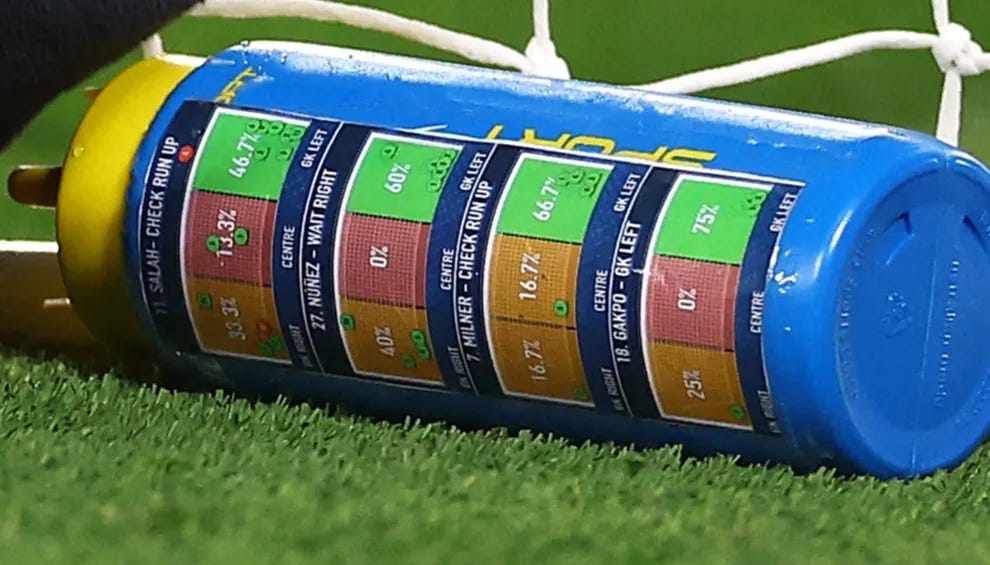
That’s why so many goalkeepers keep a cheat sheet with them, either taped to the inside of their sleeve or, more famously, printed on a water bottle. The notes often highlight each kicker’s preferred foot and which side he tends to favor. If you’re curious, Matt Freese doesn’t bother. After saving three penalties in a shootout, he was asked about his notes. “I had no cheat sheet, nothing like that,” he said. “I had all 20 guys on their roster memorized.” Admittedly, this is a very Harvard-econ-grad way to prepare for a soccer game.
There’s a real puzzle underneath all this preparation, one that would exist whether or not anyone had a cheat sheet at all. The kicker wants to pick the spot the goalkeeper won’t reach. The goalkeeper wants to dive toward the spot the kicker is about to pick. Neither can decide in isolation, because the right answer for each one depends entirely on what the other does.
Suppose you’re a kicker who’s excellent at going low to your right. Should you stick with it for your next kick? If the goalkeeper knows your tendency, he can anticipate the shot and turn your shot into an easy save. But the goalkeeper faces a mirrored version of the same problem. If he commits to diving one way every time, kickers can adjust their shot to the other side and score more frequently.
This back-and-forth decision-making, where one player depends entirely on what the other is doing, is what economists study as game theory. It turns out that penalty kicks are one of the cleanest real-world examples of strategic interdependence there is. Neither player can safely repeat the same choice over and over, which means neither has a dominant strategy. So the only sound approach for both kicker and keeper is a mixed strategy that involves deliberately varying your choices so no pattern ever forms for the other side to exploit.
But players are only human. They have biases and tendencies like anyone else, which is exactly why a goalkeeper would want a water bottle’s worth of them or a Harvard research paper’s worth memorized in his head. But this raises an interesting question about what happens when the kicker walking up to the line has no tendencies on record at all?
The Players With No Patterns
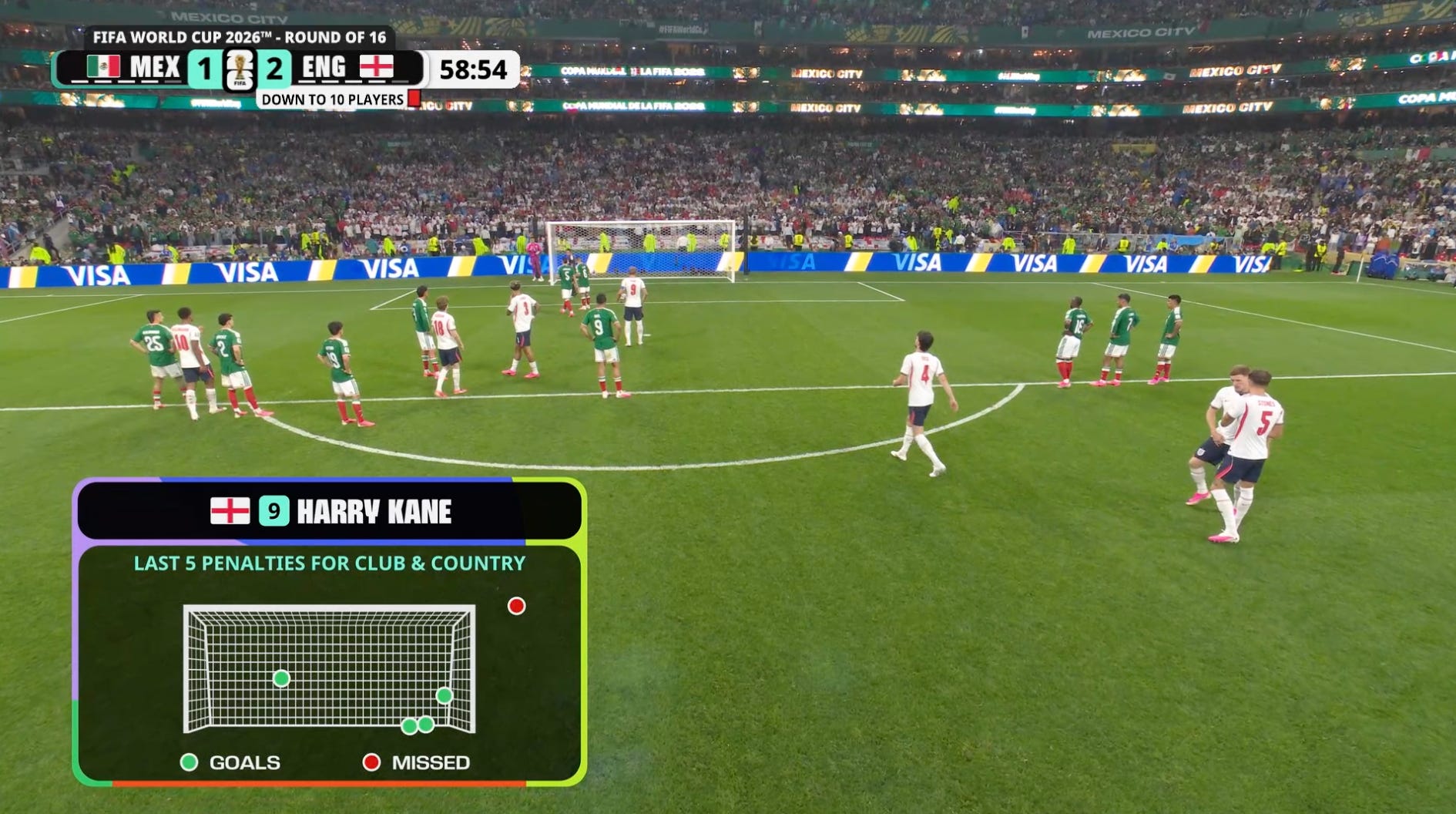
Over the past week, Freese has almost certainly been adding data points to the paper nobody’s allowed to read. The World Cup’s knockout rounds have produced a run of shootouts, and it’s hard to imagine him watching them as just a fan. He’s likely clocking foot plants and run-ups the way a scout studies film. But one of last week’s shootouts probably taught him something about the limits of that work.
Germany was eliminated by Paraguay in a shootout last week. Tied 3-3 in sudden death, four German players in turn declined to take the deciding kick. It finally fell to Jonathan Tah, a center-back who had never taken a competitive penalty in his career. He struck it over the crossbar, and Paraguay won on the next kick, taken by another center-back with little to no penalty pedigree of his own. Across several shootouts last week, more than a few shooters stepped up with career penalty logs that were either empty or nearly empty.
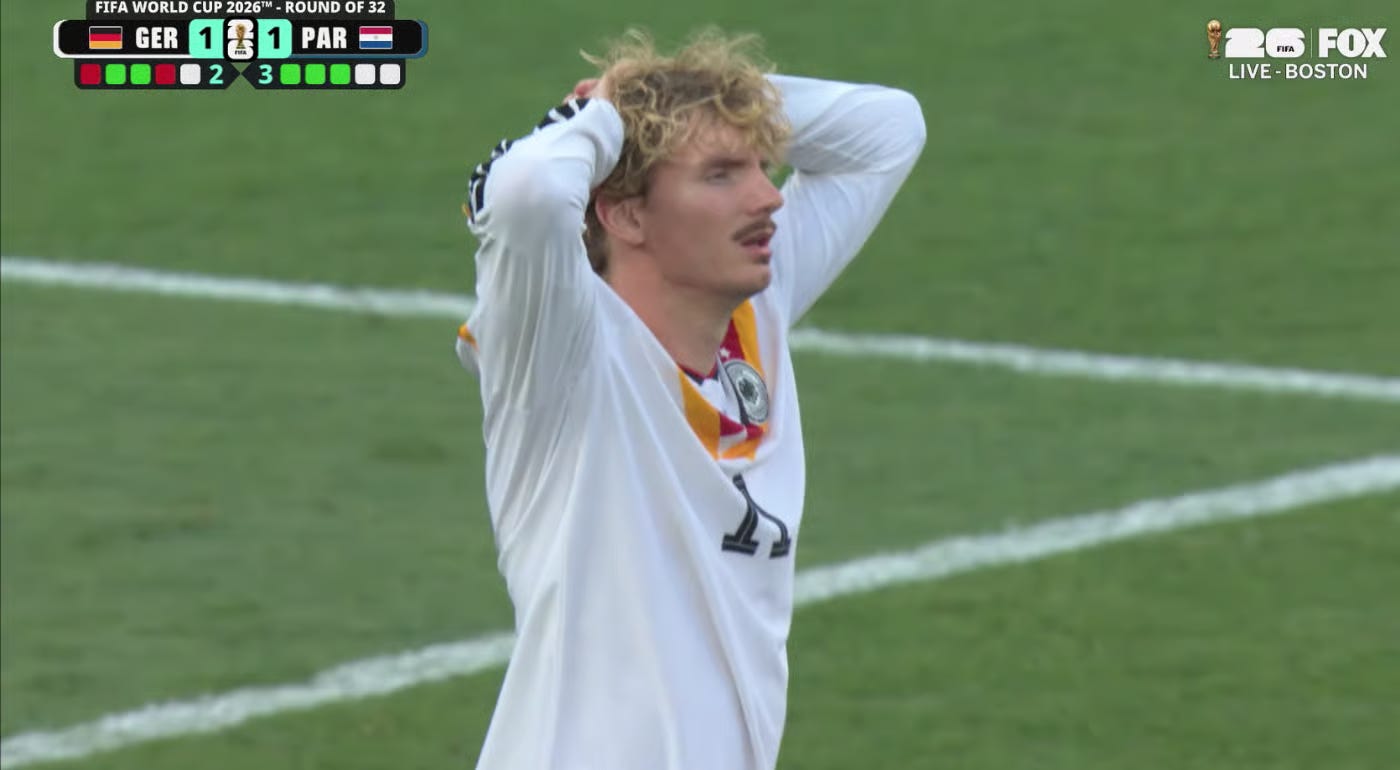
If you only watch soccer once every four years, you’d be forgiven for assuming this is unusual. It isn’t, and there’s a simple reason inexperienced shooters keep ending up on the spot in the sport’s biggest moments. In-game penalties only need one or two trusted takers, but a shootout needs at least five. But teams rarely get to build up shootout experience in the first place because shootouts themselves are rare. They only happen in knockout matches, which are a small fraction of the games any team plays in a year.
Think about what that means for a goalkeeper like Freese. Every scouting report and tendency chart he builds for a typical opponent would have been useless against Tah because there was nothing there to study. The Paraguayan goalkeeper didn’t need to worry too much since Tah’s kick sailed well over the bar. But if you only get one shot at a penalty in your life, where should he have actually aimed it?
The Boring Shot Nobody Takes
Of course, Matt Freese isn’t the only person who’s turned penalty kicks into a research subject. Steven Levitt and Stephen J. Dubner devoted the opening chapter of their book Think Like a Freak to exactly this question: where should you actually aim?
After analyzing data on hundreds of professional penalty kicks, a team of researchers found something almost insultingly simple. Goalkeepers dive left 57% of the time and right 41% of the time, which leaves them standing in the center on just 2% of kicks. That means a shot driven straight down the middle is about seven percentage points more likely to score than one aimed at a corner. It’s not all that dissimilar to the famous Panenka chip shot popularized by Antonín Panenka’s shot in the 1976 European Championship final.
So why doesn’t everyone do it? Only 17% of penalties are ever aimed at the center. According to Levitt and Dubner, the answer is about shame, not strategy. A kicker who goes for the corner and gets stopped can blame a great save. A kicker who strikes it down the middle and watches the keeper catch it without diving looks like he didn’t even try.
Tah’s shot missed so badly the announcers kept piling on, but at least he looked like he was trying to beat the keeper outright. A kicker who aims for the middle and gets it saved doesn’t get that cover. He just looks like he wasn’t playing to win.
Final Thoughts
Knowing all this, don’t expect a wave of players to start driving penalties down the middle. If kickers started aiming center more often, goalkeepers would adjust, and the boring shot would stop being a genius shot. The advantage only exists because almost nobody exploits it.
There are other penalty-kick debates economists haven’t settled, either. Pundits will tell you, with total confidence, that a team should always choose to kick first in a shootout, because the pressure of constantly playing catch-up supposedly rattles the team kicking second. Some of the largest studies ever done on this, covering well over a thousand shootouts, back that up. Other studies just as large find no advantage at all.
And then there’s the matter of what a penalty is actually worth. Last week, Neymar scored a penalty in the tenth minute of stoppage time against Norway. On paper, it was identical to any other penalty. But Norway led 2-0, and Neymar’s kick only brought the score to 2-1 in a match Brazil had already lost. A penalty like that carries almost none of the psychological weight of one that could actually change the outcome, and it’s worth wondering how much that changes the contest playing out on the spot.
Which brings us back to Matt Freese and the paper he still isn’t sharing. He may know more about penalty kicks than almost anyone alive. Standing on his line at his first World Cup, he may be about to find out that sometimes, that still isn’t enough.
Know someone who still thinks aiming for the corner is obviously smarter? Send them this and let them argue with Freese’s economics degree.
And if you want more stories where economics hides inside things you already love, hit subscribe. We’re here every week.

Across the U.S., there are over 40.4 million people who have completed some college but have not earned a credential [Inside Higher Ed]
Freese’s father is a neurosurgeon who pioneered gene therapy research, and his mother holds an MBA in healthcare management [US Soccer]
A record five games at the 2022 World Cup in Qatar were settled by penalty kicks, including the final when Argentina beat France [ABC News]
Germany had won six consecutive shootouts in all competitions before this World Cup, with their only previous defeat occurring in 1976 following Antonín Panenka’s legendary spot-kick in the semi-final of the European Championship [The Guardian]
Penalty kicks, where a goal immediately secured victory, were successful 89.1% of the time, but dropped to 60.4% when a miss meant immediate elimination [Wired]
I remember PKs being an example in game theory lessons in my early Econ courses!
The goalkeeper has to defend the area he can actually stop the ball. Basically where he's actually standing.
Then there is an zone where the goalkeeper has a good chance to save.
Then there's a zone which is difficult, top and bottom corners near the post.
To increase the chance of a save. Just don't move until the ball is kicked. The three zones come into play.
Green easy, yello great possibility, red a good penalty kick.
The trick then is posture. This is a key. Crouched position as if you were a cat. Your in a pounce position, you spring to where the ball is going.
If you were standing, in order to get to the ball you have to bend the knees and that initial motion loses a valuable second and makes it easier for the penalty taker.
When I played in goal, I applied this approach and it worked. Even a penalty stopped near a post.
If a goalkeeper does this and is known to be a stopper, all future penalty takers are under pressure.
That in my experience and opinion is probably the best way for goalkeepers to be more successful.
Key.. just keep your eye on the ball. Ignore the penalty taker..more pressure on them.