


Hi y’all! Here are five stories from this week that contained some neat applications of economic principles or are related to teaching:
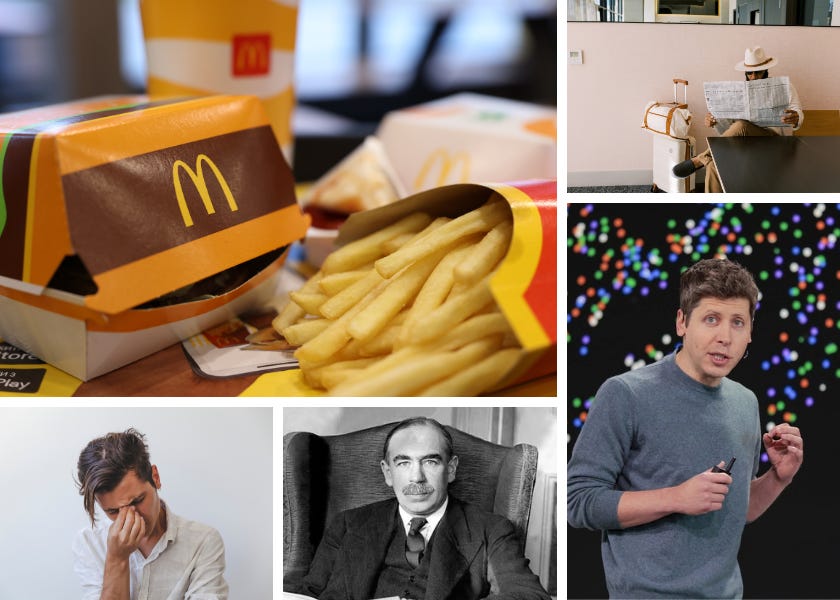
McDonald’s uses machine learning to have AI price your Big Mac [The Verge]
Holiday airfares are tracking toward a 10-year high in the US, with the average round-trip flight over Thanksgiving weekend running close to $100 more than last year [CBS News]
US consumer confidence fell to its lowest level since 2014 as Americans contend with inflation and rising fuel prices [CNBC]
A Keynes bot can tell us what John Maynard Keynes might have said about artificial intelligence [The New York Times]
OpenAI CEO says the “world should accept some bad things happening” in exchange for the benefits of artificial intelligence [Politico]

Oktoberfest welcomes millions of visitors each year, and yet only six breweries are allowed to pour at the world’s largest folk festival. Even the prince whose family started it can’t get his beer served under the big tent. This week’s newsletter uses Munich’s beer lineup to explain how cartels work and why government-backed ones seem to last for generations.
The Oktoberfest Cartel

Oktoberfest wrapped up this past weekend, and Munich is cleaning up after roughly 7 million visitors stopped by the world’s largest folk festival. It shouldn’t take them too long; the city has been throwing this party since 1810.
Are you an educator looking for ways to introduce this week’s newsletter into your classroom? Sign up for the Classroom Edition of Monday Morning Economist to get assessments and lesson plans delivered straight to your inbox every week.
I am of course going to comment on Sam Altman and his tin-eared comment on the likelihood that AI will have negative effects, such as, for example, eating all our jobs or destroying humanity: “we believe that the world should accept some bad things happening for the benefits of this technology and people having the agency.”
This week in my Micro class we are talking about externalities, which is exactly what Sam Altman does not know he is talking about. AI has lots of those, both positive and negative. It is surely too early to come up with a definitive list; however, someone should ask Sam if he is in principle ready to accept the principle that OpenAI should agree to pay to mitigate the negative effects of the creation and use of AI -- doing so would give him and all the other CEOs incentives to put guardrails in place.
This reminds me of globalization -- a reorientation of world trade patterns that released tremendous benefits for global economic growth, but had severe negative repercussions for many workers who lost jobs. If the principle of paying for negative externalities had been incorporated into this process from the beginning by, for example, retraining workers for new jobs in growing industries, a lot of workers would have been grateful instead of furious in the face of change, which would have saved us a ton of trouble.
And many other examples. Fossil fuel companies. Chemical companies. Etc.