


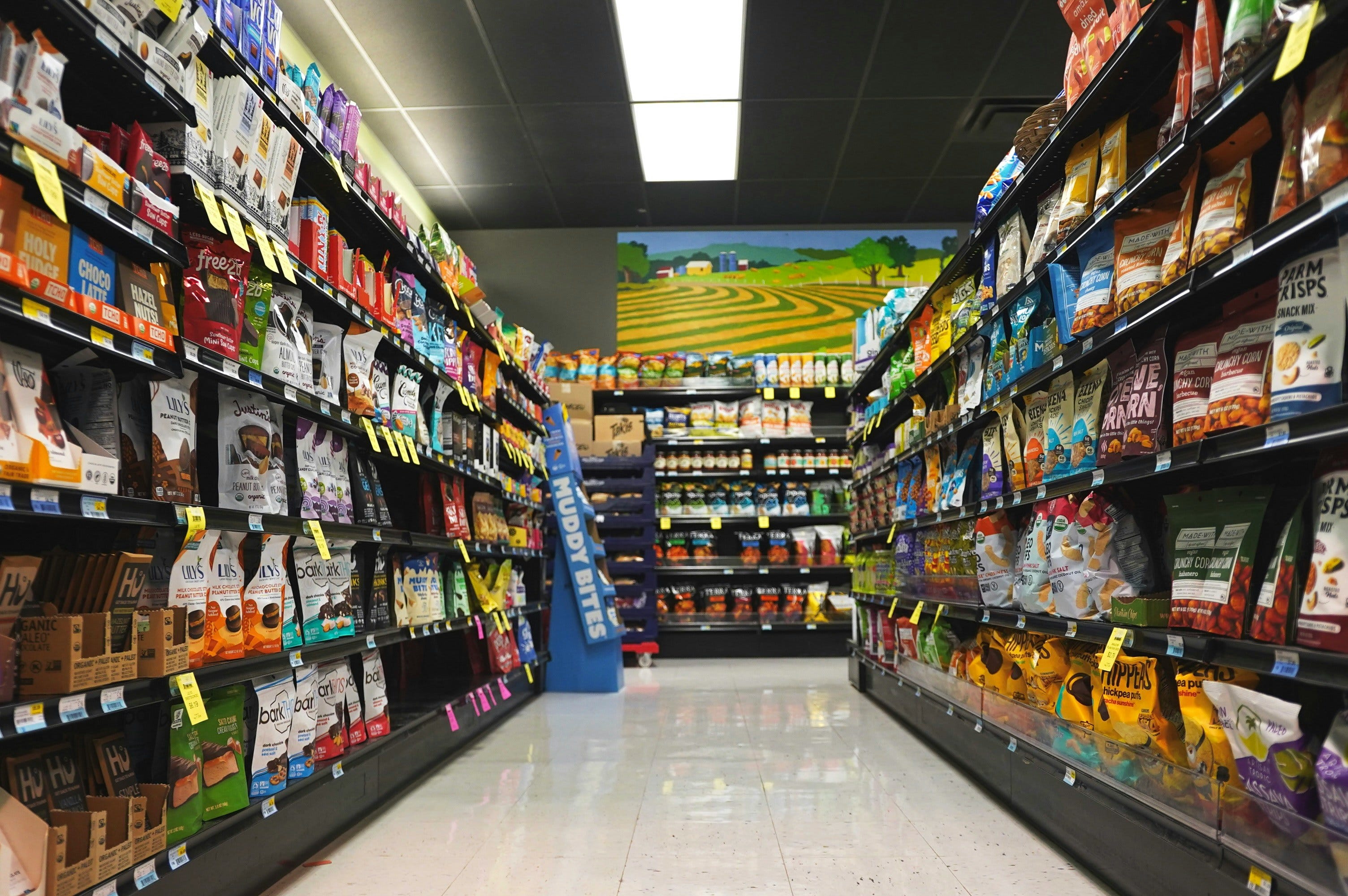
You’re standing in the cereal aisle, and you’re doing math you don’t remember doing on previous shopping trips. The name-brand box of your favorite cereal is $4.29. The store brand is shelved right beside it and only costs $2.29. You wouldn’t have thought twice about grabbing your favorite box last year, but today is different. You put the store brand version in your cart and head to the back of the store to pick up your milk. You’re buying the same amount as last time, even though it’s up 6.6% since this time last year.
You may not realize it in the moment because you’re worried about your final total at checkout. Still, you just performed two completely different economic behaviors in the span of a few minutes. Recent headlines have found that grocery unit sales around the nation dropped 1.8% last month compared to a year ago, all while grocery prices have climbed 2-3%. On the whole, that shouldn’t be too surprising since we know demand curves slope downward.
People are spending more and getting less, but the story is more nuanced. If we look closer at the data, the cuts aren’t landing evenly. Grocery spending overall is bending, but it hasn’t broken. Here’s what the latest data reveals, one aisle at a time.
What the Data Actually Shows
You’re not the only one doing this math in the grocery aisle. Bain & Company’s U.S. Consumer Pulse Wave survey found that 80% of Americans are still trying to spend less overall, and 28% say they’re actively cutting back specifically on groceries. What matters for our story today is how those particular shoppers are cutting back. Among that group, 56% are trading down to cheaper brands, 49% are just buying fewer items, and 44% are leaning harder on coupons and promotions.
If we go back to 2019, a grocery trip that used to ring up around $300 now runs closer to $400. Grocery prices roughly 33% higher than they were in 2019. But not every price hike gets treated the same by shoppers. Some get shrugged off, some trigger a full brand switch, and some just mean an item quietly disappears from the cart altogether. Here’s why.
Why Some Prices Sting More Than Others
Economists have a word for these reactions: elasticity. At its core, it’s just a measure of a consumer’s sensitivity to a price change. When demand is elastic, a price increase sends shoppers running for alternatives. When it’s inelastic, people pay up and barely change their behavior at all.
Let me add a technical caveat real quick. Economists usually talk about elasticity whenever the price of one item or group of items moves, and everything else in a shopper’s life stays exactly the same. That’s not really what’s been happening the past few years, since prices are increasing across the board. If you haven’t gotten a raise in the past year, that distinction probably feels pretty academic. A price increase is a price increase, regardless of whether it’s actually an example of how an economist would measure a “pure” elasticity scenario. It’s worth noting that CEOs and business leaders have been talking about consumers’ reaction to inflation in exactly these terms anyway.
So we’re going to use the term the way it actually shows up in a shopper’s life to answer our simple question. When the price goes up, do you keep buying it anyway, or do you change what’s in your cart? It turns out the answer depends on a handful of factors that quietly decide how elastic any given purchase turns out to be.
How Narrow You Draw the Line
The first factor is how you define what you’re even measuring. Broad categories like “groceries” as a whole are pretty inelastic. Everyone has to eat, so when prices go up, there isn’t much we can do about the total amount of food we buy. Our grocery budgets just absorb the hit instead.
But narrow the frame to “cookies,” and people suddenly have more room to make changes. Cookies aren’t a necessity, so a category-wide price increase means some shoppers just buy fewer of them and others grab a bag of chips instead. If we narrow the framing all the way down to a single product, the reaction gets stronger. Raise the price of Oreos, and shoppers can still switch to chips, but they can also switch to any other brand on that aisle.
This factor is likely what’s driving the shoppers who are trading down to cheaper brands. They aren’t making wholesale changes in their weekly diet, but they are making one swap at a time. The narrower the category, the easier it is to find something else to purchase.
Necessities vs. Everything Else
The second factor is what type of item you’re actually looking at. Some parts of the cart look completely untouched from last year: milk, eggs, bread, butter. Other aisles are getting cut left and right: name-brand cereal, premium frozen meals, specialty drinks, the good cookies. This is the difference between necessities and luxuries.
Few people negotiate with milk and eggs, but a lot more people negotiate with cereal and cookies. Remember when egg prices spiked a few years back? People kept buying them anyway, because breakfast doesn’t really have a substitute for eggs for a lot of families. That’s an inelastic demand. The more elastic response happens with luxury items, which explains why people are skipping the “splurge” items to save money for their necessities.
Why It Took This Long
The third factor is time. In the short run, demand for food is almost perfectly inelastic. You need groceries to make tonight’s dinner regardless of what things cost at checkout. There’s no backup plan for the first time you feel a price spike. You just shake your head in the parking lot, staring at the receipt, wondering what happened.
But give people some time, and they start to adapt. They set up a budget, buy in bulk, or give the store-brand pasta sauce a try and discover it’s actually fine. It’s a slow build, and it’s probably why one of the more striking parts of Bain’s data is showing up only now: after two or three years of elevated grocery prices, unit sales are just starting to decline. The long-run response is finally catching up to years of steady price increases.
The Same Price Tag, Two Different Budgets
The last factor addresses how much room a price increase has to work with in your budget. For a household where groceries eat up 6-8% of the monthly budget, a price increase may not change any decisions. But for a household where groceries make up 30-35% of the budget, that same increase is a much bigger issue. The larger the share of a budget something takes up, the more sensitive people become to its price.
Take meat, for example, which makes up 22-26% of a typical grocery budget. Any price changes in that category have a much larger impact, which explains why rising beef prices have stung so much lately. This factor also helps explain the rise in coupon-clipping and brand-switching more broadly. As price increases work their way up the income ladder, more households start feeling the squeeze, and more households start adopting the same cutting-back habits.
Final Thoughts
Most people affected by food prices have realized that relief probably isn’t coming soon, so they’ve started finding even more ways to cut back. Even the people who look like they have it all together are running some version of the same calculations you are. That’s likely what’s behind the rise of social media cooks showing you how to feed a family for $5 or $10 using dollar-store ingredients.
Of course, we never really touched on the policy side of this story, but it’s worth knowing it exists. Over the past few years, some politicians have pushed for price caps on groceries, while others have floated the idea of city-owned grocery stores to compete on price directly. Whether either approach would actually work (and whether it’s the government’s role to try) is a genuinely contested question. Unsurprisingly, people’s views on it tend to split predictably along party lines. Alas, that’s a conversation for another day.
I can’t help you find a better deal on your favorite cereal or tell you how to stretch this week’s budget. But I can let you know you’re not alone. The math you’re doing in that aisle is the same math showing up in survey after survey, cart after cart, all over the country right now. The next time you’re in the checkout line, you’ll at least know why the box in your cart isn’t the one you would have grabbed a year ago. It’s elasticity, working in real time, and you’re not doing this math by yourself.
If this made you feel a little less alone in the checkout line, pass it along to someone who might feel the same.
Household spending on food at home averaged $6,224 in 2024, compared with $3,945 spent on food away from home (restaurant meals, delivery, and takeout combined) [Bureau of Labor Statistics]
About 66% of Americans now describe grocery costs as unaffordable, up sharply from 45% in February [The Washington Post]
About 34% of high-income households say they shop several times a week, compared with 25% of middle- and lower-income households [YouGov]
19% of Gen Zers, 18% of millennials, 17% of parents of young kids, and 22% of low-income households (under $30,000) say affording food has become very difficult, compared with just 5% of baby boomers [Lending Tree]
This is fantastic classroom material. Just the sort of example that works great for small group discussions.
When prices go up i work to grow my income.