


Every now and then, I get on a kick of cleaning out my pantry. Once it starts to feel cluttered, I get the urge to start tossing things. Goodbye, unopened pack of cookies. So long, half-eaten bag of chips in a flavor I didn’t love. Oh, hello, four bottles of wine that have been sitting on the top shelf for several years. I didn’t realize I had started collecting wines.
If you’re anything like me, you have a similar story. Maybe not the chips, but the bottles collecting dust on the top shelf. Americans just aren’t drinking like they used to, and wine is no exception.
That shift has sent shockwaves across California. From Napa and Sonoma down through the Central Valley, growers crushed fewer grapes last year than in any year since 1999. Roughly half of this year’s harvest went in without a buyer. It turns out growers have started doing some cleaning out of their own.
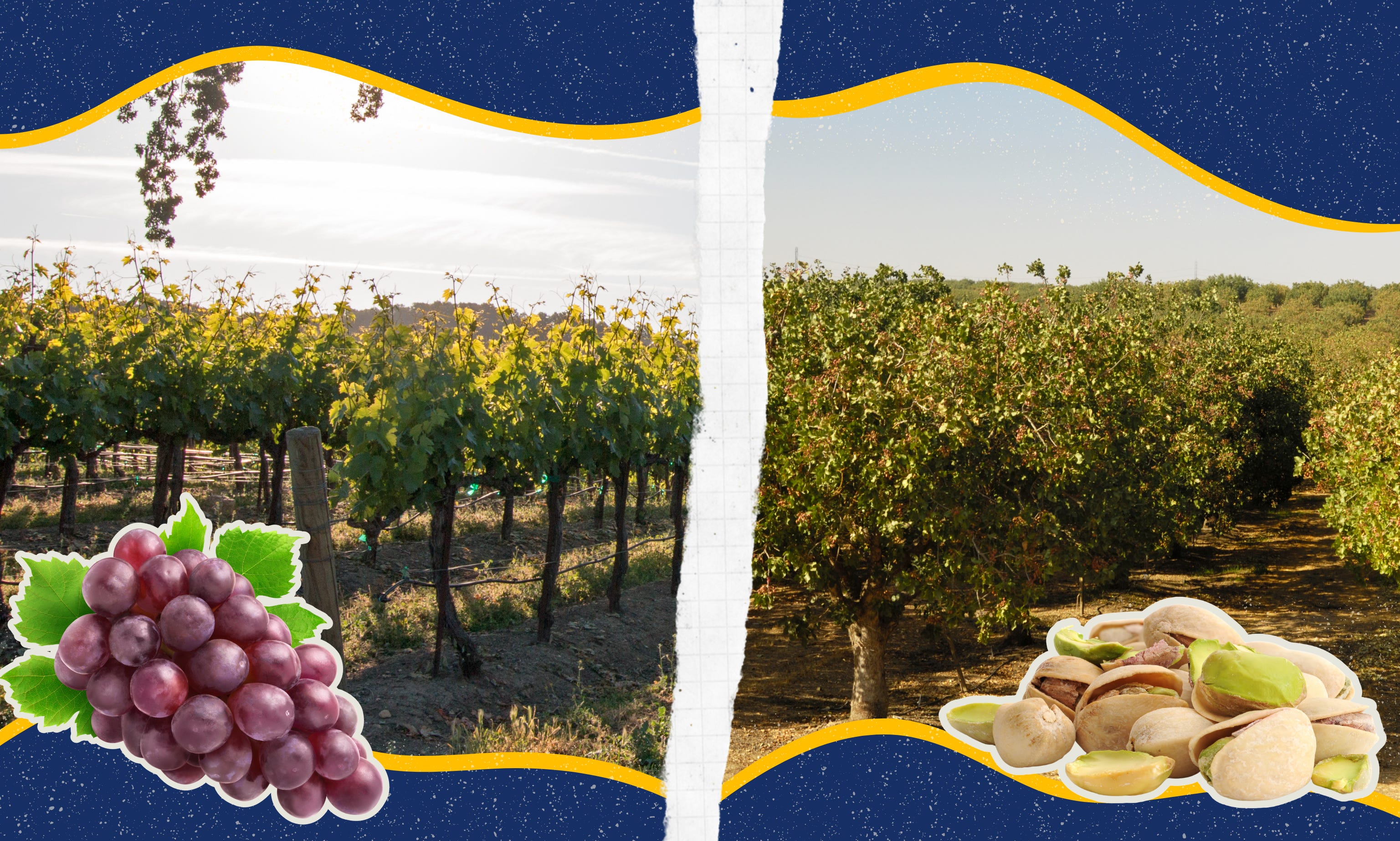
Farmers have been pulling up endposts, lining up excavators, and ripping out vineyards that previously produced for decades. Over just the past year alone, California has removed almost 10% of its vineyards. In their place, farmers are planting almond orchards, pistachio groves, and olive trees.
Let’s give this story a few minutes to breathe before we start looking at the economics and look at why Americans stopped pouring a second glass.
The Demand for Wine Keeps Falling
For the sake of transparency, those bottles in my pantry were gifts. I’ve never been much of a wine drinker, and I can’t remember a time when I bought a bottle myself. I’ll have a glass if I’m at dinner with friends splitting a bottle, but I’m not ordering one on my own. It turns out my habits don’t look all that different from everyone a lot of other Americans.
There’s been a slow and steady move toward drinking less and reaching for non-alcoholic options instead. That shift isn’t just coming from aging Millennials like me. Gen Z drinks noticeably less than older generations did at the same age, but that’s not a phase they’ll likely grow out of. GLP-1 drugs like Ozempic and Wegovy are also getting some of the blame, but these collectively point in the same direction: Americans want less wine.
That ripples all the way back to the vineyard, since people aren’t exactly buying wine grapes to snack on. Economists call this derived demand, since the demand for wine grapes comes almost entirely from the demand for wine. As bottles pile up, wineries and retailers have had to cut prices to move what’s on the shelves. Some well-known wineries are even selling their surplus to retailers like Costco to sell under a private label rather than let it sit unsold.
And that squeeze has made its way down to the grape growers as well. Red wine grapes that sold for $1,822 a ton back in 2020 fetched about $1,281 in 2025. That’s a drop of about 30%! People aren’t just shifting from Cabernets and Merlots to Chardonnays, either. White wine grapes have slipped too, though not as much, from about $797 a ton to $707.
As growers see those prices fall, it shouldn’t come as much of a surprise that they’ve reduced the quantity of grapes they’re supplying to the market. That’s the law of supply at work. Fewer grapes means less wine, and U.S. wine production has fallen more than 27% since 2020.
But most farmers aren’t going to let their land sit idle. If they aren’t growing grapes, what are they growing instead?
The Other Kind of Substitute
The short answer is nuts. Not the “this market is nuts” kind. I mean actual tree nuts, like pistachios, almonds, and walnuts. To understand why, we need to think about how sellers handle substitutes.
Substitutes are a lot easier to picture from the buyer’s side. We see them sitting next to each other on store shelves every time we go shopping. And when a streaming subscription gets more expensive, we start eyeing the other services. For consumers, people tend to buy more of a product when its substitute gets pricier.
Sellers care about substitutes too, just in a different way. Farmers can often use the same land, labor, and equipment to grow something else. When the price of one crop falls relative to another, they shift those resources toward the one that pays better. It’s the mirror image of what buyers do. Buyers move away from the expensive product toward the cheaper one, while sellers move away from the cheaper product toward the one that pays more.
This story has been playing out in California for the past several years. Much of the Central Valley land that grew Cabernet grapes can also grow pistachios, since both crops like hot, dry summers and cool winters. Switching isn’t costless, because the vines have to come out and new trees have to go in. But farmers have been doing it anyway, and they’ll keep doing it as long as the new crops look more profitable.
And boy, do they look profitable. California farmers have expanded their pistachio acreage roughly sixfold over the past two decades, from about 100,000 acres to more than 600,000. The crop brings in an estimated $2.5 billion a year!
More and more growers are looking at neighbors who swapped their vines for orchards and considering the same. The catch is that a pistachio tree doesn’t pay off right away, and every other grower is seeing the same signal.
The Cobweb Problem
Put all these trends together, and you get a much more complete picture of how markets work. Nobody in Sacramento told farmers to swap Cabernet for pistachios. Prices nudged them to do it on their own, which is what economists call spontaneous order. A grower doesn’t need to understand why someone in Chicago skipped wine at dinner. They just need to read the prices.
But in farming, you can’t respond to a price signal right away. Pistachio trees take several years to reach full yield, so a grower who rips out their vines today won’t see a real harvest until the early 2030s. They have to make decisions based on today’s prices, even though they’ll be selling at 2032 prices. Nobody knows what those will be.
That lag is the heart of one of the oldest ideas in agricultural economics: the cobweb model. It gets its name from the spiral it traces on a supply-and-demand diagram.
When a crop’s price is high, lots of farmers decide to plant more of it at the same time. They all see the same high price and hear cash registers ringing in their ears. Years later, all of that extra harvest arrives at once. To get buyers to take the whole bounty, prices fall until it all sells.
Now farmers are looking at a much lower price, and have to respond again. Some plant a little less, while others switch part of their acreage to a different crop. A few years later, the harvest comes in smaller than buyers want, and prices climb back up. Those higher prices lead to more planting, which leads to another glut, which pushes prices back down. Depending on how strongly farmers and buyers react, those swings can shrink over time or keep going for years.
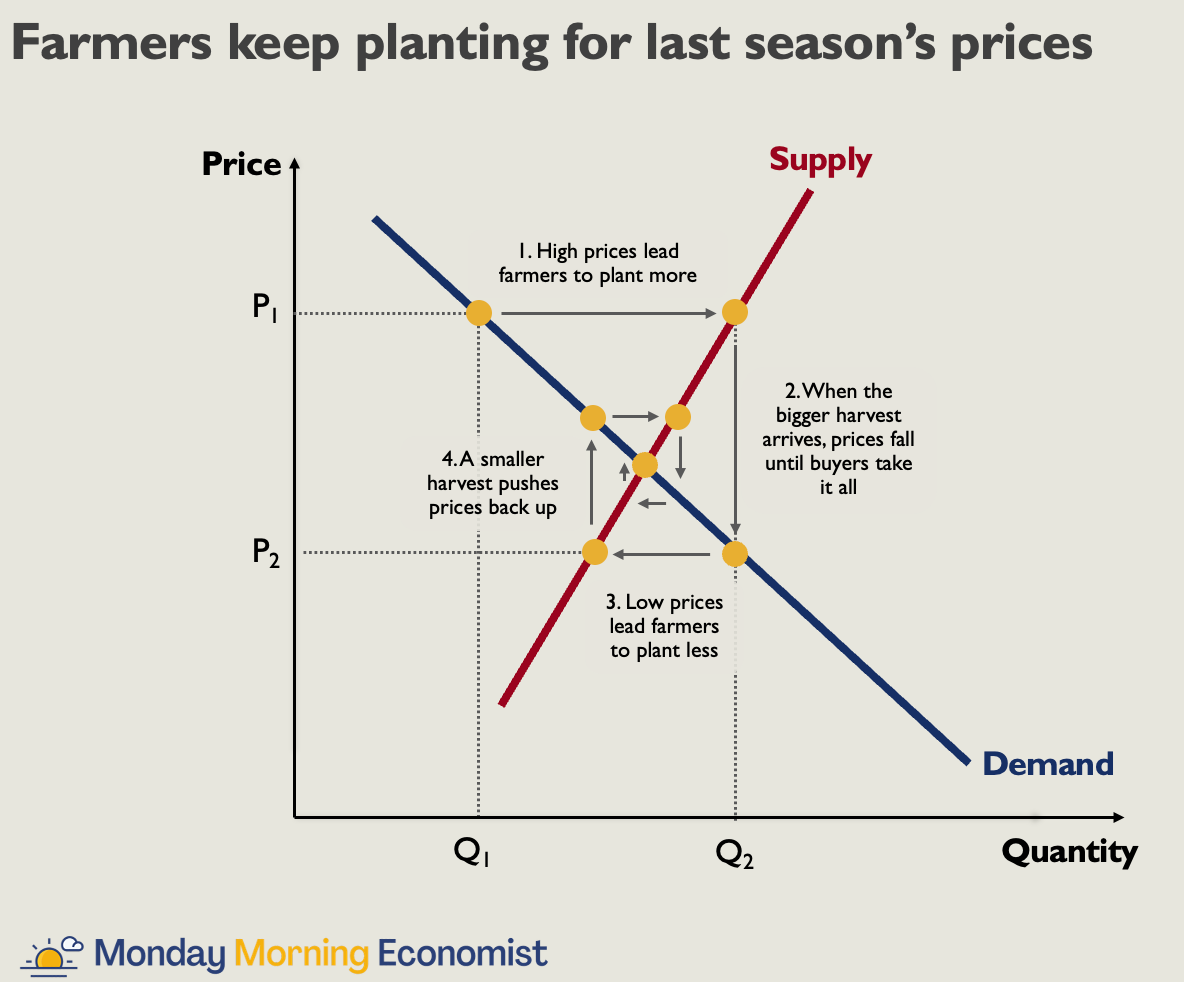
Almond farmers have been living in this web of prices and quantities for the past decade. New almond plantings peaked at nearly 136,000 acres in 2016 as high prices lured growers to convert their farmland. By 2024, new plantings had fallen by more than 90% after the 2016 wave started producing and dragged prices down.
Pistachios may soon be headed into the same spiral. Plantings were strong through 2022 but fell off sharply as growers grew wary of a looming wave. Even so, about 124,000 acres of young pistachio trees will start producing over the next three to five years.
A slowdown in planting doesn’t mean acreage is shrinking. Rather, it means it’s growing more slowly. Add tens of thousands of acres of freshly cleared vineyard to that picture, and growers answering today’s pistachio signal may end up harvesting into tomorrow’s pistachio slump. That’s exactly what the cobweb model predicts.
Final Thoughts
There are a lot more layers to this story than this article can hold. For starters, some growers are probably falling for the sunk cost fallacy. Their family’s identity is tied up in vines that took decades to mature, and it’s hard to walk away from something you’ve invested that much in. That’s not how economists say you should make decisions, but behavioral economics would tell you it isn’t surprising either.
Then there’s water. Tree nuts generally need more water than wine grapes, and it’s not clear California can support a big expansion of orchards. The state’s Sustainable Groundwater Management Act is already reshaping which crops can profitably grow in which basins.
There’s also a trade war story hiding in here, too. Almonds, walnuts, and pistachios depend heavily on export markets, and they’ve become regular targets for retaliatory tariffs from countries hit by higher U.S. import tariffs. Most tree nuts are sold abroad, and American buyers aren’t likely to pick up the slack if exports dry up.
I’m not ready to spend the next few weeks writing about tree nuts, so I’ll leave those stories as homework for you. Feel free to submit your answers in the comments. In the meantime, it’s time to restock my pantry with some new snacks. I hear pistachios are really popular. If the cobweb model is right, I should be able to get them cheap by 2031.
If this one paired well with your Monday morning, pass it along. Share it with a friend who is excited about stocking their wine cellars with soon-to-be cheaper vintages.

Just 54% of U.S. adults say they drink alcohol, the lowest share since Gallup started asking in 1939 [Gallup]
California produces more than 80% of U.S. wine, thanks to its Mediterranean climate and geography [Associated Press]
California grows about 99% of U.S. pistachios and more than 60% of the world’s supply [Fortune]
California’s pistachio bearing acreage has grown nearly fivefold over the past two decades, passing walnuts in 2021 to become the state’s second-largest tree nut crop [US Department of Agriculture]
Pistachio trees are “alternate bearing,” meaning a heavy crop one year is often followed by a light one the next [Rahmani Group]
I'm more of a wine drinker - great article! Question...if wine supply has outpaced demand in the past few years, why does it "feel" like the average bottle of "inexpensive, not not crappy" bottle of wine is up about 20% over the past few years?