


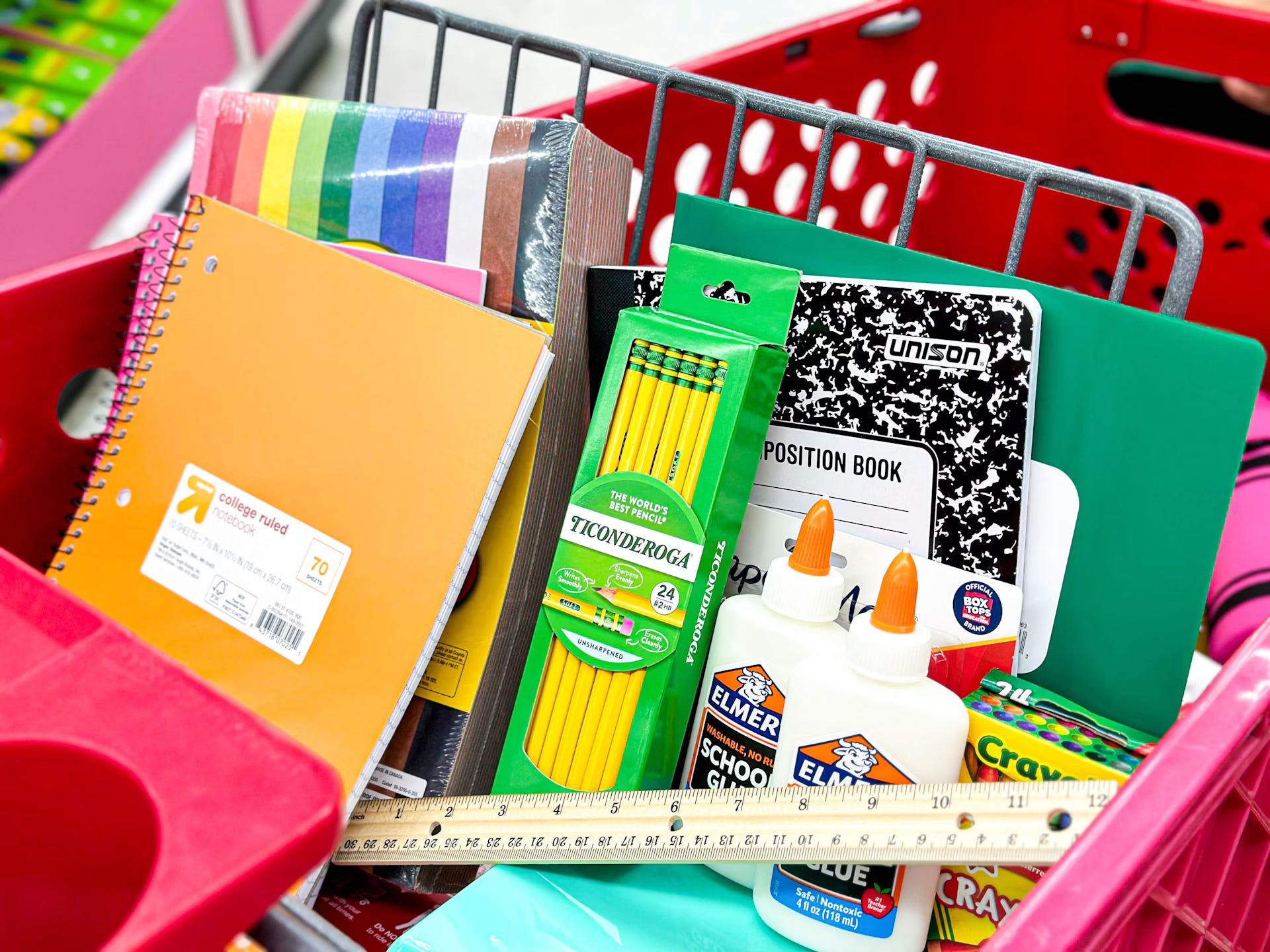
You’ve been dreading it all summer. Your cart is stuffed with notecards, three-ring binders, a backpack, and a new pair of sneakers. It’s a basket in the most literal sense, but it also turns out to be an economic one. As the summer slips away, you’ve found yourself staring down the cashier as the total keeps climbing. You can’t help but wonder: was it all this expensive last year, too?
Spoiler: it was not.
Prices for a typical back-to-school basket have climbed a lot faster than prices for pretty much everything over the past year, and we have two different sources to back that up. Government price data and independent retail tracking measure things in completely different ways, but they’ve landed on the same answer.
Even though your back-to-school basket will likely end up more expensive this year, it doesn’t mean every single item will cost you more. Before we get into specifics, take a guess: of everything in a typical back-to-school basket, which one do you think has increased in price the most over the past year?
The Itemized Receipt
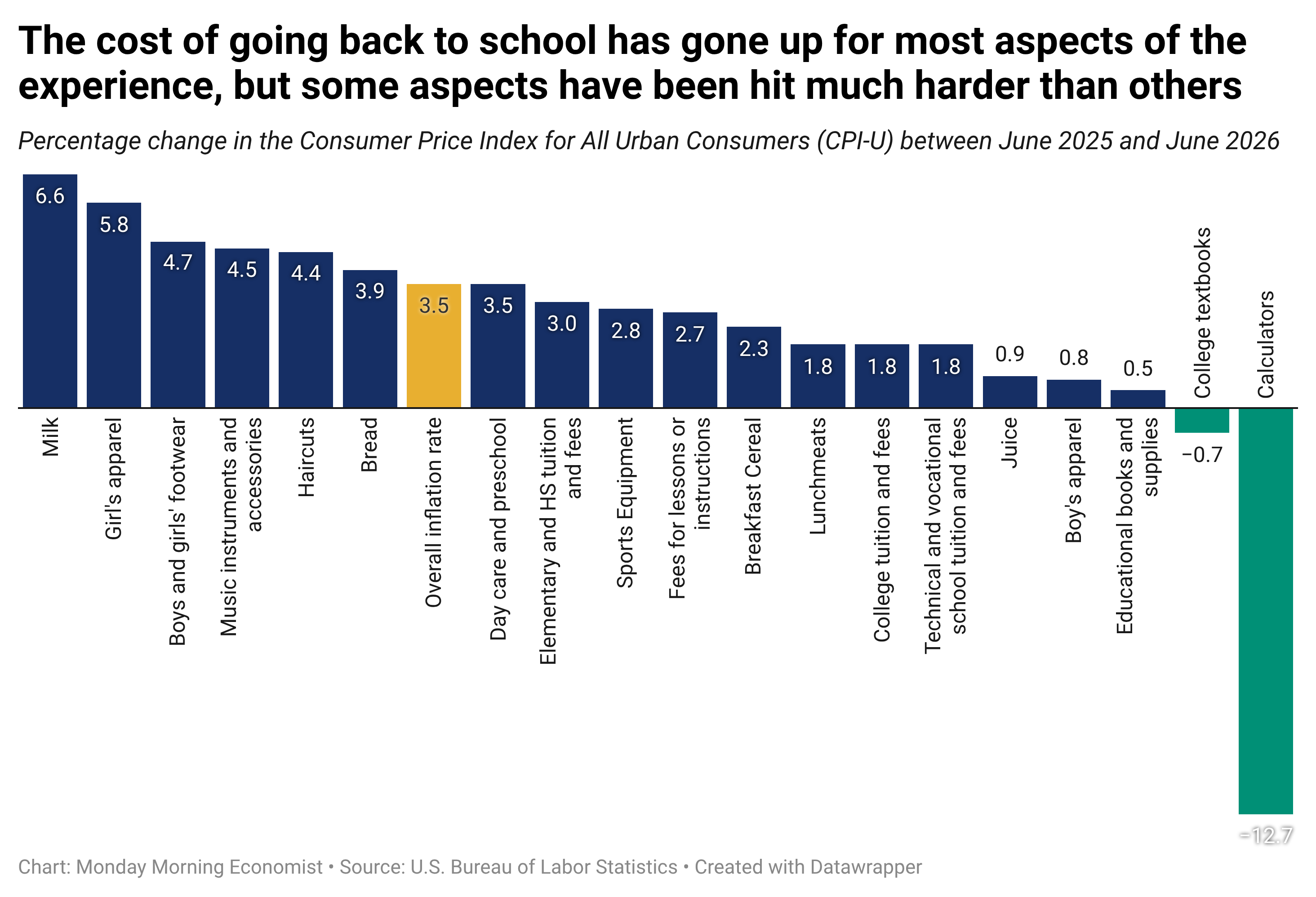
The overall inflation rate in the United States is currently running around 3.5%. That number is built from a much larger basket that covers everything from energy to shelter to medical care. It’s meant to represent what the average American household buys every month. Your back-to-school basket is very different than the average. It’s small, seasonal, and heavily influenced by what grade your kid is going into. Swap the government’s basket for yours, and many of its items are running hotter than 3.5% over the past year.
Let’s start with one of the biggest purchases before the start of each new school year: clothes and shoes. Once you see the data, it’s no surprise that the majority of shoppers say they’re specifically worried about clothing and footwear costs this year. Footwear for both girls and boys is up 4.7% since last year, while girls’ apparel is up 5.8%. But boys’ apparel? It’s only up 0.8%. It’s the same back-to-school season, but parents are facing sharply different increases depending on which department they’re standing in.
The BLS also tracks tuition and childcare, which can be an even larger expense for some families this time of year. Prices have increased across the board, but not quite as quickly as the overall inflation rate. Day care and preschool are up 3.5%, while elementary and high school tuition and fees are up 3%. If your kids have already graduated high school, technical and vocational school tuition is up 1.8%, and college tuition and fees are up 1.8% as well.
Those are broad categories based on official government data, but even those categories are themselves baskets that average together everything inside them. Zoom into individual groups, and the picture gets a lot more interesting.
Let’s start in the morning as you pack a sandwich for your kid’s lunch. Bread is a notch above the headline inflation rate, but that represents a mini-basket of several types of loaves sold around the country. Using retail transaction data, The Century Foundation found that a single loaf of sandwich bread is up 21.8% over the past year! That’s nearly six times the CPI’s broader bread category.
The rest of the lunch box tells a similar story. Overall grocery inflation isn’t running especially high this year, but you wouldn’t know it from the individual items filling a kid’s lunchbox: animal crackers are up 15.7%, sliced ham and turkey are each up at least 12%, and applesauce packets are up 6.9%.
A similar pattern holds for many of the items on your child’s school supply list. A tally of the 21 most common school supply items found prices up 7.7% on average over the past year. That’s several percentage points more than the overall inflation rate. Some items are up a whole lot more: lunch boxes are up 27%, notebooks and notebook paper up around 20%, scissors up 14%, crayons and colored pencils up 5 to 7%.
Some Things Didn’t Move, and Others Went Down
To be fair, not everything in the basket got more expensive. The BLS reports calculators are down 12.7% and college textbooks are down a slim 0.7%. Retail tracking data found pocket folders and sticky notes ringing up for the same price as last year, and a pound of grapes is almost the same price as last year.
I don’t have any good explanation for why pocket folders, sticky notes, and grapes are essentially unchanged from a year ago. It’s a useful reminder that “everything is getting more expensive” isn’t a law of nature. Basket averages hide flat prices right alongside rising ones, but there’s no reason to be surprised when some prices don’t budge from one year to the next.
The deflation in calculators and college textbooks has a potentially interesting story. Open educational resources like Desmos and OpenStax have continued to work their way into classrooms, reducing demand for the expensive alternatives. This isn’t much help if you bought a calculator last year. If you are in the market for one, it helps that the used market is strong, too. A lot of us still have our old TI-84 in a junk drawer somewhere, even though we graduated several years (decades?) ago.
Two Forces, Same Direction
We’ve looked at what got more expensive and by how much, but it’s worth also considering the why. There isn’t a single narrative to explain it all, but economists generally look at two broad factors to explain rising prices.
The first is cost-push inflation: prices increase because it costs more to make the thing in the first place. Manufacturing costs for key back-to-school items have increased by an average of 24% over the past five years. This past year has also been especially tough as tariffs and rising oil prices have driven their own cost increase. That material, labor, and shipping all feed into a higher price before a backpack or a box of crayons ever reaches a shelf.
The second is demand-pull inflation: prices rise because a lot of people want to buy the same thing at the same time. Back-to-school shopping is about as concentrated as demand gets. There’s a lot of buying happening in a fairly short window, every summer. A lot of families start shopping early, but at a certain point it’s hard to wait much longer for price drops. That doesn’t mean people aren’t trying, though. Nearly half of shoppers say they plan to only buy the essentials for the start of the school year and replenish supplies as needed.
Final Thoughts
Back-to-school shopping is a relatively small slice of what any household spends in a given year. Groceries, rent, and healthcare all dwarf it. But small doesn’t mean insignificant. It’s the second-largest shopping event for most people, behind only the winter holidays. It’s Christmas in July, just with green notebooks instead of red bows.
But like any major shopping season, the bill doesn’t stop at the register. School districts across states including Arizona, Ohio, Florida, and New Jersey are cutting bus routes and rethinking transportation altogether as fuel, maintenance, and driver costs climb. For some families, the back-to-school basket now includes figuring out how their kids actually get to school in the first place.
It’s tempting to look at your back-to-school basket running this far above headline inflation and conclude the math is broken somewhere. It isn’t. Your personal inflation rate always depends on what you’re actually buying, and this month, you’ve been buying a very specific, very back-to-school-shaped basket.
That mismatch creates a real, practical problem for anyone still holding out for lower prices. When most of the items in your cart are jumping up all at once, it’s hard to tell whether any single price jump reflects genuine scarcity or just the broader drift of inflation carrying every item upward together. That distinction matters a lot for all the shoppers deliberately holding out for a better deal. Waiting is a reasonable bet when prices are stable, but it’s a riskier one when they’re still climbing. The wait itself may end up costing more than it would have saved.
There’s one other thing that hasn’t increased in price over the past year: subscribing to this newsletter. If someone in your life is taking an economics course this fall, or if your friends are trying to make sense of their back-to-school receipts, forward this to them and encourage them to sign up. There’s been no inflation on the subscription price for this one.
Families are spending an average of $863 per K-12 student and $1,437 per college student on back-to-school shopping this year [National Retail Federation]
54% of shoppers say they’re concerned about affording everything they need this season [Yahoo! Shopping]
The second week of September is the most common week for school picture day nationally [Lifetouch]
Nearly half of Crayola’s annual sales happen between July 4th and Labor Day, when its flagship factory produces 13 million crayons a day [Bloomberg]
Newell Brands, the maker of Sharpie, Paper Mate, Expo, and Elmer’s, paid $174 million in tariff costs last year and expects $130 million more in 2026 [Atlanta Business Chronicle]
If you told me my textbooks and calculators were cheaper i wouldn't believe you.
Please explain why the CPI chart shows college textbooks, plain as day, going up by 10.2%, whereas the text in the section "Some Things Didn't Move..." states: "college textbooks are down a slim 0.7%." Inquiring minds want to know...