


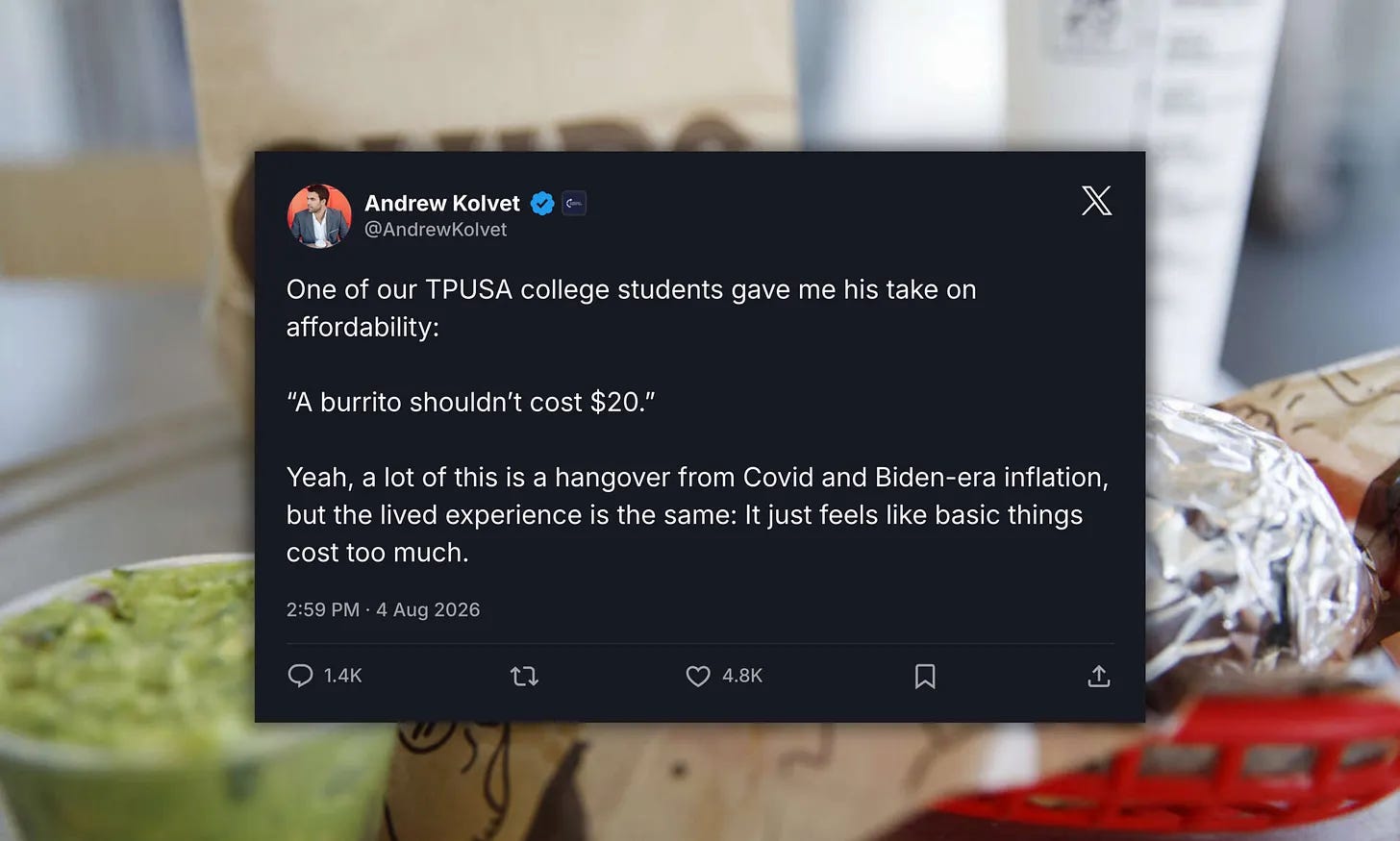
What started as a common gripe about the cost of eating out for lunch turned part of the internet upside down. A spokesperson for Turning Point USA shared the complaint on his social media account, igniting an online debate about affordability. The original post has already been viewed more than 3 million times over the past two weeks.
Could this be Gen Z’s version of the millennial avocado toast debate? One political commentator told the unnamed student to eat at the dining hall with the meal plan he’d presumably already paid for. Another argued it’s just a sign of a generation that doesn’t know how to cook. A third chimed in with imperative advice to get a job and eat ramen instead.
Of course, none of them took the time to see if prices have really changed by that much or why the student may be seeing such a high price. All of them sidestepped the underlying point about affordability, which has been a persistent concern for Americans for several years now.
Let’s skip the fighting and look at the data together. Yes, burrito prices are up. But are they really that much more expensive than they were a few years ago? It turns out the answer depends entirely on how you measure “more expensive.”
How Do We Get to a $20 Burrito, Anyway?
Before we figure out how much burrito prices have changed, it’s worth debunking the number everyone’s actually mad about. Few burritos actually cost $20 unless you’re eating at a proper sit-down restaurant, loading up on premium toppings, or having it delivered. Paying for labor-intensive services will always cost more than cooking at home.
So where does the $20 figure actually come from? A walk-in burrito doesn’t get you there, but a delivered one can get you close.
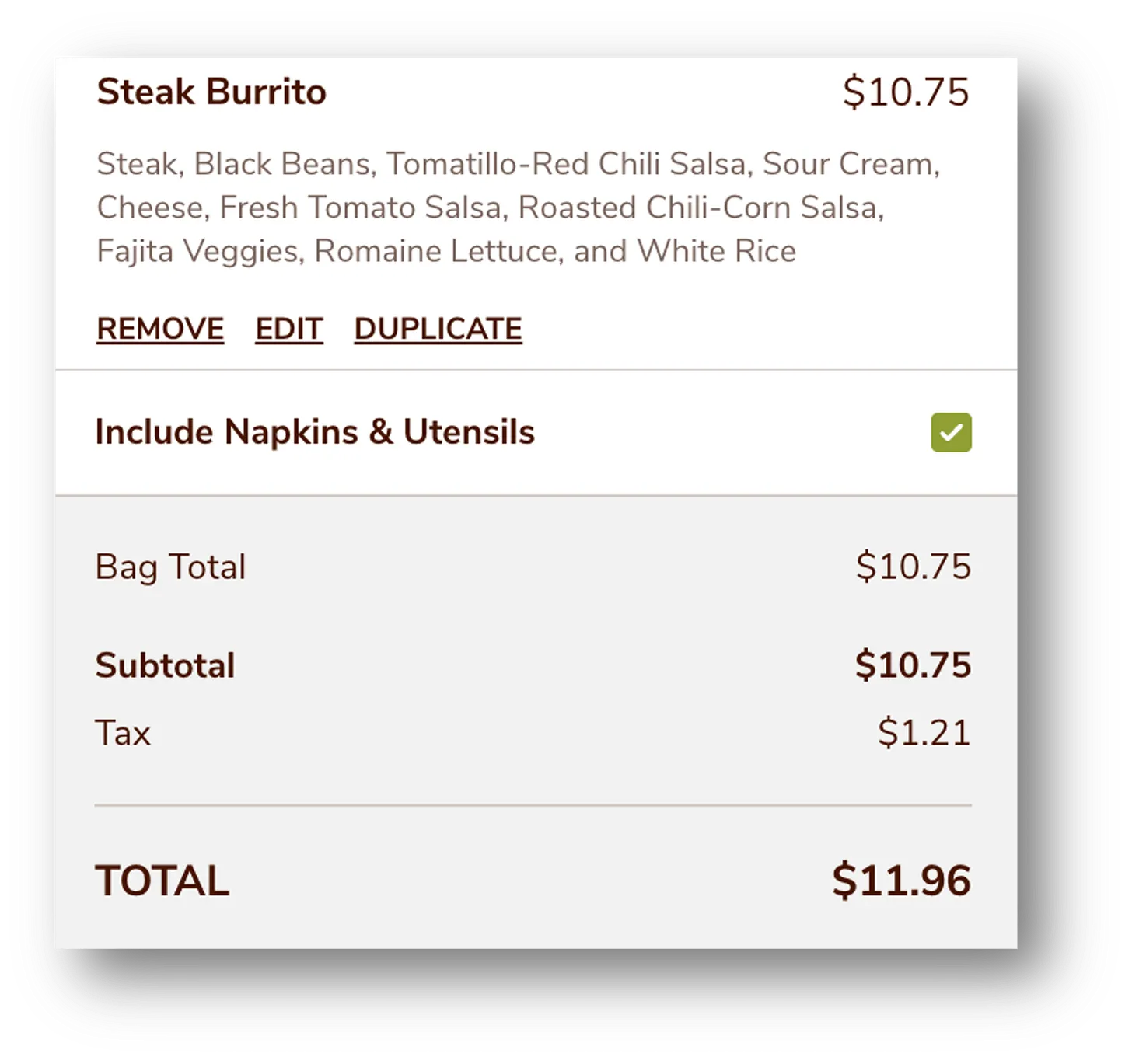
I pulled up the Chipotle app and priced out a steak burrito from my nearest location. I chose steak on purpose since it’s the most expensive protein on the menu. I legitimately wanted to see if it would cost $20, but the after-tax total came to about $12.
I’d have to drive to get that burrito, but I could also order through a delivery app, Grubhub or DoorDash. That’s not uncommon, as it turns out that nearly 2 in 5 Gen Z and Millennials order from delivery apps at least once a week. I suspected this is where the $20 burrito can be found.
So what was the damage? Both apps landed around $23 before tipping the driver. DoorDash came in slightly cheaper, but only because it was running a no-delivery-fee promotion when I was pulling data. Tack that fee back on, and the two are effectively the same. Realistically, the final totals would run a few dollars higher because I don’t want to find out what happens to my food (assuming it shows up at all) if I skip out on the tip.
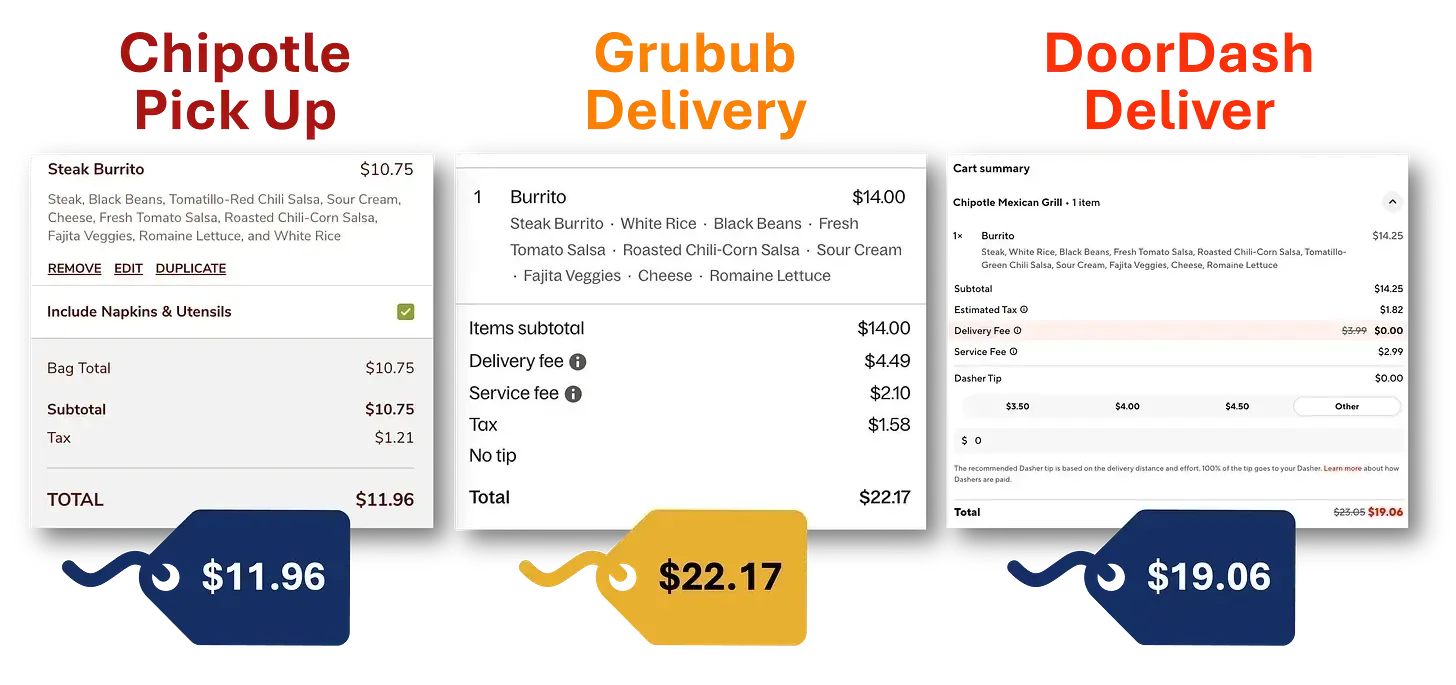
The delivery layer is how we can find our mysterious $20 burrito. For starters, restaurants raise delivery-app menu prices to offset platform commissions. You can already confirm this markup by looking at the actual item in question. Chipotle lists the steak burrito at $10.75 in-store versus $14 on the delivery apps.
And then there are the added fees. In casual conversations with my own students, most assume ordering through these apps adds only a few dollars in fees. They’re typically unaware that restaurants have already baked a markup into the delivery-menu price and then the platform tacks on two or three separate fees. It looks like our $20 burrito comes from a delivery platform charging $10 for a burrito and $10 for the privilege of not going to get it yourself.
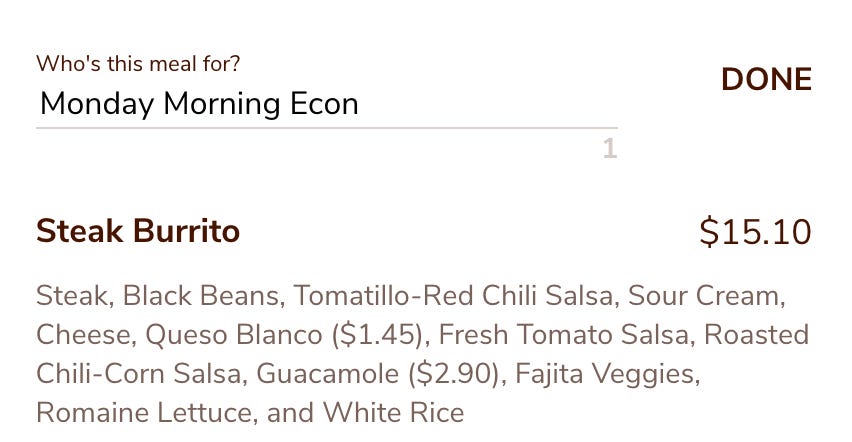
I do have one caveat before we move to actual price history. This comparison only covers the burrito itself, without premium add-ons or sides. I went back and added guac and queso, but my total only came out to $15 if I picked it up in-store. I would need to add chips and a drink to get all the way $20, but then we’re talking about a full meal and not just a burrito.
Now that we know what’s actually driving the $20 figure, let’s look at whether the base price of the burrito itself has really changed all that much.
What Actually Happened to Burrito Prices
A Chipotle burrito runs about $10 in the store today. The underlying question is how much that’s actually changed over the past few years. Thankfully, there’s no shortage of old Chipotle menu photos floating around. Since a lot of the current angst traces back to the inflation spike of the past few years, I went looking for a menu board from 2022. Back then, a chicken burrito ran about $7.35:
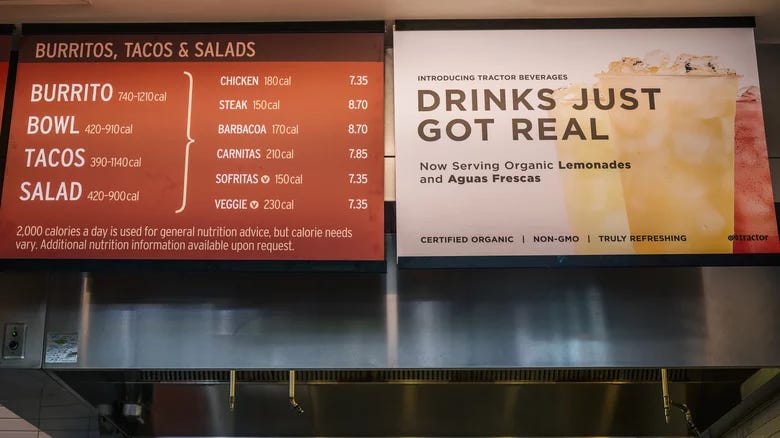
Is that increase actually meaningful, or is it just what happens to every price in an economy with any inflation at all?
Every price has two versions: the nominal price, which is just the number on the receipt, and the real price, which adjusts that number for inflation. That $7.35 chicken burrito is the nominal 2022 price. Prices have gone up since then, but nominal prices almost always go up. That’s what a growing economy with any inflation looks like.
I’ll admit that adjusting for inflation can feel like we’re dodging the issue. It can feel like we’re conceding everything got more expensive and calling it math. That’s not quite what’s happening. Inflation isn’t one price rising in isolation, but rather it’s the value of a dollar shrinking across the board. Gas, rent, movie tickets, and burritos are all moving at roughly the same time, for related reasons. Looking at inflation-adjusted values lets us ask whether burritos got more expensive faster than everything else did.
This distinction really matters because it’s the same logic behind cost-of-living raises and calls for increasing the minimum wage. As prices go up, wages are supposed to go up as well. If they don’t, real income falls even while the paycheck number gets bigger. We’ll get to wages directly in the next section, but let’s just isolate the burrito from the rest of inflation.
One economist has done exactly that, tracking down old menu prices and adjusting them into today’s dollars. Once you do, the real price of a chicken burrito (in 2026 dollars) has been remarkably stable. It’s up less than 50 cents over the past four years.

Adjusting for inflation shows the burrito hasn’t really outpaced the rest of the economy, but inflation-adjusted dollars can feel abstract. Thankfully, there’s a more intuitive way to feel the same finding.
Using Time to Measure Inflation
It can be hard to get an intuitive sense of what a “2026 dollar” actually is. Fortunately, there’s another way to look at price changes that some people find more concrete: how long does the average worker have to work to afford the thing? This is called the “time price” of a good.
A Chipotle chicken burrito ran about $6.25 back in 2010, and average hourly earnings for a private-sector, nonsupervisory worker were about $19. That works out to roughly 20 minutes of work. Today, a Chipotle burrito costs $9.92 nationally, while the average hourly wage for that same group is $32.40. That’s about 18 minutes.
Nominal prices have gone up, but our wages have gone up faster. It now takes the average worker less time to earn a burrito than it did sixteen years ago. The student was right that the number on the receipt is bigger, but the number that measures affordability hasn’t actually gotten worse for the typical worker.

Who Is the Burrito Actually Expensive For?
That 18–20 minute finding is only true for the average worker. It’s worth complicating a bit further, in the interest of transparency. You might reasonably wonder whether the number is skewed upward by high earners, and whether the median would tell a different story. Those two measures are surprisingly similar, so that adjustment wouldn’t make much of a difference.
A better complaint about the calculation probably lives on the other end of the income distribution. A college student is unlikely to be earning the average or median wage while in school. What if they’re working a minimum-wage job to pay for their meals?
The federal minimum wage has been $7.25 an hour since 2009. In 2010, a minimum-wage worker would have spent about 52 minutes earning that $6.25 burrito. The same worker earning the federal minimum wage sixteen years later needs about 81 minutes for a $9.79 burrito. That’s more than 50% more time for the same meal.
Of course, the share of workers actually earning at or below the federal minimum has fallen substantially over that period, partly because state minimum wages have climbed while the federal floor stayed frozen. Fewer people are technically affected by that $7.25 number, but the ones who are have watched their burrito get meaningfully less affordable.
So is a burrito expensive? It depends entirely on what you earn, which is often a function of where you live. For the average worker, the burrito is exactly as affordable as it was in 2010. For a minimum-wage worker, it’s meaningfully less affordable. And for either worker, getting it delivered makes the numbers worse across the board.
Final Thoughts
None of this was ever really about burritos, or really about $20. It’s the same reason grocery prices keep coming up in conversations that have nothing to do with which groceries people are putting in their cart. Food is one of the only prices people see updated in real time, every week, with their own eyes.
So let’s be clear about what the data does and doesn’t say. If people are paying $20 for a burrito, they’re probably paying for convenience. Yes, a burrito assembled at home costs a fraction of the delivered price, but the original complaint was an admission that someone felt squeezed by higher prices. Dismissing that feeling doesn’t address the root problem. People who are genuinely struggling with affordability don’t feel heard by being told to toughen up. If anything, it probably confirms their suspicion that nobody in charge is listening.
The most honest complication of all this is that if you’ve read this far and none of it matches your own experience, you might be exactly right. The “average worker” is a statistical construct, not an actual person. If your wages have outpaced inflation, you may not understand what all the fuss is about. But for every worker whose earnings have outpaced prices, there’s someone else watching prices rise faster than their paycheck. The data above describes the average, not either one of them specifically.
If you’ve made it this far, do me a favor: go price out a burrito and reply with the numbers. While you’re at it, share this with anyone you see complaining about the price of fast food. It may not change their opinions about the prices, but it will let them know they aren’t alone.

“Food away from home” has increased 24.2% since the start of 2022 [U.S. Bureau of Labor Statistics via FRED]
There are 4,064 Chipotle restaurants in the United States as of June 16, 2026 [ScrapeHero]
The median usual weekly nominal earnings for workers age 20 to 24 who are employed full time is $831 per week [U.S. Bureau of Labor Statistics]
With the passage of the Fair Labor Standards Act of 1938 (FLSA), the U.S. minimum wage was initially set at $0.25 per hour for covered workers [Department of Labor]
Five Southern states (Louisiana, Mississippi, Alabama, Tennessee, and South Carolina) have no minimum wage laws, but three states (Georgia, Oklahoma, and Wyoming) have state minimum wage rates that are lower than the federal rate [UC Davis Center for Poverty and Inequality Research]
Hey, I'm not an economist, but $20 is $20
I absolutely love the "time price" concept, and every time it comes up, I am reminded of https://humanprogress.org/light-has-burst-forth-in-astonishing-abundance-2/
Another thing I often think of in the context of affordability and living standards isn't just the devaluing of the dollar, but the often even greater effects of regulation on various industries: https://humanprogress.org/time-pricing-and-mark-perrys-chart-of-the-century/
Note that this chart only shows changes in price and ignores the change in quality. A modern TV blows the doors off of a TV from 20 years ago, and yet costs a fraction as much.
Local prices and taxes vary, though! Currently my usual order, a barbacoa burrito with guac, is $15.44 for pickup at my local Chipotle in Atlanta, GA. I know I've seen close to $20 for the same order when traveling.