


If you wanted to start brewing beer at home this weekend, nothing’s really stopping you. You could order a starter kit online and have a batch bubbling in your closet in a few days. The same goes for wine, hard cider, mead, or kombucha. The law isn’t even hazy on this one: Congress has explicitly allowed home brewing since 1978.
But what if you took that batch of beer to the garage, heated it in a small copper pot, and collected what boiled off? That’s distilling, and doing it at home is a federal crime punishable by up to five years in prison, a $10,000 fine, or both.
Home distilling has been banned at the federal level since 1868, but plenty still do it. Appalachian moonshiners like Popcorn Sutton became folk heroes because they ignored those federal rules, and Discovery’s Moonshiners has spent more than a decade turning illegal stills into reality TV. Most people who want to distill at home aren’t trying to be outlaws. They’re usually hobbyists who want to try something new.
A few of those hobbyists have challenged this federal ban, and last week the Supreme Court announced it agreed to hear their case next summer.
You may be wondering why the federal government cares so much about a copper pot in someone’s garage. It turns out that for much of American history, whiskey was how the government paid its bills.
How Do You Fund a Country?
It’s likely not a surprise that the government’s case for keeping the ban on the books is based on money. Lawyers for the Justice Department told the Court that the liquor tax is a significant revenue source that brings in billions of dollars every year for the government. That argument is nearly as old as the country itself.
Let’s go back to the year 1791. The United States was a brand-new country with a problem as old as government itself: debt. The Revolutionary War left the federal government $54 million in debt. Congress asked Alexander Hamilton, the first Secretary of the Treasury, to figure out how to pay that debt off.
There are only a few types of taxes Hamilton could choose from, and the federal government already taxed imported goods through tariffs. Pushing them higher risked choking off the trade that produced the revenue. A direct tax on land or people came with a constitutional headache since it had to be divided among the states by population.
That left an excise tax, which is a tax on the production or sale of a specific good. You pay excise taxes today whenever you fill your gas tank or buy a pack of cigarettes. Once the type of tax is selected, it’s time to figure out what to tax. He chose American-made liquor as his tax base. Lots of Americans made it and lots of Americans drank it, so even a small tax would add up.
On March 3, 1791, Congress passed an act that set a tax of between six and 18 cents per gallon on distilled spirits, depending on proof. It was the first federal tax on a product made inside the country, and many historians think Hamilton also saw it as a chance to prove the new federal government could tax its own citizens directly.
On paper, it was a modest tax. Out on the frontier, it didn’t feel modest at all.
America’s First Tax Protest
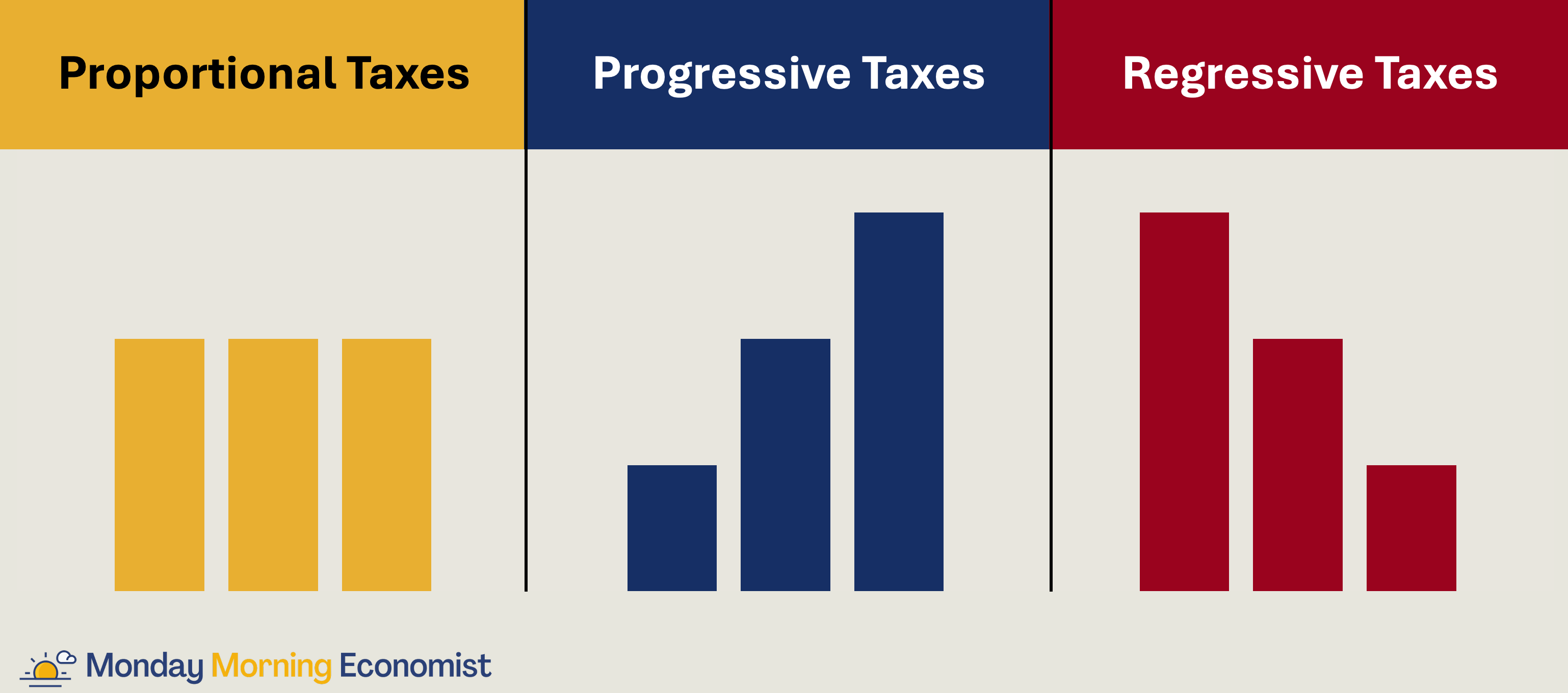
The trouble with the new tax was how the burden was spread across different taxpayers. Taxes can be sorted into three basic structures based on how they compare to a person’s income. A proportional tax takes the same share from everyone. A progressive tax takes a larger share as income rises. A regressive tax takes a larger share from people who have the least income.
Hamilton’s tax landed in that last category. Distillers could pay either a flat fee based on the size of their still or a tax on every gallon they produced. Big commercial distilleries ran their stills nearly year-round, so they were able to spread that flat fee across thousands of gallons. Their effective tax rate, what they actually paid per gallon once everything was counted, fell to as low as 6 cents per gallon. Frontier farmers fired up their small stills only when they had spare grain, so they ended up paying a higher tax of 9 cents per gallon.
Those small producers were usually the poorest, and were now expected to pay 50% more per gallon than the big, rich producers. Before the tax, western Pennsylvania farmers were turning their surplus grain into whiskey because hauling it over the mountain was expensive. Many of them were also using whiskey as a form of barter, but the federal government wanted to be paid in actual cash.
That combination was too much. Protests turned into attacks on tax collectors, and by 1794 the frontier was in open revolt. The Whiskey Rebellion ended only after George Washington sent roughly 13,000 militiamen into western Pennsylvania and rode out with them himself for the first leg.
The government had proven it could collect the tax, but they weren’t able to convince them to like it. Thomas Jefferson and his Federalists repealed the whiskey tax in 1802. It had a brief comeback to help pay for the War of 1812, but the federal government lived on tariffs for most of the next half-century.
Then came the costliest war the country had ever fought, and Congress went right back to the bottle.
Whiskey Taxes (Round #2)
The Civil War cost more than every previous American war combined, and the Union needed money fast. In 1862, Congress brought back the liquor excise at $0.20 per proof gallon. A proof gallon is a gallon of 100-proof liquor, and it’s still how spirits are taxed today.
The rate didn’t last long. By the end of the war, it was raised to $2.00 a proof gallon. That’s a tenfold increase in the tax rate! The government believed it would bring in tenfold the revenue, so long as the base stays the same.
It didn’t.
Distillers turned to tax evasion, illegally hiding what they owed. By 1868, the government was collecting tax on fewer than 7 million gallons of spirits out of an estimated 50 million consumed. The rate had gone up tenfold, but roughly 86% of the base had vanished.
The rate increase was only part of the problem. Commercial distilleries were relatively easy to tax because they had fixed buildings, known grain purchases, and output that inspectors could measure. A still in a farmhouse was largely invisible since tax collectors couldn’t easily inspect every kitchen and barn. A family making whiskey for itself left almost no paper trail. That’s a classic tax compliance problem: high tax rates create a strong incentive to hide activity, and the government has little chance of catching anyone.
In 1868, Congress attacked the problem from two directions. First, it lowered the tax to $0.50 per proof gallon. This lowered the payoff for cheating. Second, it banned distilling in homes and attached buildings entirely. Instead of trying to measure what came out of every still, the government just made the still itself illegal. That’s a lot easier to find a still than to find every jar of moonshine that comes out of it.
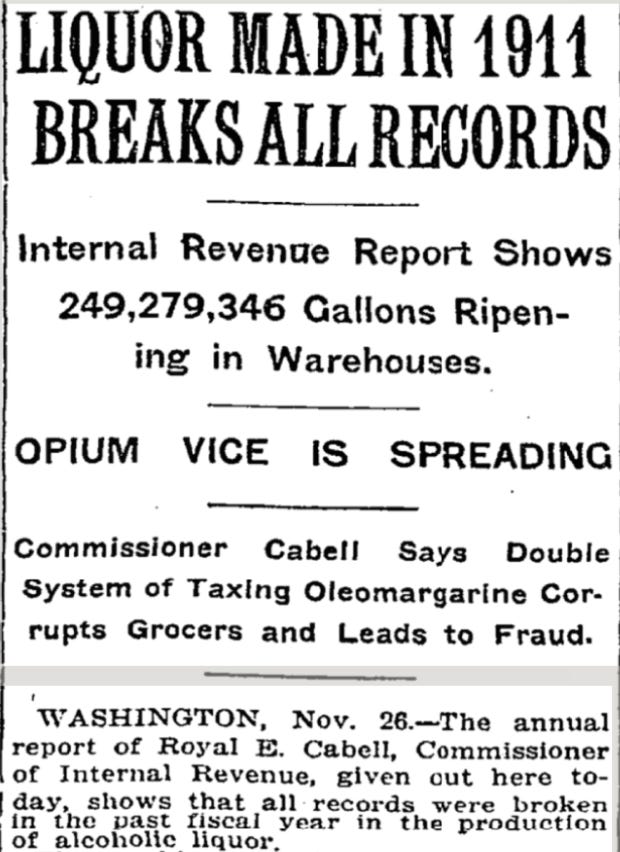
Those policies mostly worked. Moonshining was greatly reduced, but not completely eliminated. Liquor became one of the federal government’s most reliable money-makers. For the next half-century, only tariffs raised more. By 1910, alcohol accounted for 71% of all internal revenue. The federal government was, in a real sense, funded by bars and saloons.
All that started to change in 1913, when the 16th Amendment allowed a permanent income tax. It was arguably the biggest expansion of the tax base in American history, and it came with a progressive structure. By 1920, the income tax brought in about two-thirds of federal revenue. That’s roughly nine times what liquor taxes and tariffs raised together. Of course, that’s also the year Prohibition began. The timing wasn’t a coincidence. Congress could finally afford to give up the liquor tax because a much bigger base had replaced it.
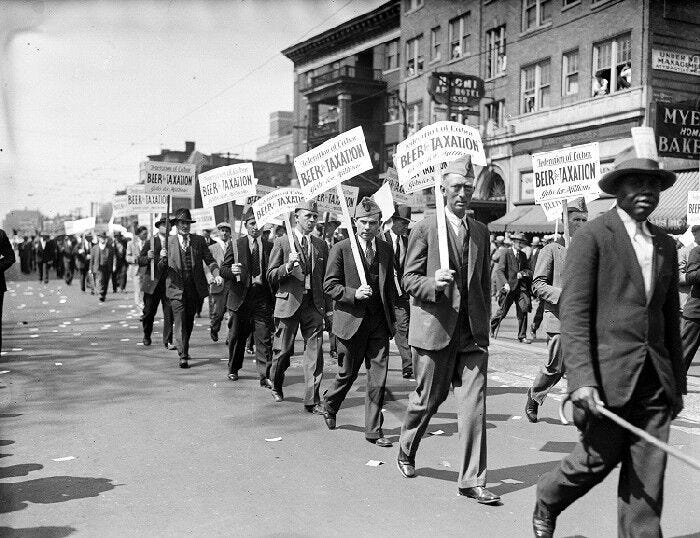
The Great Depression reversed the math. Income tax revenue fell by about 60% between 1930 and 1933. All that untaxed liquor suddenly looked like money left on the table. When Prohibition ended in 1933, liquor taxes went right back to work.
Nearly a century later, the income tax still carries the load. The whiskey tax never went away, and neither did the 1868 ban that protects it.
Final Thoughts
So why can you brew beer this weekend but not whiskey? Part of the answer goes back to Hamilton, whose original law made malt beverages exempt from the tax. Beer has been the lightly taxed drink ever since. Today the federal excise tax works out to about 58 cents a gallon for beer and roughly $1.07 to $3.40 a gallon for wine, depending on alcohol content and bubbles. Spirits are taxed at $13.50 per proof gallon, a rate that has been kept steady since January 1, 1991.
To be fair, liquor is much stronger, so comparing gallons exaggerates the gap. Per drink, a shot of 80-proof whiskey carries about 13 cents in federal tax. Compare that with about 5 cents for a can of beer and 4 cents for a glass of wine. Even on equal terms, spirits pay two and a half to three times as much. Spirits are where both the money and the history of evasion have always been concentrated. When Congress legalized home brewing in 1978, it left the 1868 distilling ban alone.
Of course, that money matters far less than it used to. In fiscal 2025, federal alcohol taxes brought in about $8 billion. Sure, that’s real money, but excise taxes as a whole make up only about 2% of federal revenue. That puts alcohol at roughly 0.2%. A century ago, liquor paid for about a third of everything the federal government collected. Today it pays for about one-fifth of one percent.
That’s the tension the Supreme Court will have to sort out. The government argues that the spirits tax still brings in billions and the home-distilling ban protects it. That’s the same logic Congress used in 1868. The challengers argue that the ban raises no revenue, since you can’t tax a drink that’s never made.
Whatever the justices decide, the economics won’t change much. As long as spirits carry the highest alcohol tax around, some people will have a reason to make their own, and the government will have a reason to worry about it. Hamilton figured that out in 1791. Congress figured it out again in 1868. The only new question is whether the Constitution allows the solution they chose.
Know someone with a homebrew kit and big ambitions? Send this their way before they upgrade to a still.

Franklin County, Virginia, became known as the moonshine capital of the world in the early 1900s when federal prosecutors alleged that a conspiracy ring had defrauded the government out of 5.5 million dollars in whisky excise taxes, equivalent to roughly 95 million dollars today [Blue Ridge Country]
When federal, state, and local taxes are counted together, more than 52% of the price of a typical bottle of spirits goes toward a tax of some kind [Distilled Spirits Council of the US]
The excise tax on a 12 oz. can of beer is approximately $0.05, or $0.30 for a six-pack of beer [US Congress]
In 2025, 88% of excise tax revenues came from highway taxes, taxes on tobacco and alcohol, aviation taxes, and the tax on corporate stock repurchases [Congressional Budget Office]
"You may be wondering why the federal government cares so much about a copper pot in someone’s garage."
Wickard v Filburn was in 1942. Anyone still wondering about absurd overreach like this after that simply hasn't been paying attention.