


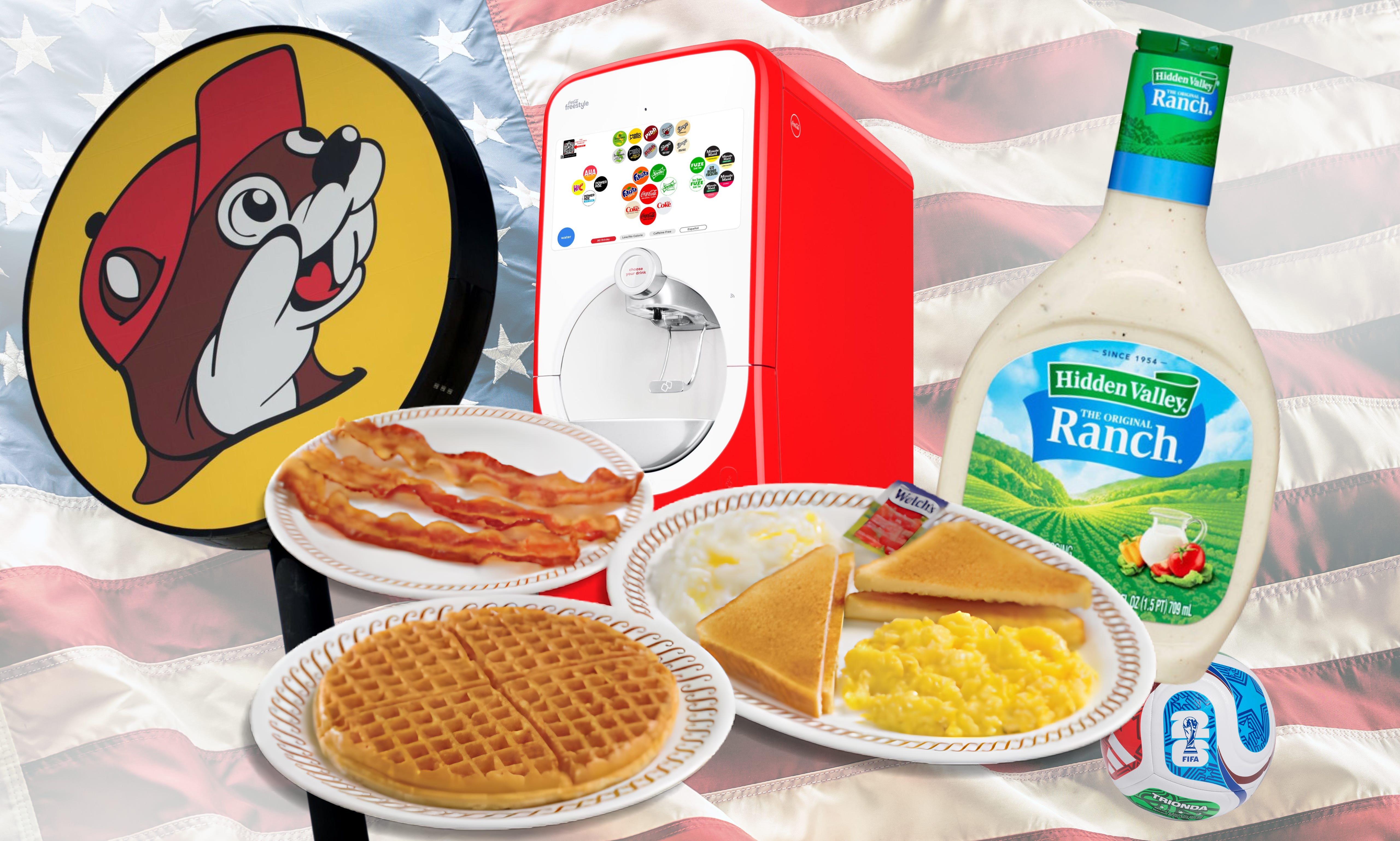
More than a million international visitors will descend on the United States for the FIFA World Cup this summer. They’re coming for the soccer matches, but a lot of them have already carved out time to get a taste of what the States have to offer off the pitch.
A German fan named Freddy has garnered a following for chronicling his road trip across the South, with stops at Waffle Houses, Bass Pro Shops, and Walmarts. A Swedish visitor named Elsa went viral for her reaction to ranch dressing. A Scottish fan named Shaun couldn’t stop talking about Buc-ee’s.
Fans from across Europe, Asia, and South America are posting content that has left Americans simultaneously proud and a little confused about exactly what is being celebrated.

If there’s one thing that keeps surprising visitors, it’s the sheer variety of choices. Who among us hasn’t also been overwhelmed by the choices available to us in a Coke Freestyle machine? Most of us would be surprised if a restaurant didn’t offer ranch dressing. Wait until our Swedish friend learns that most restaurants make their own version. Perhaps she’ll spark a Nordic trend of her own. After all, the recipe isn’t some uniquely American knowledge.
When asked about her experience being so surprising to everyone on the internet, one of her statements really stood out:
People are kind of amused seeing me experience America and thinking so big of little things for them. But for someone like me... it’s really cool.
She’s onto something, even if she doesn’t quite have the economics vocabulary for it yet. These visitors aren’t coming from poor countries. Freddy, Elsa, and Shaun all come from market economies with grocery stores and shopping malls. So why does the American experience feel like a different planet?
As it turns out, someone had this exact reaction decades ago. The circumstances couldn’t have been more different, but what he took away from it would change history.
A Visitor From a Very Different Economy
The date was September 16, 1989. Boris Yeltsin was newly elected to the Supreme Soviet of the USSR, and he was in Houston for a tour of NASA’s Johnson Space Center. He had already traveled across ten American cities, making speeches and public appearances along the way. None of it particularly moved him.
But on the way to the airport, Yeltsin made an unusual request. He wanted to stop at a local grocery store to see where the typical American would have shopped. His team called ahead with about 15 minutes notice, and a reporter from the Houston Chronicle tagged along. Otherwise it was just a regular Saturday at a regular grocery store.
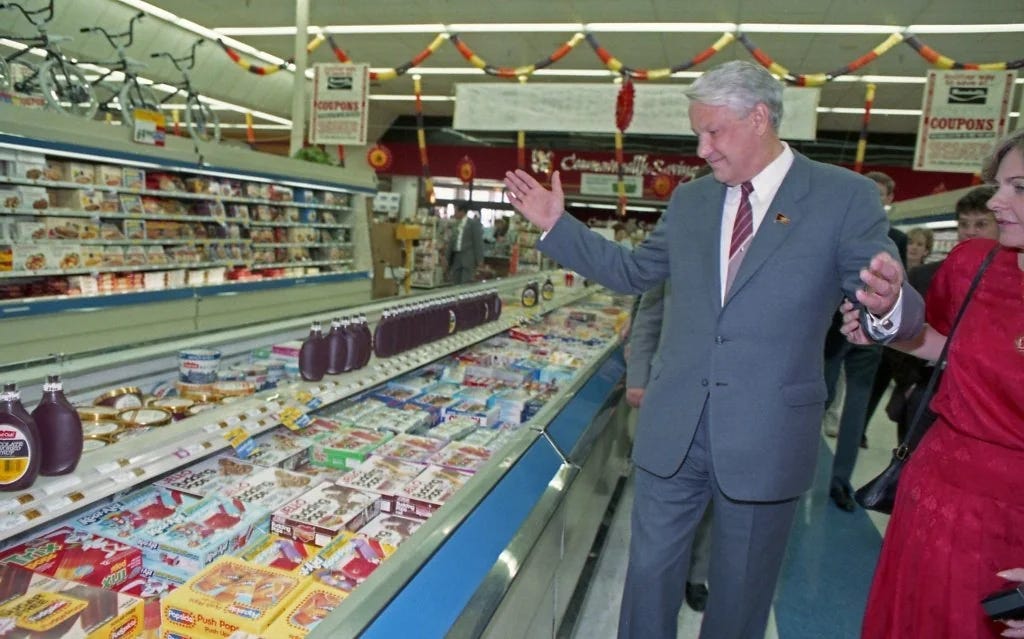
Yeltsin roamed the aisles, inspecting the produce and trying free samples of cheese. He talked to employees and customers through an interpreter, asking how much they spent on groceries relative to their salaries. He lingered in the frozen food section.
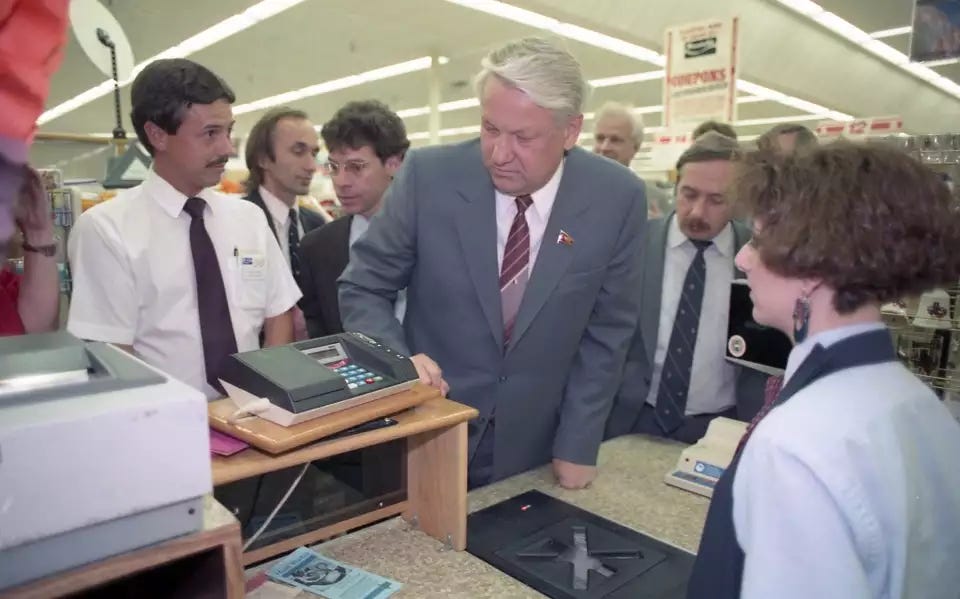
But what floored him wasn’t the technology or the architecture. It was the fact that this wasn’t a special showcase store in New York City. It was a suburban grocery store, available to anyone. After the visit, on the flight to Miami, Yeltsin went silent for a long time before asking, “What have they done to our people?” In a later biography, he had this to say about his visit:
When I saw those shelves crammed with hundreds, thousands of cans, cartons and goods of every possible sort, for the first time I felt quite frankly sick with despair for the Soviet people. That such a potentially super-rich country as ours has been brought to a state of such poverty! It is terrible to think of it.
Within two years, Yeltsin had left the Communist Party, become the leader of the democratic opposition, and won election as Russia’s first president. He would go on to lead the country’s transformation from a one-party communist state toward democratic capitalism. He wasn’t moved by the rockets at NASA or the Statue of Liberty. All it took was a box of pudding pops at a suburban grocery store.
No One Planned the Dr. Pepper Aisle
Boris Yeltsin noticed something that day that our World Cup visitors are still picking up on more than three decades later. And yet, most Americans probably never stop to notice.
No central planner decided how many Dr. Pepper flavors to make.
This may seem incredibly obvious to most people, but it’s something we largely take for granted. We don’t have a politburo in Washington approving a new Dark Berry flavor or a committee telling Kroger and HEB how much shelf space to give Strawberries & Cream. When you walk down the soda aisle, you’re seeing the result of millions of decentralized decisions.
The economist Friedrich Hayek had a name for this: spontaneous order. Complex, functional systems can develop without design, and work incredibly well. They often work well because nobody designed them. The magic of these systems comes from the accumulation of signals. When prices rise, producers make more. When a flavor doesn’t sell well, it quietly disappears. As summer trends emerge, some company steps in to fill it. Nobody coordinates all this. It coordinates itself.
For Yeltsin, the contrast was visceral. The Soviet system had committees deciding what to produce, how much, and where it would go. The result wasn’t just fewer flavors. It was breadlines, empty shelves, and a system that couldn’t respond to what people actually wanted because nobody was allowed to ask the question through price. Yeltsin's reaction was in response to a mechanism that his country had tried to replace with paperwork and failed.

Why Buc-ee’s Could Only Exist in America
But there is something else interesting about our visitors this summer. Freddy is German. Elsa is Swedish. Shaun is Scottish. None of them are coming from centrally planned economies. They come from economies that rely on the same foundation as ours: price signals and competition. So why are they just as gobsmacked as Yeltsin was?
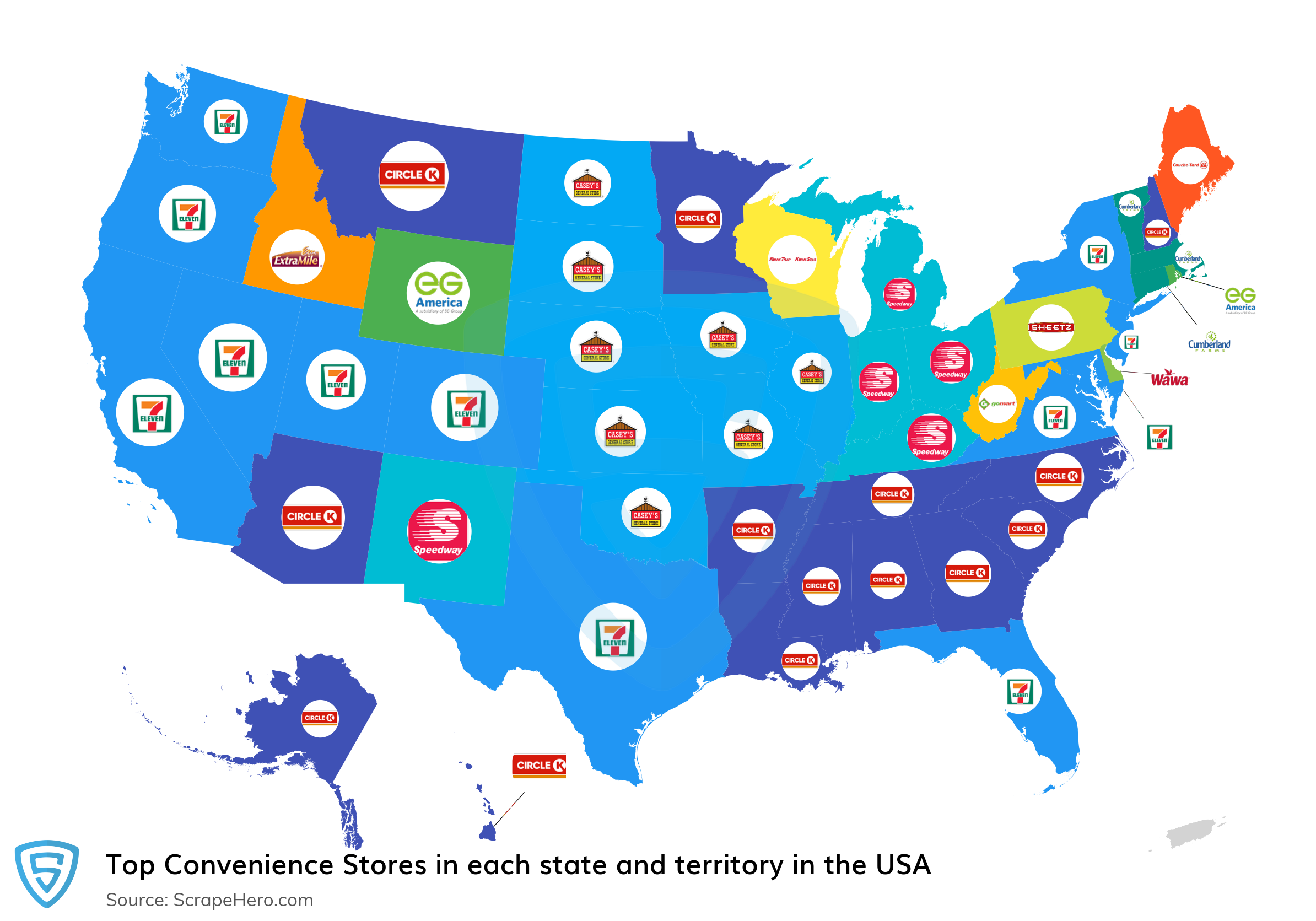
The U.S. has 330 million relatively wealthy consumers inside a single unified market with no internal trade barriers. A gas station concept that captures even a tiny slice of that market can support 70,000-square-foot locations, a wall of beef jerky, and 100 pump fuel stations. The same concept in Scotland, which has a population of 5.5 million, likely doesn’t even break even.
Retail structure adds another layer. Many countries are dominated by a few large companies that hold enormous power over what reaches shelves. American retail is far more fragmented, with regional players all competing intensely for the same customers. That competition creates pressure to give someone a reason to walk through your door instead of the one down the street.
The full picture, then, isn’t just “markets good.” It’s spontaneous order running at an almost incomprehensible scale, inside one of the most competitive retail environments on the planet. Shaun sensed it immediately. He just didn’t have the economics vocabulary to explain why.
Final Thoughts
Yeltsin left that Houston grocery store in 1989 with the beginning of a realization: that a system which lets millions of people make their own decisions produces outcomes no central planner could have designed. That understanding helped set him on a path toward dismantling the very system he’d spent his career inside.
It’s worth noting that even this abundance has its limits. In recent years, record inflation pushed many companies to quietly scale back their product lines, cutting options that couldn’t justify their shelf space. And yet, even a trimmed-down American grocery store or gas station still stops international visitors cold. The floor of American variety, it turns out, is still the ceiling almost everywhere else.
That’s what Freddy was really documenting in front of that Coke machine. It’s what Shaun was capturing at Buc-ee’s. Elsa put it so well when she talked about thinking so big of little things. Their fascination isn’t just about the excess or the novelty. It’s evidence of the same mechanism Yeltsin stumbled onto in a Houston suburb more than 35 years ago.
You probably walked past it the last time you went to the store. You just didn’t think to film it. Next time, stop for a moment to take it all in.
The World Cup only comes around every four years. The economics lesson it’s teaching? That one’s permanent. Share this story while the moment is still fresh.

The #1 Song in the United States on September 16, 1989, was Don’t Wanna Lose You by Gloria Estefan [On This Day]
Friedrich Hayek was awarded the Nobel Memorial Prize in Economic Sciences in 1974 alongside Gunnar Myrdal [The Nobel Foundation]
The market size of the Gas Stations in the US is $122.2bn in 2026 [IBIS World]
There are 9,402 7-Eleven locations spread out across 38 US States & Territories [Scrape Hero]
The world’s largest convenience store is located in Luling, Texas, and spans 75,593 square feet (about 1.7 acres) [Buc-ee’s]
As always, I enjoyed it. But, your Facts & Figures You Didn't Know You Wanted often lack that little bit extra that I want. For example, Luling, Texas, home of the largest convenience store in the world is in a town of fewer than 6,000 people. To people not for the United States, that is super confusing, I am sure. But seeing on a map that it is between Austin, San Antonio, and on the way to Houston, you have potential buyers traveling between these large cities constantly. If people weren't driving like Americans are prone to do, this place would not exist.
120 gas pumps?
200 employees on site at a time?
10,000 to 20,000+ customers per day?
Those are the numbers that intrigue me more than the physical size of the place!
A bigger story here is that path-dependent differences in national, and even regional, tastes make international welfare comparisons highly problematic except when one country has more of everything. A moderately well-off Parisian would hate the life of a a wealthy Midwestern suburbanite and vice versa with a switch of incomes.
Regionally, Sydney isn't that much different from the Sunshine Coast, but you'd have to pay me millions a year to live there. Same true in reverse ( a little less so with Noosa, which is a Southern enclave)