


You’re reading Monday Morning Economist, a free weekly newsletter that explores the economics behind pop culture and current events. Each issue reaches thousands of readers who want to understand the world a little differently. If you enjoy this post, you can support the newsletter by sharing it or by becoming a paid subscriber to help it grow:

Let me preface all of this by saying I fly a lot for work and have never worn sweatpants on a plane. I wore shorts once and felt so uncomfortable that I swore I’d never do it again. I’ve always thought sweatpants were reserved for lazy days around the house. I know that makes me an outlier, because most travelers seem perfectly comfortable flying in whatever feels easiest.
That context is why the reaction to Transportation Secretary Sean Duffy caught my attention. He suggested Americans should dress (and act) a little nicer when they fly, and the internet immediately pushed back. In a world where air travel feels stressful and unpredictable, upgrading your outfit can feel like the least important part of the whole experience.
All the comments touch on something more interesting than airline fashion. It raises a question economists don’t always talk about enough: Why do social norms matter at all?
Can something as small as clothing really shape the way people behave in tight, shared spaces like airplanes? Maybe dressing up could lead to better flight experiences for all of us. Let’s instead focus on how social norms shape behavior in ways that are easy to overlook but show up in everyday economic life.
Why economists care about social norms
Flights aren’t frustrating because some people on the plane are wearing sweatpants. They’re frustrating because social norms in crowded spaces can easily break down, and clothing is one of many cues people use to set expectations about how we’ll treat one another.
Social norms are the informal rules we follow, not because they’re written down, but because almost everyone else follows them. The police won’t show up at your doorstep if you cut in line at the grocery store, ignore a friendly greeting from a passing stranger, or talk too loudly in a coffee shop. And yet, most of us avoid those behaviors. We know what others expect, and we feel the pushback when we ignore it.
These expectations aren’t universal. They are unique to the setting, culture, and generation. But they all serve the same purpose: they help us navigate situations where the rules aren’t spelled out. For example, standing in line at a busy coffee shop, lowering your voice in a library, or respecting personal space. These norms make interactions smoother and reduce friction.
Economists care about norms because when someone breaks them, the cost can easily fall on other people. It creates an externality: a behavior that affects someone who didn’t choose it. Most days, we don’t think much about it. On a plane, it’s hard to ignore.
Social Norms at 35,000 Feet
Airplanes seem to amplify everything. It’s one of the few places where people are packed tightly together with almost no ability to escape. Most of the unwritten rules of air travel aren’t complicated, but they matter: don’t play videos without headphones, don’t take your shoes off, and don’t let your kids turn the aisle into a runway.
In other environments, these behaviors might be harmless. On a plane, they turn one person’s choice into someone else’s discomfort. Passengers lose the quiet they expected, crew members take on extra stress, and the flight gets harder for everyone in a way that’s nowhere reflected in the ticket price.
That’s the externality. One person’s behavior spills over to others.
Which brings us back to the original question: Does wearing sweatpants create an externality? I have to imagine most travelers would say no. Sweatpants don’t make noise or take up extra space. They don’t disrupt the person in the next seat.
But clothing does send signals about expectations and behavior, and that’s where this conversation gets more interesting.
Does What We Wear Shape How We Behave?
There’s an interesting line of research in psychology that looks at enclothed cognition. It’s the idea that what we wear can influence how we carry ourselves. In one well-known study, participants became more careful and attentive when wearing a lab coat described as a doctor’s coat. When the same coat was described as a painter’s coat, the effect disappeared.
The meaning attached to the clothing, not the clothing itself, drove the change. This research is often interpreted to mean that dressing more formally can nudge people toward more deliberate behavior. The effects aren’t huge, but the pattern is consistent. Clothing can shift mindset, and mindset can influence how we treat people around us.
But this is also where the internet’s reaction becomes useful. People aren’t rejecting the idea that norms influence behavior. They’re pushing back on the idea that clothing is the norm that needs to be fixed. If passengers are frustrated, cramped, delayed, or stressed, it’s not because the person in 23B is wearing joggers. It’s how the airlines have designed the entire flying experience.
Still, the debate resonates because most people intuitively understand that norms guide behavior. Clothing is one of the many signals we use to set expectations. When those signals shift, even slightly, the way we interact can shift too.
Final Thoughts
I mentioned earlier that I don’t wear sweatpants in public, including on planes. Most of my students wear them to class and around town, even when it isn’t that cold out. That alone tells us something: norms have shifted.
In fact, a recent UK survey showed a clear generational divide around what counts as “appropriate” clothing on airplanes. Younger travelers see casual attire as completely normal. Older travelers often see it as out of place.
Neither group is wrong. They’re responding to different versions of the world they grew up in. Flying used to be expensive, rare, and treated as a special occasion. Now it’s routine, crowded, and built around efficiency. Wanting to be comfortable on a long flight makes sense.
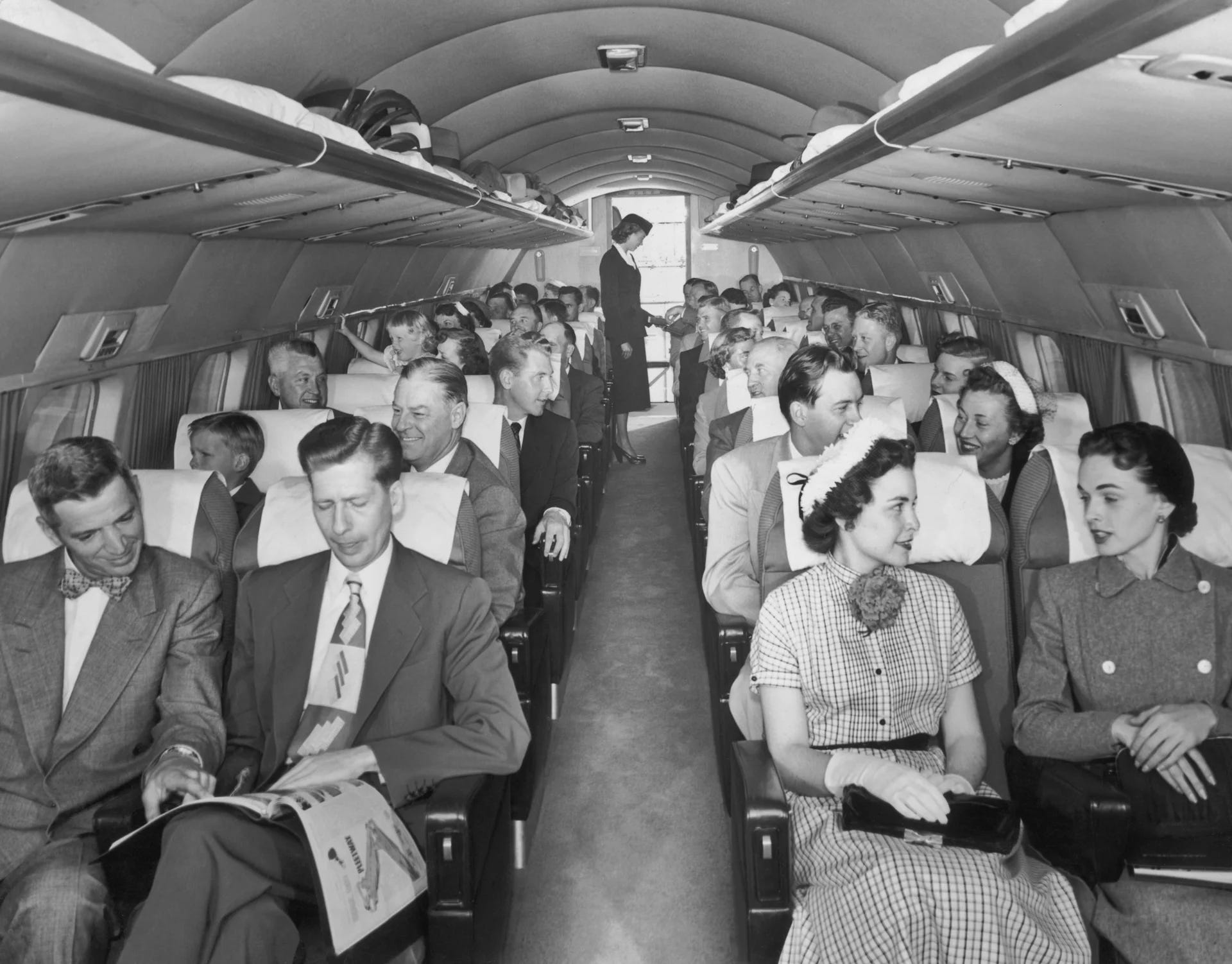
So the debate over sweatpants isn’t really about clothing. It’s about how quickly social norms evolve when the experience around them changes. And it leaves us with a completely different question than the one we started with: When a shared space feels different than it used to, how long do we expect the old norms to stick around?
Getting rid of sweatpants won’t fix the frustrations of modern air travel, but they can serve as a reminder that social norms rarely stay still. People adapt much faster than we sometimes expect.
If you know someone with strong opinions about airplane etiquette or sweatpants, feel free to share this article with them. It’s a small way to help more people see the economics in everyday life.
The average legroom in economy class typically ranges from 30 to 32 inches [Booking.com]
The average flight from L.A. to Boston in 1941 was worth $4,539.24 per person in today’s money, and it would have taken 15 hours and 15 minutes with 12 stops along the way [Travel + Leisure]
On average, air traffic controllers in the United States monitor more than 44,000 flights and more than 3 million airline passengers across more than 29 million square miles of airspace [Federal Aviation Administration]
64% of older Americans believe it’s unacceptable to wear pajamas in a common hotel area, while only 32% of young Americans believe the same [YouGov]
A Morning Consult study found that 83% of baby boomers were bothered by people being visibly intoxicated on a flight, but only 55% of Gen Zers said they found it annoying [Business Insider]
If, by pajamas, we mean the traditional shapeless long pants and long sleeved top in a soft material, why can that only be worn at night and at home? It's as arbitrary as what tradition defines as clothing for women or men. Those pajamas are certainly modest, so that can't be the objection. As are sweat pants.
Is it just that it's not "traditional"? Bah! Peer pressure from dead people 😀. If it's as this man believes, that it will make people act more "respectful" (what he describes is simply being polite) then I think he is mistaken. I don't assume that someone will be inconsiderate because they're wearing casual, non-traditional clothing. Actually, I think I'd be more wary of some obvious traditionalist in a 3 piece suit and tie.
And, btw, I'm 68.
Your survey regarding pajamas is from the UK. It would be interesting to see results comparing different countries. And I think people's attitude towards sweats on a flight might be different than their attitude towards pajamas.
This is interesting. As someone fresh out of high school, I find the idea of sweatpants making flights worse almost confusing. I had to read the article to even understand the concept. You mention social norms in this article, but something that I want to point out is that some younger people tend to dress like this most of the time. I don't dress like this, and not everyone does, but it wasn't rare to see students back in my high school wear pajama pants to class, much less sweatpants. Many younger people don't dress up for anything special unless they are told they need to, or they need to make a good impression. When you are traveling there is no dress code or anyone you need to meet, so they don't dress up.
I also point out, would dressing nicer really solve the problem or make it worse? The last time I got on a plane I had to wake up at 2:30am, and then our flight got delayed by several hours because they had to change a tire. We missed our layover, so we got to our destination about 9 or 10 at night, and I know I'm not the only one to have to wait in an airport all day. I think that wearing comfortable clothing makes people less irritable or more calm on a plane, especially if the flight is late or early in the morning. Wearing nice clothes might make people be more deliberate, but I care more about people being calm, not barely holding back their annoyance when we are going to be in a cramped space for a prolonged period of time.