


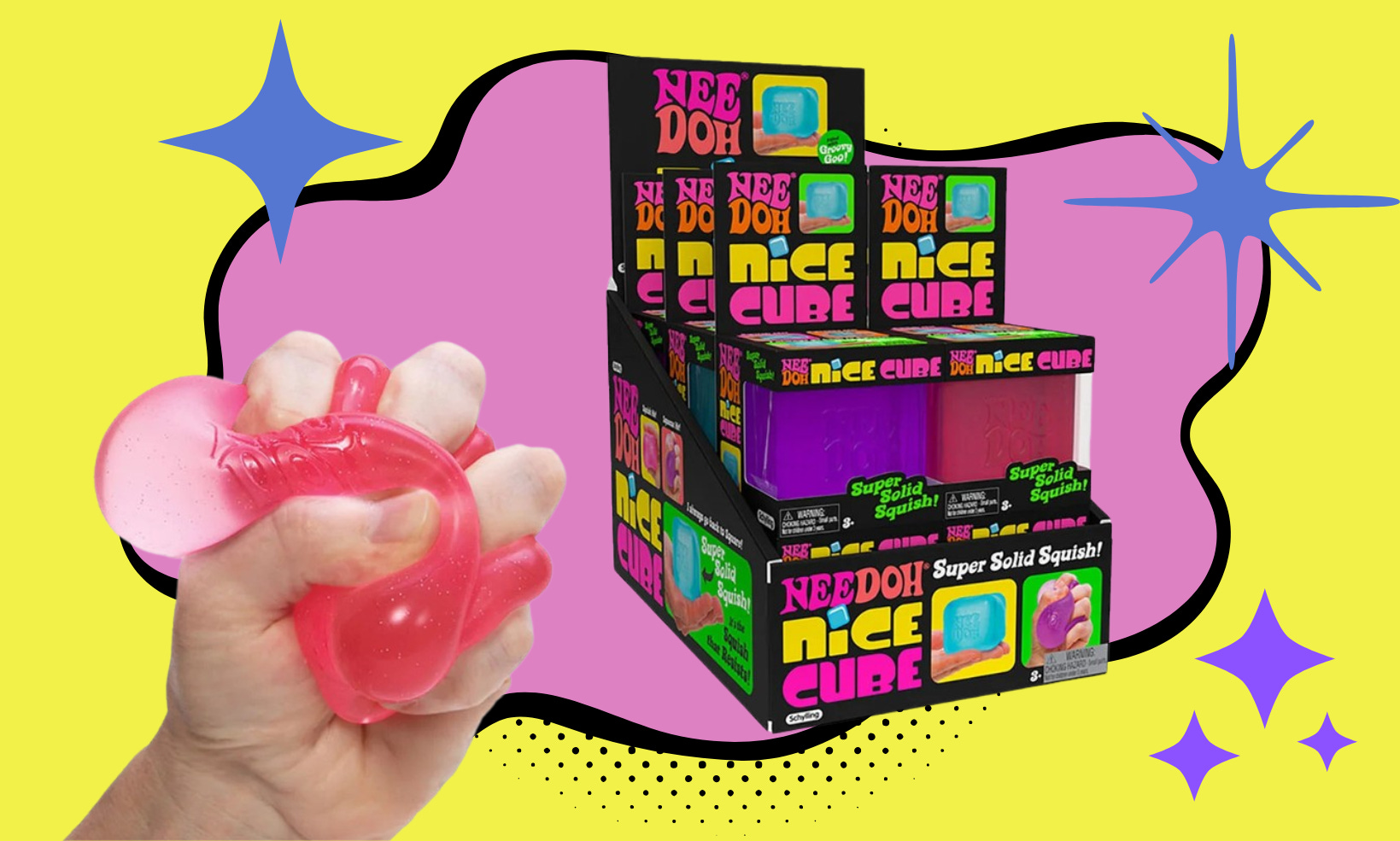
I’ve heard about these viral NeeDoh squishies for the past few years, but I’ve never actually seen one in real life. I’ve seen the fidget spinners and pop-its that preceded them, but the squishy, dough-filled stress balls have somehow taken over American childhoods, backpacks, and TikTok.
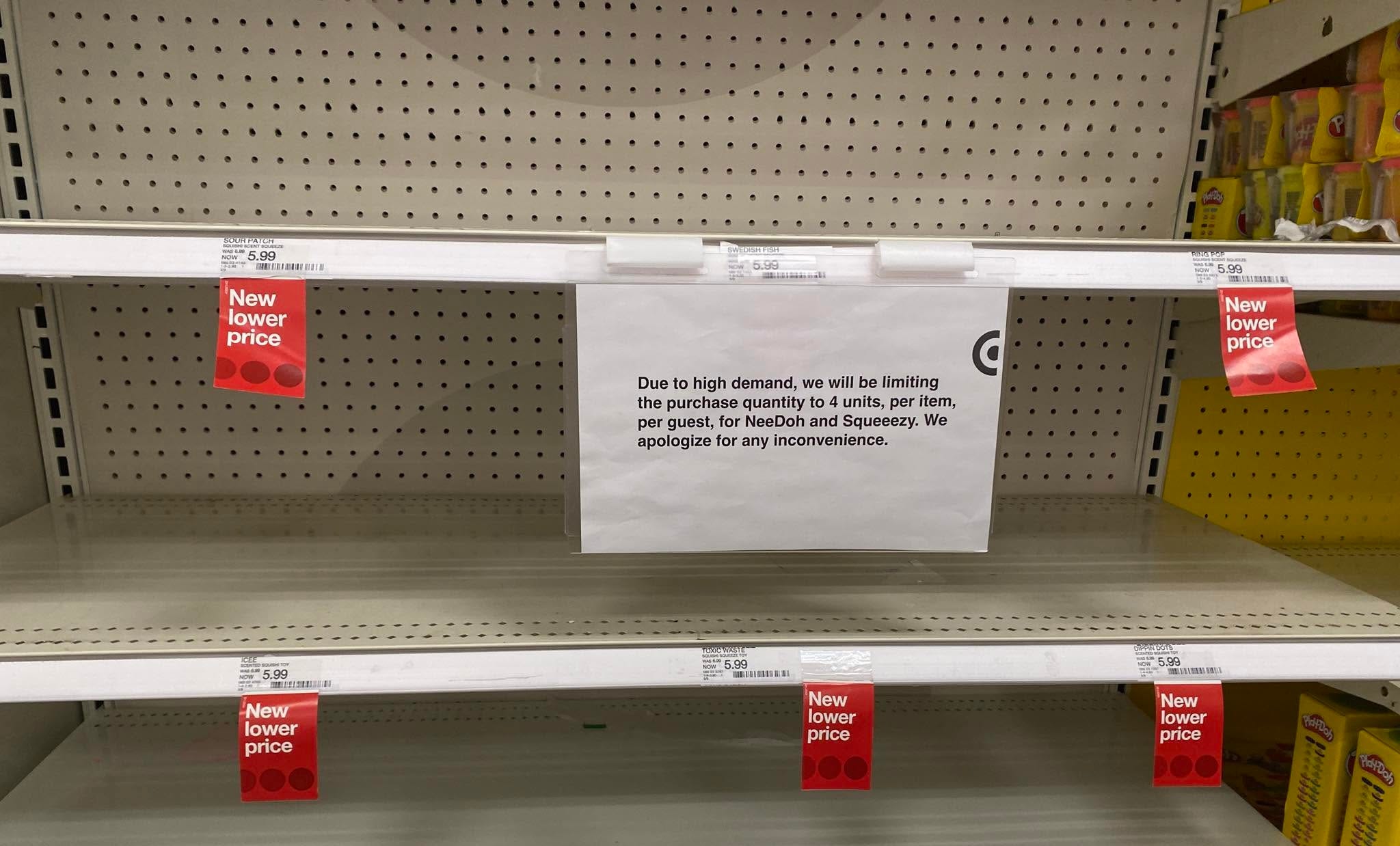
So I went on a quest for a toy that’s been named a finalist for toy of the year. I’ve seen videos of parents hunting them the way Arnold Schwarzenegger hunted a Turboman action figure in Jingle All the Way, but I was really hoping for better luck. But every time I stopped by the store, all I found was an empty gap where bright neon colors were supposed to be. Would I ever see one of these things in real life?
Like most other viral fads over the past few years, there was a sign taped neatly above the gap limiting customers to a certain quantity per person. There’s a certain irony in placing a limit on something that never seems to be available in the first place.
I may not have gotten my hands on a squishy cube, but I did get to spend the weekend reading about a genuinely simple piece of economics hiding inside a very silly toy shortage.
Everyone suddenly wants a $5 blob of dough
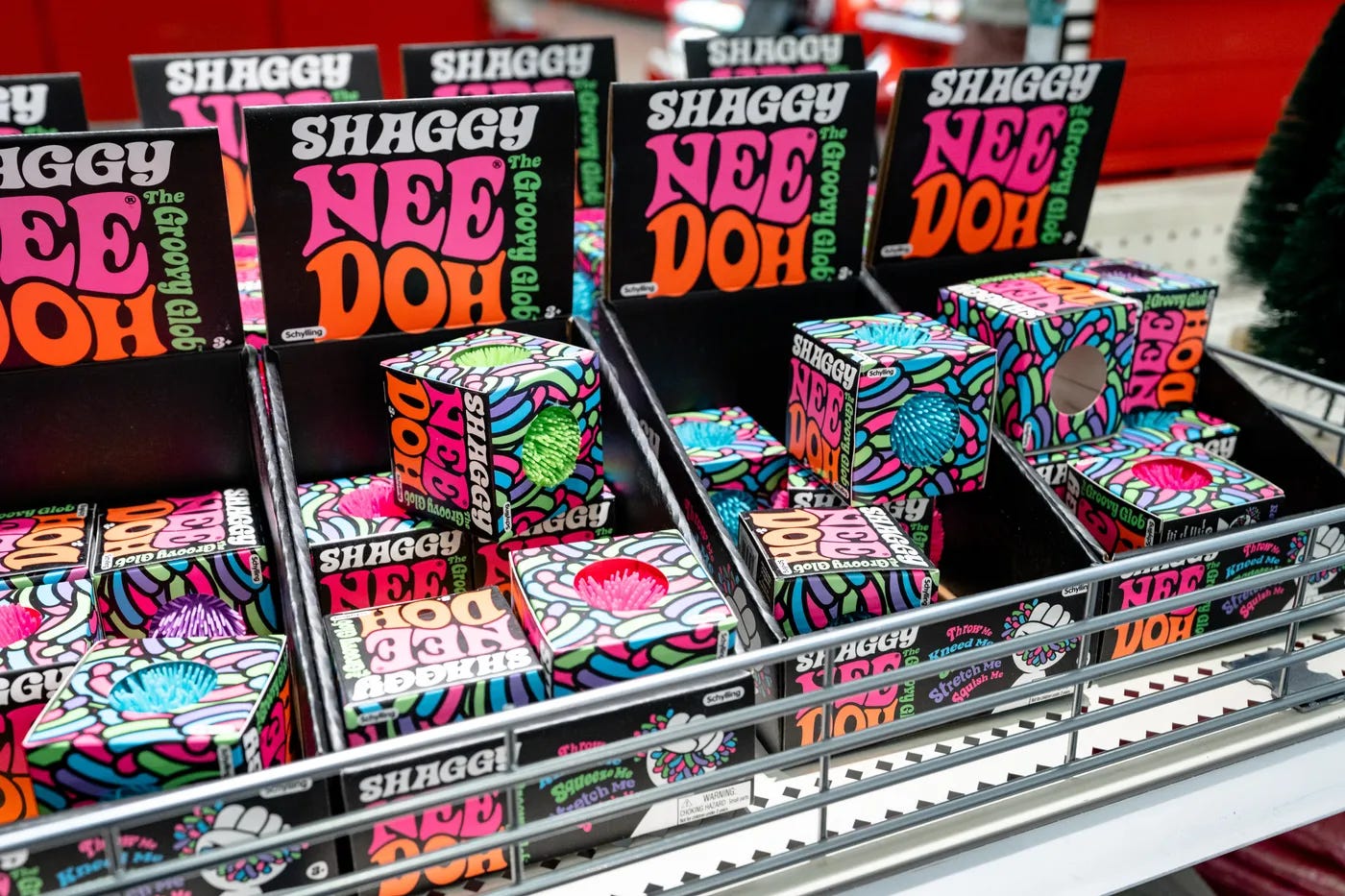
NeeDoh is the official brand name of the squishy, dough-filled stress ball made by a Massachusetts company called Schylling. Yes, it’s that same toy you’ve seen mentioned in the news where children have been seriously burned after microwaving them. This toy may be incredibly popular right now, but it’s actually been around for almost a decade, and squishy toys in general have been around since the 1960s. The product hasn’t really changed over the past decade, but its popularity has taken off. People just suddenly can’t get enough of it.
There are few driving forces to explain what we’re seeing on the empty store shelves, which will inevitably happen again when the NeeDoh fad phases, and the next random object inexplicably takes over the internet.
TikTok turned squeezing foam into content. Every video that does well makes more people want the object, which leads to more videos, which makes even more people want it. That loop alone has turned a niche stress toy into a cultural moment. It helps that the target demographic is also unusually sensitive to peer influence, but what makes NeeDoh especially interesting is how far the demand spreads beyond that generation. Stressed-out adults are also keeping one on their desk, and that’s not exactly a small market either.
That combination is a textbook shift in demand. There are several factors that could affect the demand for a product, but not every surge comes from the same source. When college towns fill back up in the fall, Target sees a predictable spike in box fans, power strips, and everything else on those “dorm room essential” lists. When refund checks hit students’ bank accounts, it’s no surprise the TV aisle looks a little emptier than the week before. Those are demand shifts driven by population and income, but that doesn’t explain the surge for Squishies.
This is a fairly simple change in people’s tastes and preferences, thanks almost entirely to social media. In a smaller way, buyers’ expectations have likely shifted, too. Some shoppers are now racing to grab one at retail price before they’re stuck paying resale. If you’re curious, there are secondary markets where rare Squishmallows already go for hundreds of dollars above sticker.
Of course, this shift has shown up in the company’s sales numbers as well. Schylling says NeeDoh sales are running about six times higher than last year. That’s even after 2025 sales had already doubled 2024’s numbers! By mid-February of this year, the company had already sold through eight months of inventory it had planned to last much longer.
But that raises the obvious next question: if demand jumps and supply doesn’t budge, shouldn’t prices increase as economics would suggest? I was certainly wondering why NeeDohs were still listed at $5 when the shelves were all empty.
The shortage nobody’s fixing
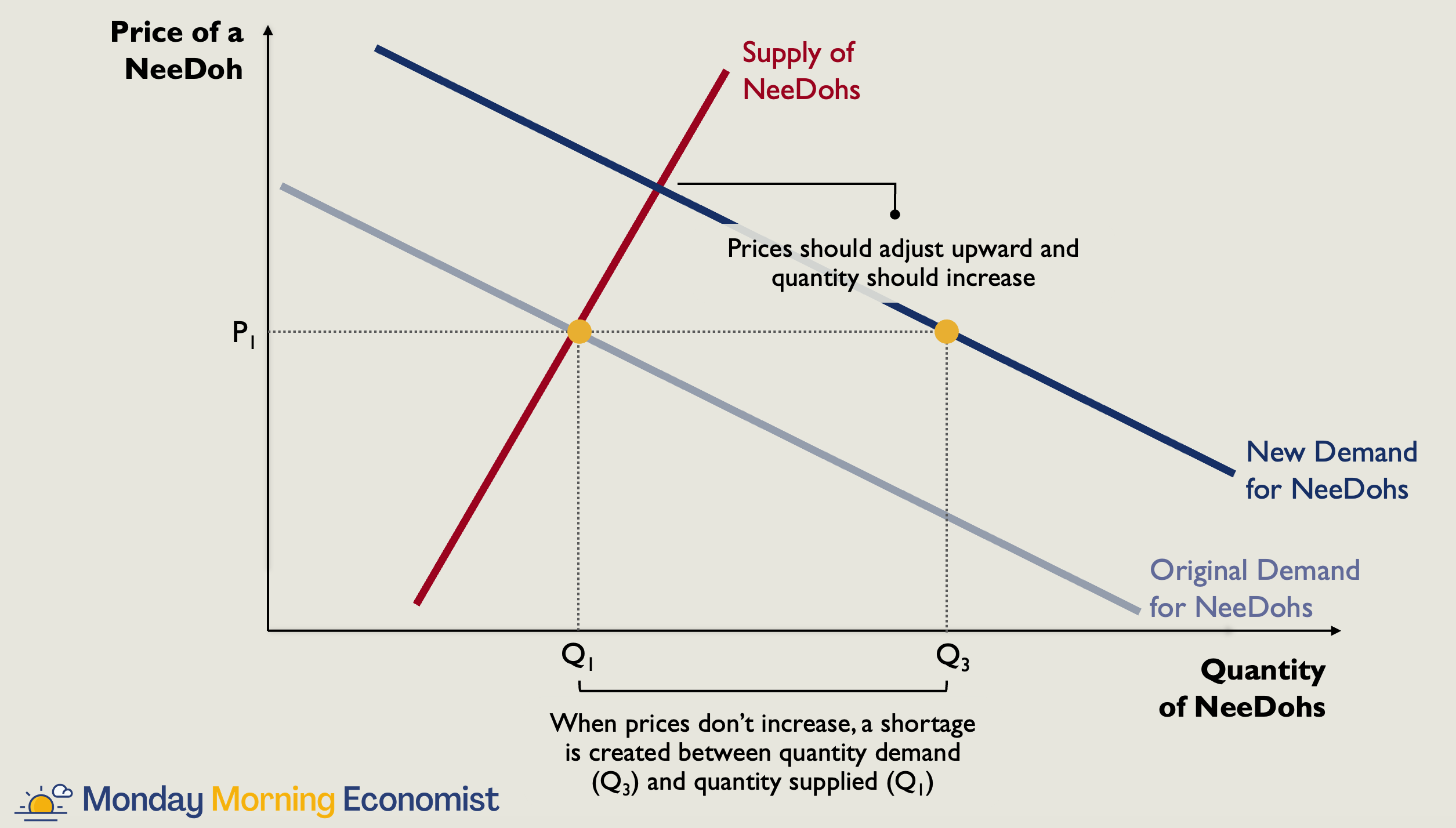
Let’s pivot from a toy story to an economics story. When demand increases, and price doesn’t move to catch up, you get a textbook shortage: the quantity demanded is larger than the quantity supplied at the going price. Normally, prices increase to release the pressure on the market. As prices increase, buyers progressively opt out until the quantity demanded equals quantity supplied. The new equilibrium is one where shelves get restocked at a price everyone can live with. Instead, the company has opted for rationing as its method for allocating a scarce resource.
So why not just raise the price? There’s real money sitting on the table given how much demand is out there. CEO Paul Weingard has been fairly candid about not wanting it. He’s seen this genre of toy fizzle out before, most notably the fidget spinners going from everywhere to landfills in about a year. Part of what killed them was flooding the market and chasing every dollar of demand while it lasted. He also doesn’t want to be the guy who priced out the twelve-year-old with birthday money.
That leaves one other way to close a shortage without touching the price: make more of it. In economic terms, the company needs to shift the supply curve to the right instead.
I don’t normally hit you with a graph, let alone two in one article. Normally, an increase in supply would bring prices down from wherever they climbed after demand spiked. We’ll likely see that in the secondary market if Schylling ramps up production, but that’s not what will happen on toy store shelves since the sticker price never went up in the first place. This supply shift will instead do what the price increase would have: close the gap between what people want and what’s on the shelf.
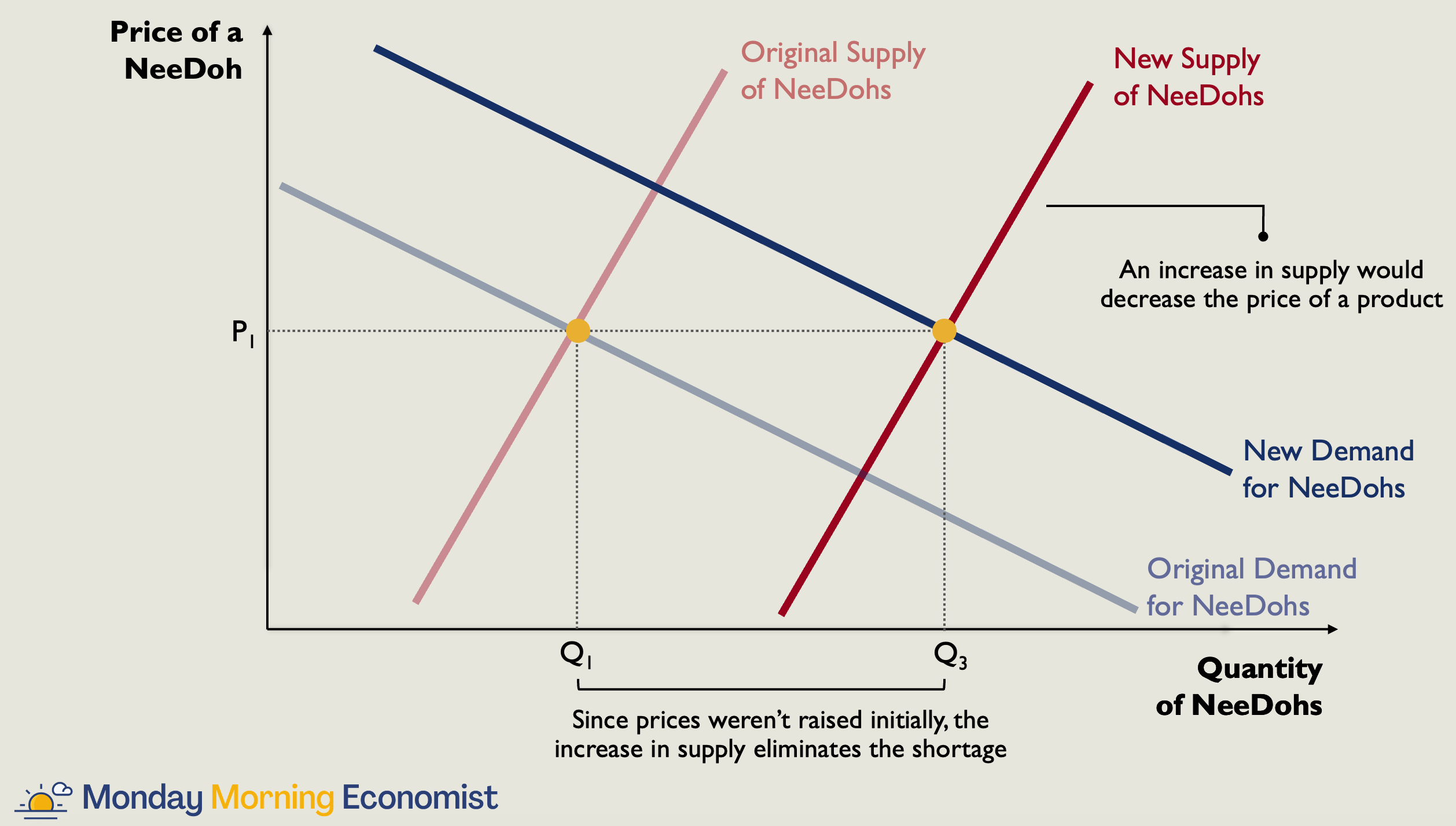
Weingard has been open about protecting the brand, but he’s also said the company is genuinely trying to make more. It’s added a second shift at the distribution center, expanded its warehouse, and has people working nights and weekends to move product through the pipeline. What they can’t do is scale production the way a software company scales a server.
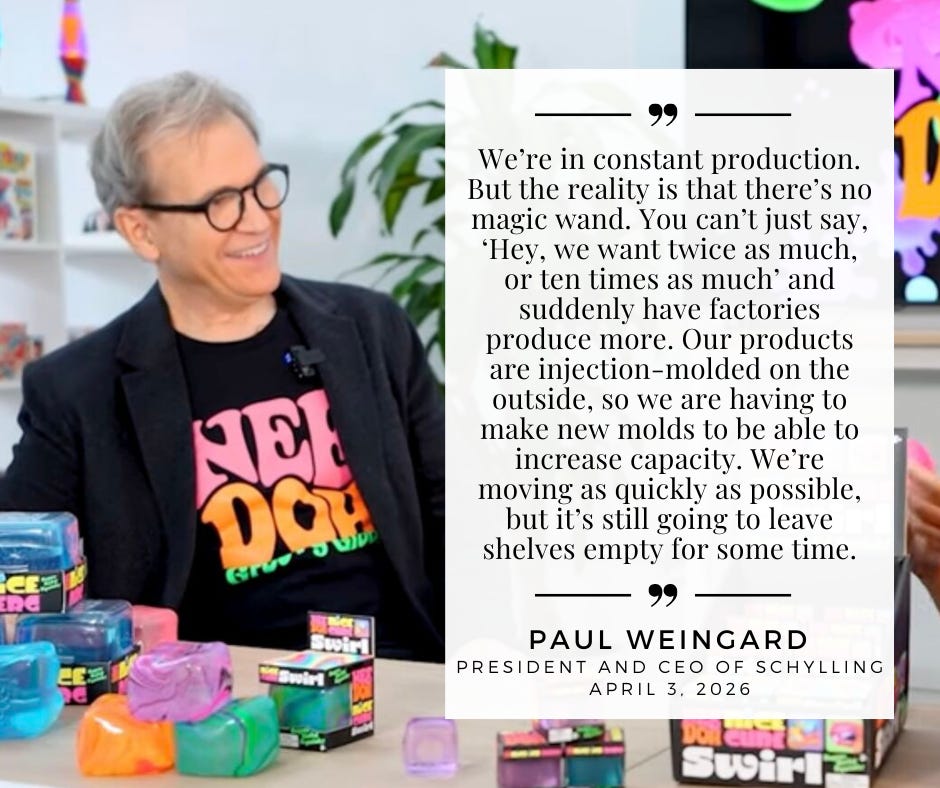
“We’re in constant production. But the reality is that there’s no magic wand. You can’t just say, ‘Hey, we want twice as much, or ten times as much’ and suddenly have factories produce more. Our products are injection-molded on the outside, so we are having to make new molds to be able to increase capacity. We’re moving as quickly as possible, but it’s still going to leave shelves empty for some time.”
NeeDoh toys are injection-molded, which means increasing capacity requires building new molds. That’s slow, expensive, physical work. By investing in new equipment, the company is introducing a supply shift. Capital investment like this shifts the whole supply curve rightward. Unfortunately for parents looking to get their hands on a replacement squishy for the one that burst in the microwave last week, it may take months to see results.
Final Thoughts
None of this is happening for the first time, either. If it sounds familiar to the adults reading over their kids’ shoulders, it should. Beanie Babies faced almost the same storyline back in the late 1990s. The company manufactured scarcity, a frenzied secondary market appeared, and people started buying bears on the bet they’d be worth more later. Then Ty flooded the market and killed the line outright, and the whole thing collapsed. Weingard’s caution about overproducing is likely built on the fact that he’s seen this movie end badly once already and would rather not star in the sequel.
Of course, it’s worth noting that we’re already seeing some pundits writing think pieces about how Gen Z can’t afford a house because of $5 squishies. It’ll likely become this generation’s avocado toast, and it’s just as unfair. No single small purchase explains a housing market, but it does at least acknowledge that we tend to underrate the cumulative cost of small, emotionally satisfying purchases, probably because each one feels too small to matter on its own.
Unlike NeeDoh, this newsletter has no injection molds, no fixed capital, and no CEO nervously watching a demand curve. Forwarding it to a friend costs almost nothing and takes about four seconds. Feel free to help me increase the demand.

The packaging and slogan for NeeDohs were designed in just one day by Schylling’s product development team [The Toy Coach]
The global stress-toy market is expected to grow to $7.95 billion in 2030 from $5.88 billion in 2025, partly because of the rising incidence of stress and anxiety among adults [The Business Research Company]
For Americans who engage in self-care activities every day, the top reasons cited are for improving physical health (53%), managing stress (52%), and enhancing mental and emotional well-being (50%) [YouGov]
Jack the Black Cat, of which only 500 were originally produced, is the most valuable regularly traded rare Squishmallow, now commanding $1,800 to $2,500 on the secondary market [Toynk]
Launched in 1993, the original line of Beanie Babies became so popular that its parent company amassed a reported $6 billion fortune [ABC News]
I predict a Chinese knock off will soon flood the market, seems to happen with all these fads. As an aside-- have you rewatched "Jingle all the Way" recently. My son went on an ARNOLD kick recently and whoa, that movie is bat-sh*t crazy. Completely wild ride.
This was great. Interesting decision to limit supply and create a huge secondary market