


I’ve had a draft article about a golf merger sitting in my account for the past few years. In 2023, the PGA Tour looked like it would merge with the upstart LIV Golf. The two had announced a framework deal to combine forces, which looked like a textbook case of rival leagues doing what rival leagues usually do. I started writing, but held off until the deal closed. It never did, and the draft stayed put.
Last week, our draft finally got an ending. It just wasn’t the one I had originally planned for. A representative from LIV Golf told a New Jersey bankruptcy court that the league is winding down after five seasons. Its original backer, Saudi Arabia’s Public Investment Fund, had put more than $5 billion into building a rival to the PGA Tour. That money paid for nine-figure player contracts and tournaments with $30 million in prize money split among the players based on where they finished.
The news will disappoint some LIV fans, but the league followed a pretty well-trodden path. Rival top-level leagues in North America rarely last more than a few years. Most fold, a few get absorbed by the incumbent, and some never even make it to their first game. The reasons have less to do with the particular sport than with a fight over players.
Every Rival League Has Lost
Rival leagues have been challenging incumbents in North America for more than a century, and the track record for challengers to the NFL, MLB, NBA, and NHL isn’t encouraging.
Only two of these fights have ended in full mergers. In the early 1900s, the American League and National League fought an intense “baseball war” before signing the National Agreement of 1903 to end it. The two leagues kept separate offices and presidents until 2000, but they’ve operated as one major-league system ever since. The second merger came in the 1960s, when the fourth version of the American Football League agreed to merge with the National Football League.
Three other rivals (the AAFC, ABA, and WHA) had some of their teams absorbed into the incumbent league. Seven went bankrupt: the Federal League, three earlier versions of the AFL, the ABL, the WFL, and the USFL. Baseball’s Continental League was announced, but never got off the ground. More on that one later.
The USFL’s story is perhaps the most interesting. It launched in 1983 as a spring league and spent heavily on stars, signing three straight Heisman Trophy winners: Herschel Walker, Mike Rozier, and Doug Flutie. Donald Trump (yes, that Donald Trump) bought the New Jersey Generals after the first season and soon pushed the other owners to move to the fall to compete directly with the NFL. He hoped the pressure would force the NFL to absorb some USFL teams, especially his own.
The owners agreed to the fall move, and the league sued the NFL for monopolizing professional football. It won, technically. The jury awarded $1 in damages, trebled under antitrust law to $3. The USFL never played its fall season, and Trump is widely blamed for its collapse.
The lawsuit is the part people remember, but the signing spree explains why leagues like the USFL keep losing. A rival can’t compete without talent, and the incumbent already has most of it under contract.
It’s a Fight Over Players
Incumbent leagues have real advantages, like loyal fan bases and established media contracts. But rivals typically don’t last because of the labor market. A single dominant league operates like a monopsony, meaning it is effectively the only buyer of top-level talent in its sport. With nowhere else to go, players have little leverage. The league can hold wages below what they would earn in a competitive market.
A rival league breaks up that market structure. Suddenly there are two buyers, and players can take the better offer. Few things improve your bargaining position quite like a second job offer! The salary data from these episodes are striking. Average incumbent-league salaries rose roughly 50% after the early baseball wars, and later wars produced much bigger jumps. Average NBA salaries went from about $20,000 to about $143,000 after the ABA formed, and NHL salaries went from about $25,000 to about $96,000 after the WHA entered the market.
Baseball salaries returned to their pre-rival levels after the 1903 agreement and the Federal League’s collapse in 1915. Salaries in later leagues didn’t fall back, but those episodes coincided with the arrival of free agency, making it hard to separate the two effects. Regardless, a bidding war transfers money from leagues to the players, so each league would prefer it stopped. Merging is the most direct way to stop it, but it isn’t the incumbent’s only option.
Block Them or Let Them In
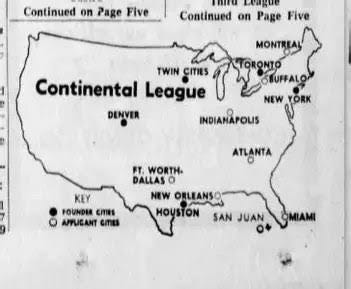
An incumbent league facing a rival has a strategic choice. It can try to deter the rival’s entry, or it can let the rival form and merge with it if it succeeds. Baseball’s Continental League is the textbook deterrence case. In the late 1950s, it had established a legal structure and identified eight prospective cities. Major League Baseball responded by expanding into some of those proposed cities by establishing new teams, including the New York Mets and the Houston Colt .45s, now the Astros.
If the incumbent league doesn’t want to expand, it can also raise its rivals’ costs. If the incumbent pays its players well, a rival has to pay even more to poach them. That makes it a heck of a lot more expensive to start a rival league.
In golf, this shows up in prize money rather than salaries. Unlike athletes in team sports, touring golfers don’t draw a regular paycheck from the PGA Tour. They earn most of their on-course income from purses, so a bigger purse is effectively a raise. LIV changed the offer by adding guaranteed contracts on top of its purses. The PGA Tour’s purse increases after LIV launched are consistent with this strategy.
Why Golf Looked Different
The research on rival leagues comes almost entirely from team sports, and golf differs in one important way: who the league has to keep happy.
In a team sport, a rival league is a collection of franchises. Owners put up money for teams in specific cities, and players sign with those teams. When a rival folds or merges, the owners negotiate which teams get into the league. Players mostly follow their contracts.
Golf doesn’t work that way. LIV did have teams, but people largely tune in to watch the players. A golf tour succeeds only if the best ones keep showing up, but each golfer is essentially an independent contractor who decides where to play. A player who leaves can also walk back to the incumbent tour, as Brooks Koepka did ahead of the 2026 season.
The “peculiar economics” of sports helps explain why that matters. The league, not the teams, is the real firm in our economic story. Fans want to see a single undisputed champion at the end of the year. Critics argue this justifies a joint venture of independent teams more than a single monopoly. Golf’s version of the championship is a handful of events no tour owns outright.
LIV never had a controlling stake in the major events. Its players didn’t earn official world ranking points, which they would need to qualify for the majors. LIV players could still enter majors through exemptions earned from past wins, and Koepka even won the 2023 PGA Championship while on LIV.
LIV’s final months showed how much those events mattered. The main European tour told players who signed with LIV 2.0 not to apply for membership since it would have made European players ineligible for the Ryder Cup. Two-time major champion Jon Rahm said he was leaving LIV, as did Tyrrell Hatton, Sergio Garcia, and Louis Oosthuizen. The investment firm that lined up to fund LIV Golf’s relaunch eventually withdrew its rescue plan of about $300 million after only about 15 players showed interest. Rival leagues can only keep going as long as their owners keep paying, but LIV 2.0 also needed the players to say yes. Most of them said no.
Final Thoughts
The 2023 framework deal surprised a lot of golf fans, but last week’s announcement was perhaps less surprising. Saudi Arabia’s Public Investment Fund said in April that it would stop funding the league after the 2026 season, reportedly after a shift in investment strategy following the start of the Iran war.
When I started this draft in 2023, I assumed our golf story would take the merger path. It ended up taking the more common one. There isn’t a lot of data to compare this to, but it follows the pattern pretty closely. Only time will tell if tournament prizes stay high now that the threat is gone. Either way, sports economists have a new case to study, and I have one less draft sitting in my folder of ideas.
A few rival newsletters have launched over the years, but there’s been no bidding war for talent, since this newsletter’s lone employee doesn’t do it for the money. There also haven’t been any merger talks, but we don’t have enough paid subscribers to buy anyone out.
That could change if you pass this one along to a friend, a student, or the golf fan in your life.

Almost half of the 103 major pro franchises then in existence owed their existence to rival leagues [Pay Dirt]
The first PGA Championship was held from October 10 to 14, 1916, at the Siwanoy Country Club in Eastchester, New York [History.com]
Jon Rahm was the highest-paid LIV Golf player, with a reported $300 million signing contract and over $105 million in career tournament and prize earnings [Fox Sports]
Scottie Scheffler leads the PGA Tour all-time career money list with $130,390,661 in official prize earnings [PGA Tour]
Saudi Arabia’s Public Investment Fund had preliminary assets under management of $910 billion at the end of 2025 [Reuters]