


Every semester, I start class with a conversation about the power of prices as incentives. I run through a few favorite examples, like how paying students and teachers can improve learning or how a small fee on plastic bags can cut usage dramatically. I want my students to start thinking like economists, so I pair each example with a possible unintended consequence. Paying teachers based on student performance can tempt some to change answers for a bigger payout. A bag fee pushes some consumers toward buying the thicker, “reusable” plastic bags instead. Prices are great incentives, but they don’t always work the way policymakers design them.
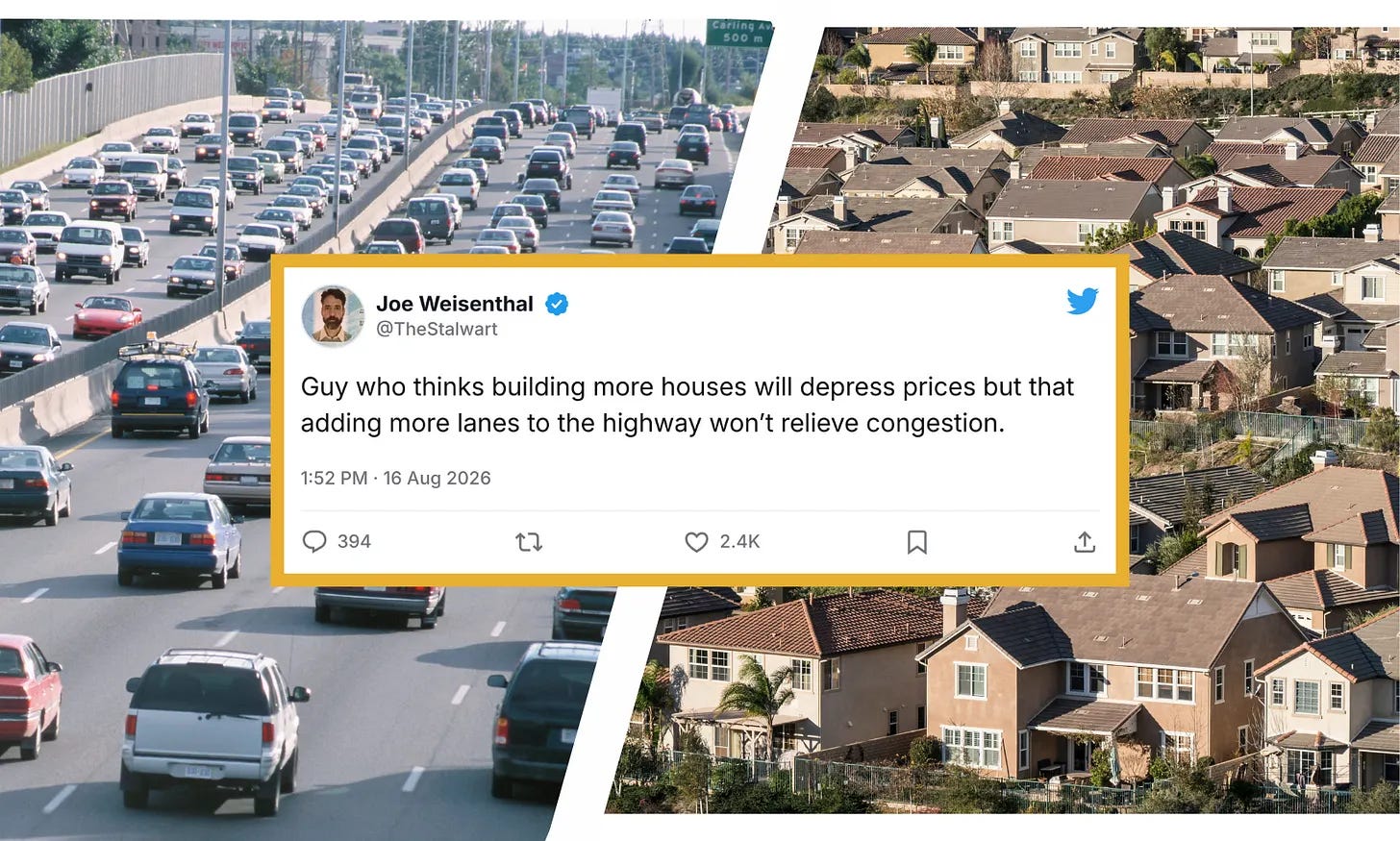
I was preparing this year’s slides when I ran into a tweet that belonged in the same lecture, even though it wasn’t about either topic. It pointed out what looked like a genuine contradiction: how can someone believe that building more housing brings prices down, but also believe that adding more highway lanes won’t fix traffic? If supply works in one case, shouldn’t it also work in the other?
It fired up a lot of people online since it reads as a gotcha moment. The implication is that you should pick a lane. Either you believe in supply and demand, or you don’t. However, both beliefs are correct. There’s no contradiction here, just two markets that ration access in totally different ways.
How Housing Actually Works
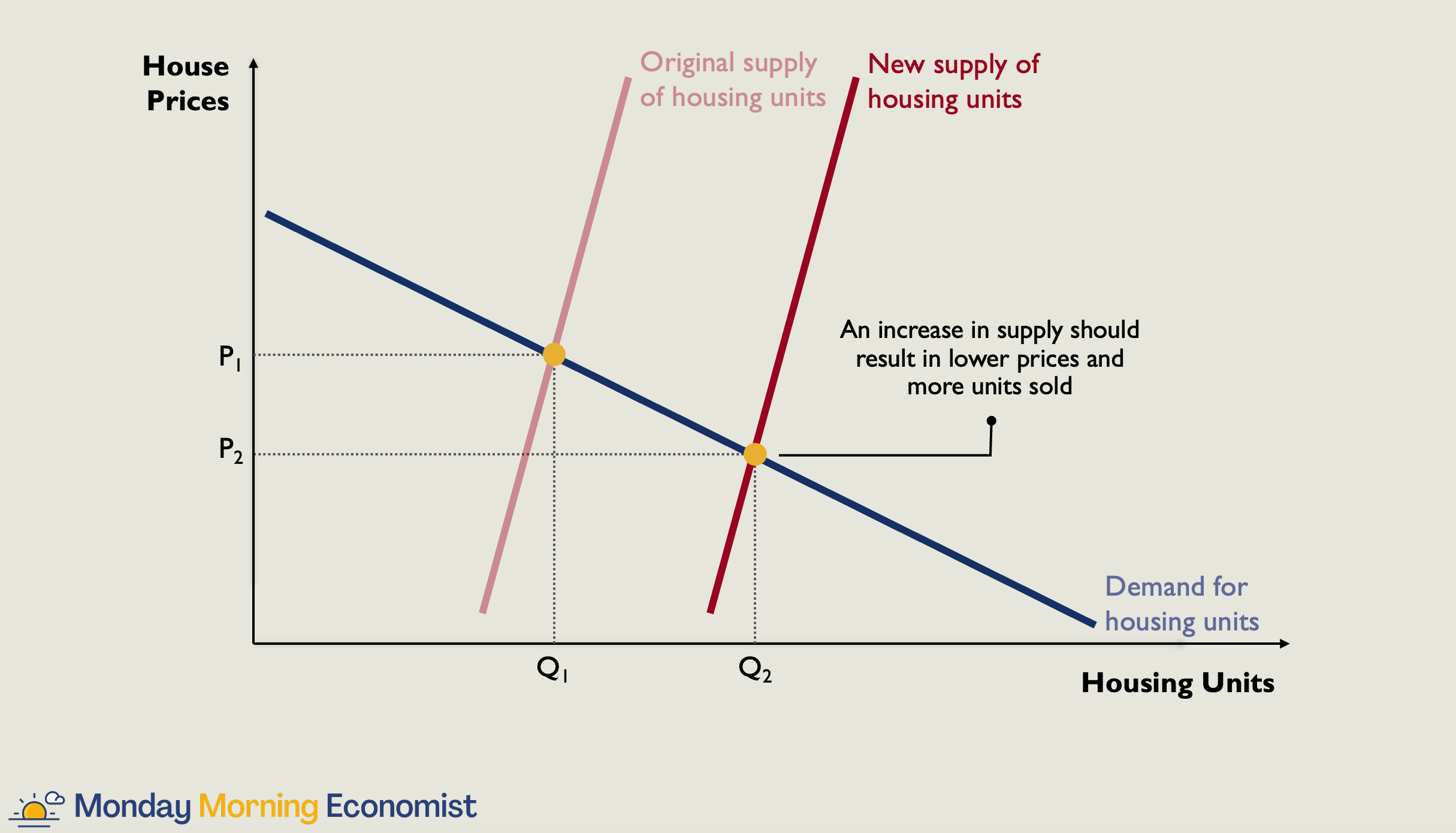
Let’s start with housing, since it follows the supply and demand model neatly. Housing affordability in the United States is a major sore spot for Americans, and short of another major recession, there doesn’t seem to be any relief in sight. Theoretically, an increase in supply would lower prices and increase home ownership.
So what’s stopping that from happening? A lot actually. There are a lot of laws in place that quietly cap how much housing a city can build, even if demand is constantly increasing. Minimum lot sizes make it illegal to build anything smaller than a certain footprint. Parking minimums force developers to set aside space for cars instead of people. Zoning reserves entire neighborhoods for single-family homes only. Tack on permitting delays and expensive approval processes, and home buyers face consistently increasing prices.
In the housing market, price rations a scarce good. When prices rise, some people get priced out and relocate to more affordable options. When supply expands, prices soften, and more people can afford to stay or move in. The market adjusts on both sides of the story because the market price is constantly sending signals, and people respond by changing their behavior.
Over the past decade, Austin, Texas has been a pretty good real-world illustration. The city built aggressively, and rents actually fell despite strong demand. The pricing mechanism worked exactly as theorized.
Of course, not every city is ready for Austin-style sweeping reform. Smaller reforms can also help: legalizing accessory dwelling units or letting a single-family lot become a duplex or triplex. The details of how a city adds supply matter, but that’s not really the point of this article. The point is simply that when supply grows, prices respond.
Roads Are Different
That same price logic explains why so many homeowners show up in droves to fight zoning changes. Plenty of people see their homes as investments, and nobody wants to watch an investment shrink. Rising home prices are a reward for the people already inside the market as much as they ration access for people trying to get in.
Roads don’t offer that same reward, or that same punishment, because the price to drive on most highways is almost always zero. That’s the whole contradiction in the original post. Housing has a price mechanism, but highways don’t. A new home enters a market where price helps supply and demand meet. A new lane on the highway enters a market with no price at all, but there’s nothing to tell the drivers that capacity is scarce.
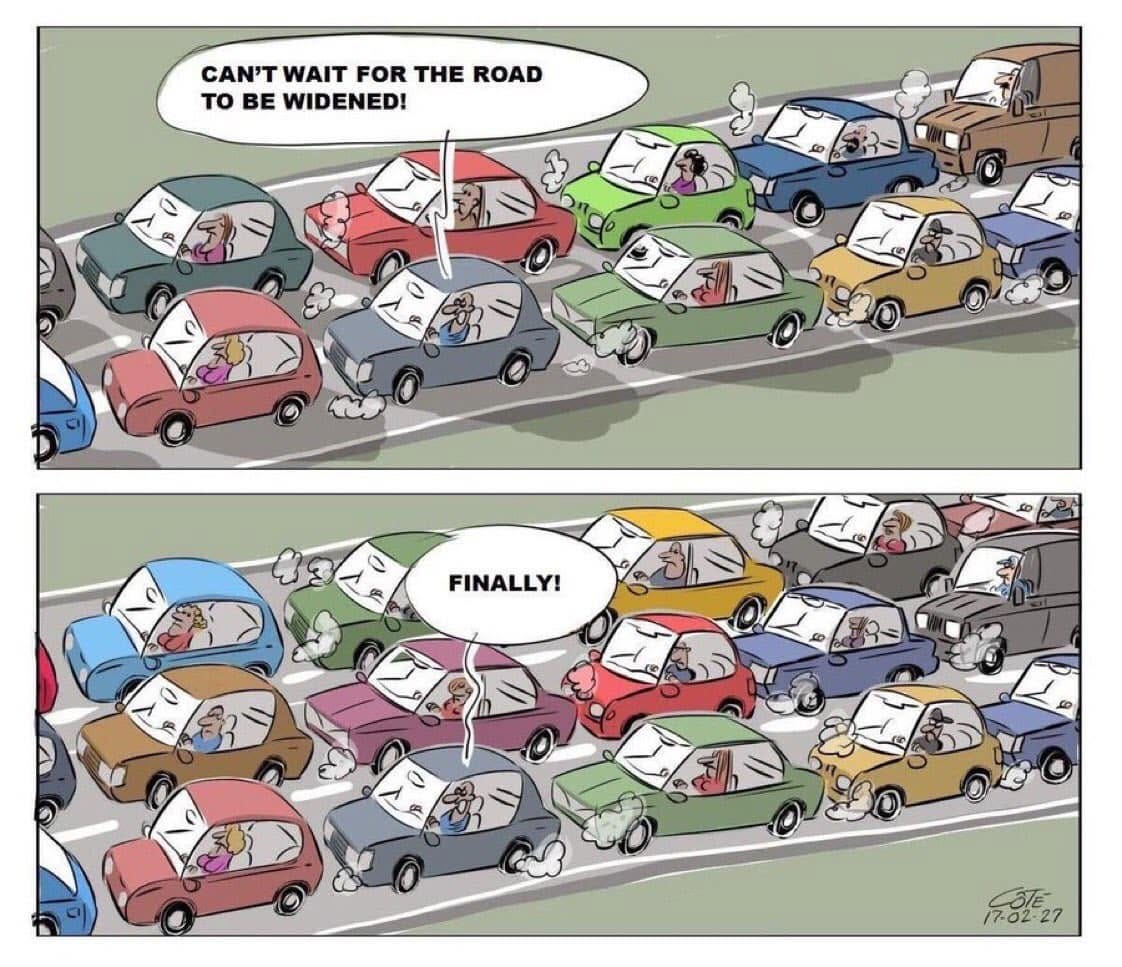
Economists have a name for that: induced demand. Drivers see a potential drop in travel time, which effectively decreases the cost of driving. As costs fall, more people enter the market. Instead of leaving early to dodge the traffic or avoiding that road altogether, they start driving again. The lane fills back up and the congestion returns.
The Fundamental Law of Road Congestion
A landmark paper examined highway construction across major U.S. metro areas and found that vehicle miles traveled increase in almost exact proportion to new lane-miles added. That means a 10% capacity increase produces roughly a 10% increase in driving. Any relief from new lanes tends to evaporate within three to five years. The finding has since been nicknamed the Fundamental Law of Road Congestion.
The highway fills back up with more cars through a few distinct channels. Existing residents who used to dodge the route or shift their schedule start driving it directly. New residents move to the area because the commute looks easier, which adds fresh demand on its own. Then, businesses relocate to take advantage of the perceived improvement in access, which brings freight trucks and employee traffic with them. Finally, people start running errands separately instead of bundling them into one trip. There’s no need to bundle it all together if an extra trip suddenly costs less time than it used to.
None of this is irrational behavior breaking our supply and demand model. In fact, the model is working exactly as it should. People and businesses see the new lane, and their demand for the road increases. Since there isn’t a price to slow that demand down, more people end up on the road. The unintended consequence ends up being the same congestion the lane was built to fix.
Final Thoughts
There’s actually only one assumption standing between these two markets: does a price exist to do the rationing? Housing has one, but most highways don’t. Some cities have taken up the call to give roads one anyway, through congestion pricing. The idea is to charge drivers more during peak hours and less during off-peak to mimic the same signal housing markets send on their own.
Stockholm, London, and Singapore have run versions of this for years. New York City kicked off its own Congestion Relief Zone tolling in Manhattan in January 2025. Despite sustained political and legal opposition, the program has stayed in effect, and the MTA has reported meaningfully fewer cars entering the zone. But putting a price on something people have always experienced as free is never just an economics problem.
“Build more” has become shorthand for a certain kind of optimism, popularized by Ezra Klein’s Abundance. The general premise is that a lot of society’s stuck problems are really supply problems in disguise, solvable if we’d just let ourselves build. Housing proves the case, but highways are the exception. An increase in supply only solves scarcity when there’s a price attached to ration it. Without one, more supply just invites more demand.
This newsletter is also free, with no price rationing supply. But unlike a highway, we don’t have a capacity constraint. Share this one with a friend without worry of gridlock in your inbox next week. Consider it one of those rare cases where induced demand is exactly what we’re hoping for.

58% of Americans say owning a home is a very or extremely important part of achieving the American Dream, including two-thirds of homeowners and half of renters [YouGov]
Based on typical affordable housing development costs, one parking space per unit increases costs approximately 12.5%, and two parking spaces can increase costs by up to 25% [Urbanism Next - University of Oregon]
The U.S. Interstate System is 46,876 miles long [US Department of Transportation]
The widest section of highway in the U.S. is the Katy Freeway in Houston, Texas, which reaches up to 26 total lanes at its widest point [The New York Times]
California requires highway expansion proposals to run through the UC Davis Induced Travel Calculator to estimate how much new driving a project would generate before it’s approved [California Department of Transportation]
Make it even simpler: increased quantity of homes goes with lower prices. Lower price for driving (easier road lane access) goes with increased quantity of cars. They're both just a slide along the demand curve.
And both bring more density.
Getting students to see problems this way is so key to good economics. It isn't a contradiction, and here's why...
Once students stop saying economics cannot explain this vexing problem and start saying, why is this happening and searching for the right answers, I know I have them hooked. This is a great article to help them get there.
I have several students who took me for microeconomics last semester in my macroeconomics class this semester, and already in week 1, several of them are asking me tough questions. I love it. But I love it more when they stop asking tough questions and start offering up the tradeoffs.