


You’re reading Monday Morning Economist, a free weekly newsletter that explores the economics behind pop culture and current events. Each issue reaches thousands of readers who want to understand the world a little differently. If you enjoy this post, you can support the newsletter by sharing it or by becoming a paid subscriber to help it grow:
Here’s a question you probably haven’t thought about in a while: Are you being paid fairly?
You might have a gut feeling. Perhaps you remember what you asked for when you took the job, or vaguely recall reading something on Glassdoor a few years back. But if someone asked you to prove it with real numbers from real people doing comparable work, most of us would come up short.
That’s a feature of how most labor markets in the United States have worked for decades. Wages are one of the most important prices in any economy. Our earnings shape household budgets, career decisions, and how we allocate our time and energy for most of our adult lives. And yet, for most workers, they’re shrouded in secrecy.
Hannah Williams noticed the same thing a few years ago and decided to do something about it. Let’s take a walk together down Salary Transparent Street.
Meet Hannah Williams
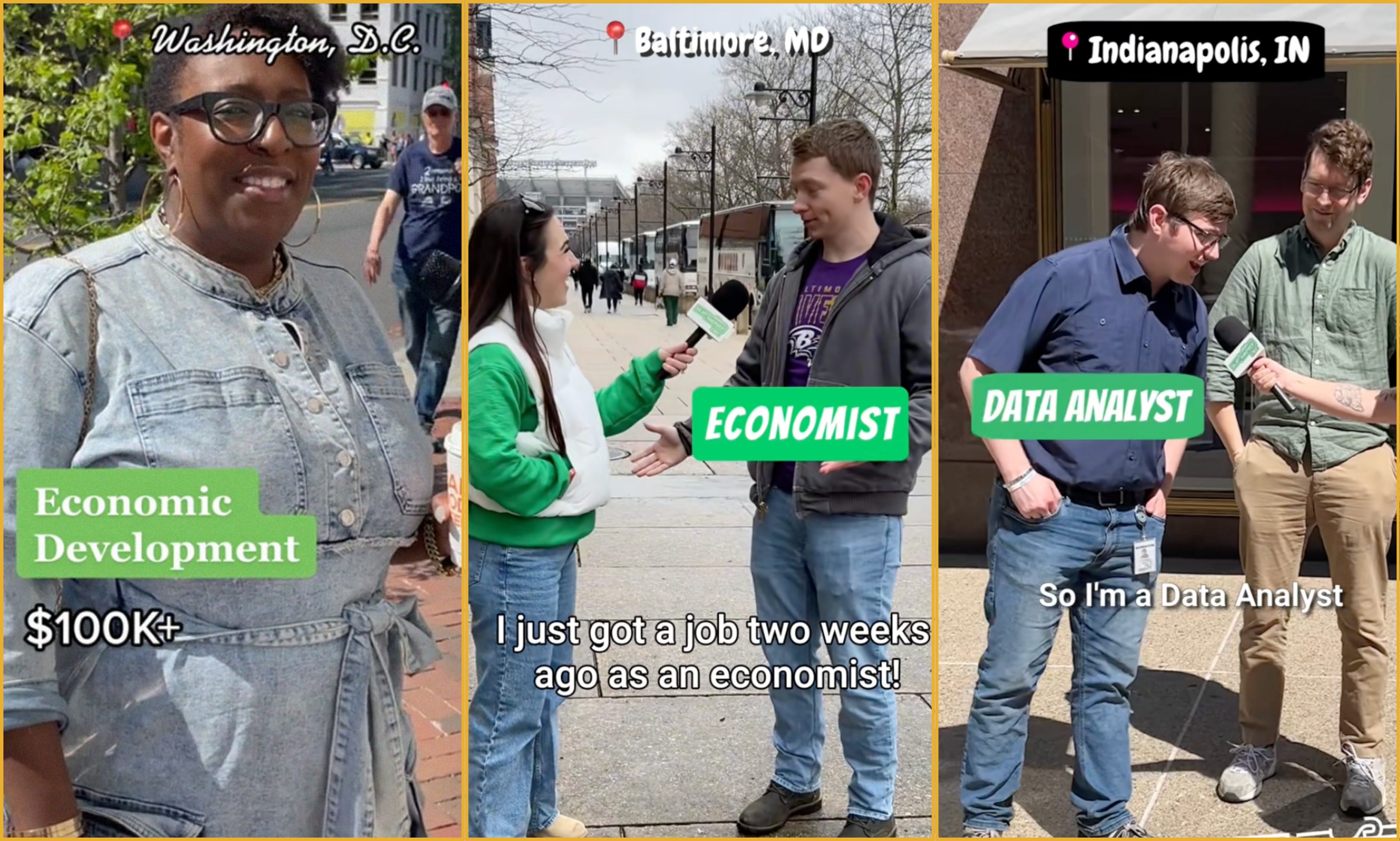
Williams is the creator of Salary Transparent Street, a social media project built on a simple premise: ask people what they do for a living, how long they’ve been in that role, and what they earn.
The interviews are short and unscripted. Just a person, their job, and a number.
Since launching the project, she has collected thousands of these conversations. The range of occupations is wide: entry-level service workers, mid-career engineers, nonprofit employees, freelancers, and government contractors. Each one adds a data point to a picture that most workers have never been able to see clearly.
Her videos have reached billions of views across social media. But people aren’t just watching because it’s entertaining. They’re watching because they want to know if they’re being paid what they’re worth.
If you haven’t come across her work yet, it’s worth checking out. Hannah and her partner have made a complex topic feel relatable and actionable for anyone trying to better understand their place in the job market.
The Employer’s Advantage
We want you to pause for a moment and think back to the last time you interviewed for a job. At some point, someone likely asked you what salary you were looking for. You probably had to make your best guess.
You may have looked some data up beforehand, or maybe a friend in the industry gave you a ballpark figure. It’s also completely possible that you just picked a number that felt reasonable and hoped for the best.
The person across the table already knew the answer. Employers typically know the approved range for the role, what current employees are earning, and what previous candidates accepted. You walked in with bits and pieces. They walked in with a spreadsheet.
Economists have a name for this kind of imbalance: information asymmetry. It’s what happens when one side of a transaction knows significantly more than the other. The classic example is used cars. Sellers know the car’s history, but buyers are guessing based on looks. That gap makes it hard to land on a fair price. The same dynamic plays out every time someone negotiates a salary.
When workers don’t know the market rate for a job, employers can end up paying different people different wages for the same work. Economists call this wage dispersion, and it tends to stick around precisely because the information gap does too.
From a firm’s perspective, keeping salaries private makes a lot of sense. It preserves flexibility and keeps labor costs lower than they might otherwise be. From a worker’s perspective, it makes the job market feel like a game where the other side has seen the answer key.
Why Changing Jobs is Harder Than it Looks
There’s another layer here that doesn’t get talked about enough: search costs. These refer to the time, effort, and resources it takes to find the right match in a market. In labor markets, those costs include updating a resume, researching companies, tailoring applications, scheduling interviews, and negotiating offers. The highest cost of all, though, might be uncertainty.
If you don’t know what a role typically pays, you may make a poor estimate of whether it’s even worth applying. Is this company known for underpaying? Would this move represent a step forward in earnings, or a lateral one? Without transparent salary data, those questions are hard to answer.
Transparency reduces that friction. When pay information is accessible, workers can compare opportunities more efficiently. They can identify which industries, companies, or cities offer better compensation. They can spot when a role is offering below-market wages and decide accordingly. The job search becomes less of a shot in the dark.
Transparency also helps workers evaluate compensating differentials. Some jobs pay more because they are genuinely demanding. They may include long hours, physical risk, or high stress. Others pay less because they offer real advantages, like remote flexibility, strong benefits, or meaningful work. Neither of those tradeoffs is obvious without wage data. When workers share their salary alongside details about their job, those tradeoffs become visible.
Final Thoughts
Salary transparency has become a policy question as well as a cultural one. Several states now require employers to post salary ranges in job listings. The intent is good: give workers better information before they apply. But in practice, the results are uneven. Some employers post ranges so wide that they technically comply without telling applicants much. The rule exists, but the useful information still does not.
That’s why the worker-driven transparency Hannah has built through Salary Transparent Street may matter more than any single policy. Instead of waiting for employers to provide information, workers are sharing it themselves.
Labor markets work best when both sides understand the prices involved. When workers know what jobs actually pay, they can negotiate better, choose more wisely, and change jobs without flying blind. That makes the market itself function better.
The next time someone asks what you make, consider answering honestly. The information only has power when people share it.
If this made you think more carefully about salaries in your own job, consider sending it to a friend. While you’re at it, you can follow Salary Transparent Street on your favorite social media platform: Facebook, Instagram, LinkedIn, TikTok, and YouTube.
A Glassdoor poll found that 66% of female professionals do not believe they’re being paid fairly for the work they do, compared to 59% of male professionals [Glassdoor]
Even the highest-income households derived 62% of their income from wages [Federal Reserve Bank of St. Louis]
As of January 2026, approximately 42.7% of U.S. adults believe they are paid fairly for the work they do [YouGov]
70% of organizations that list pay ranges on job postings say that doing so has led to more people applying to their postings [Society for Human Resource Managers]
I always found this paper to be interesting: https://doi.org/10.3982/ECTA19788 (youtube explainer: https://youtu.be/CO4Ek-3STxQ?si=m7Ce2Hn3B0gWNIvg).
“transparency laws empirically lead wages to decline by approximately 2%”
There is a inherent sysem of asymmetrical information in the hiring process. It is not the same for both employers and seekers. Employers off the back can request far more information from seekers just from the postion of decision making. While seekers are often blocked by differeing excuses that may block them from the information they seek. I think salary transparency can help dramatically. I also think we should normalize having final candidates interview with the team they will be working on with no managers present. That is something we started at my last company and i am doing everything in my power to spread it.