


You’re reading Monday Morning Economist, a free weekly newsletter that explores the economics behind pop culture and current events. Each issue reaches thousands of readers who want to understand the world a little differently. You can support the newsletter by sharing it or by becoming a paid subscriber to help it grow:
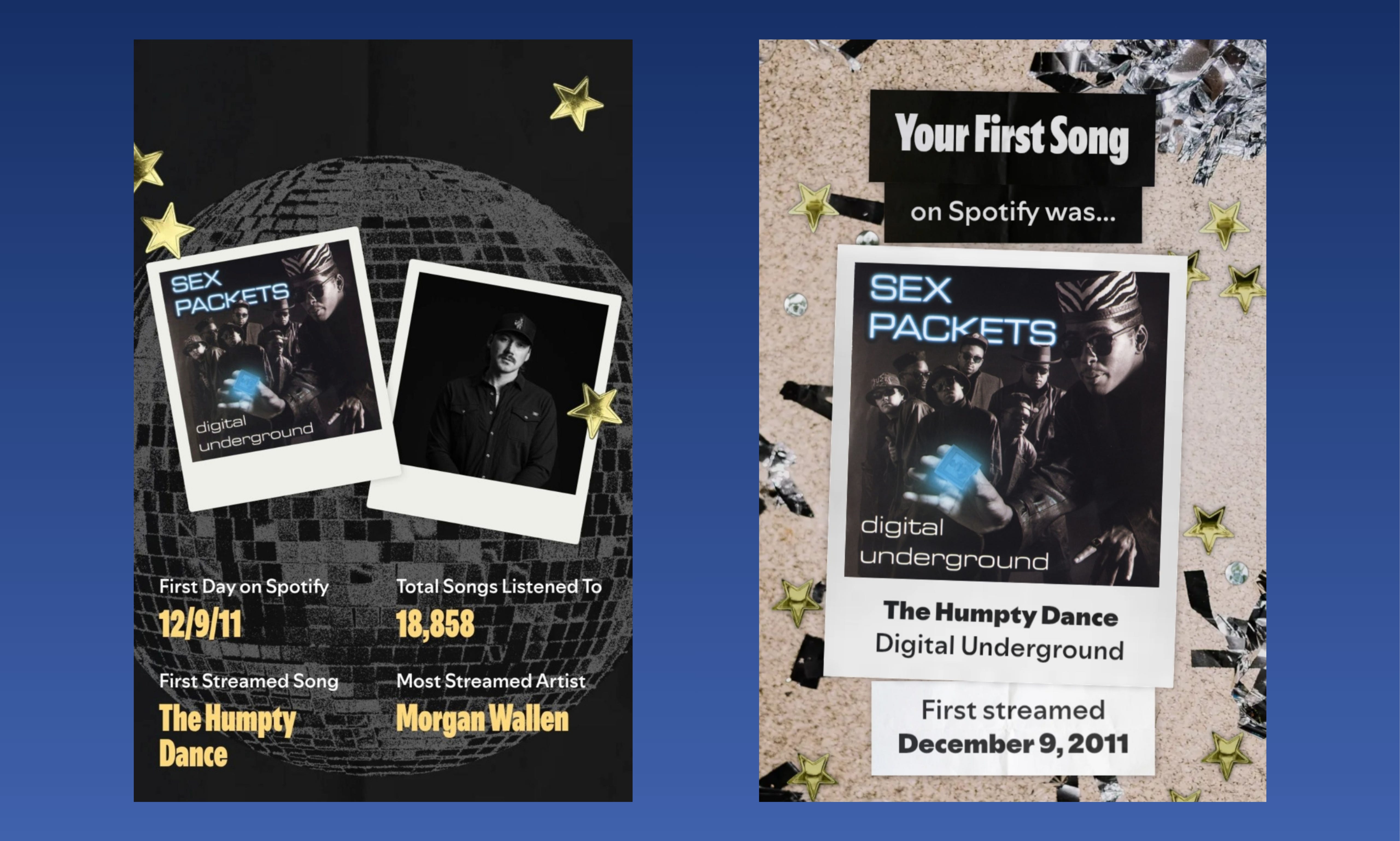
Last week, Spotify gave every user a gift to celebrate its twentieth anniversary: a timeline of their entire listening history. Your first song. Your most-played artist. A playlist of your all-time top 120 songs, complete with play counts. If you use Apple Music, YouTube Music, or another platform, you’ve probably seen your own version of this with recaps and personalized playlists. But Spotify went all the way back to day one.
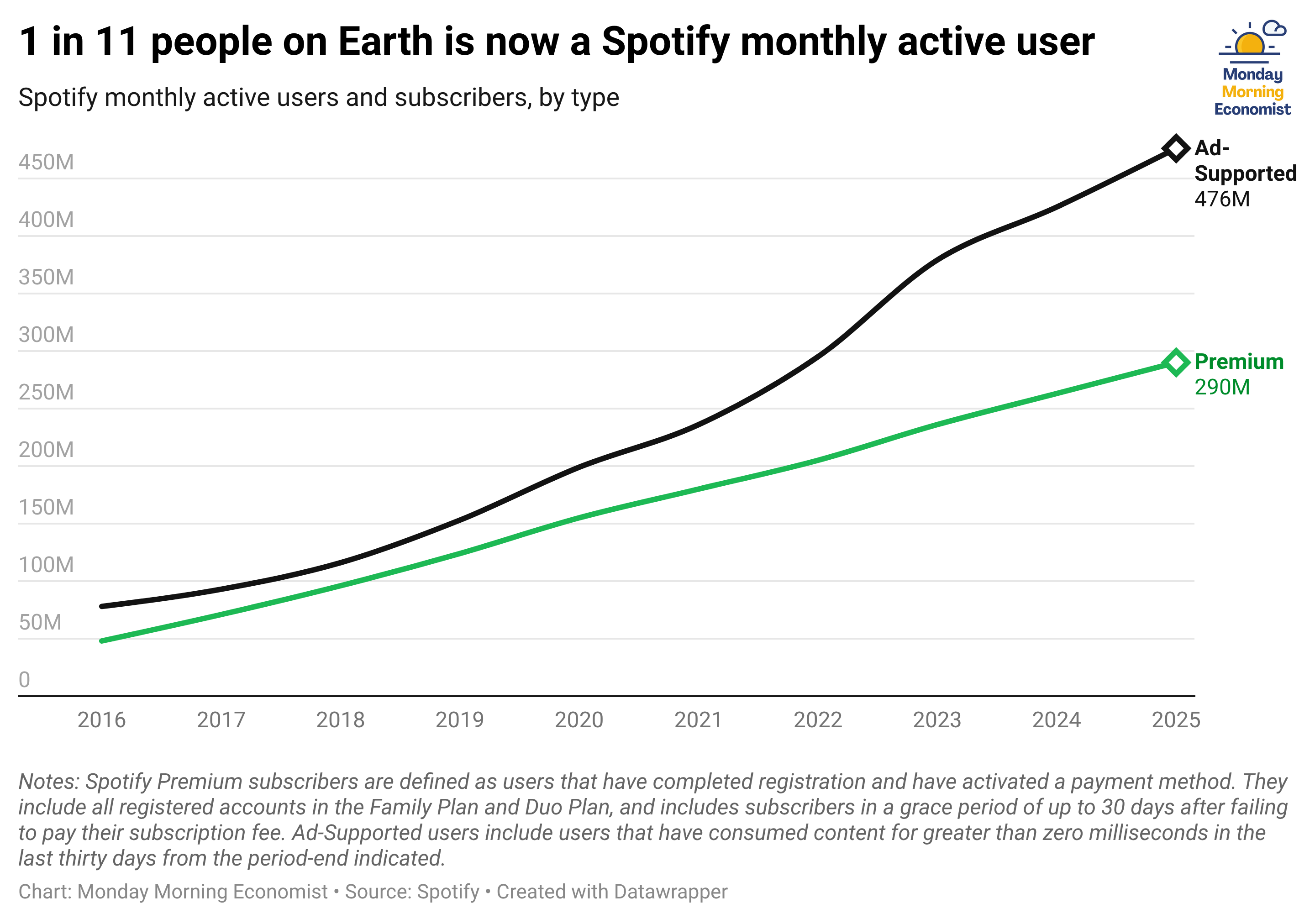
Nearly one out of every eleven people on Earth actively uses Spotify, so there’s a good chance you’ve got a special playlist waiting. Go ahead, open yours up. Check out the first song you ever streamed. Was it really cool or deeply embarrassing? Drop yours in the comments so we can all see what you got.
Now sit with that feeling for a second. That little tug of recognition, the flash of who you were when you hit play for the first time. Whether Spotify intended it or not, it’s a perfect demonstration of why you’re probably never going to cancel your subscription.
Welcome to switching costs. Before we get too deep, here’s the first song I ever streamed when I joined Spotify back in December 2011. Enjoy!
You’re Free to Go
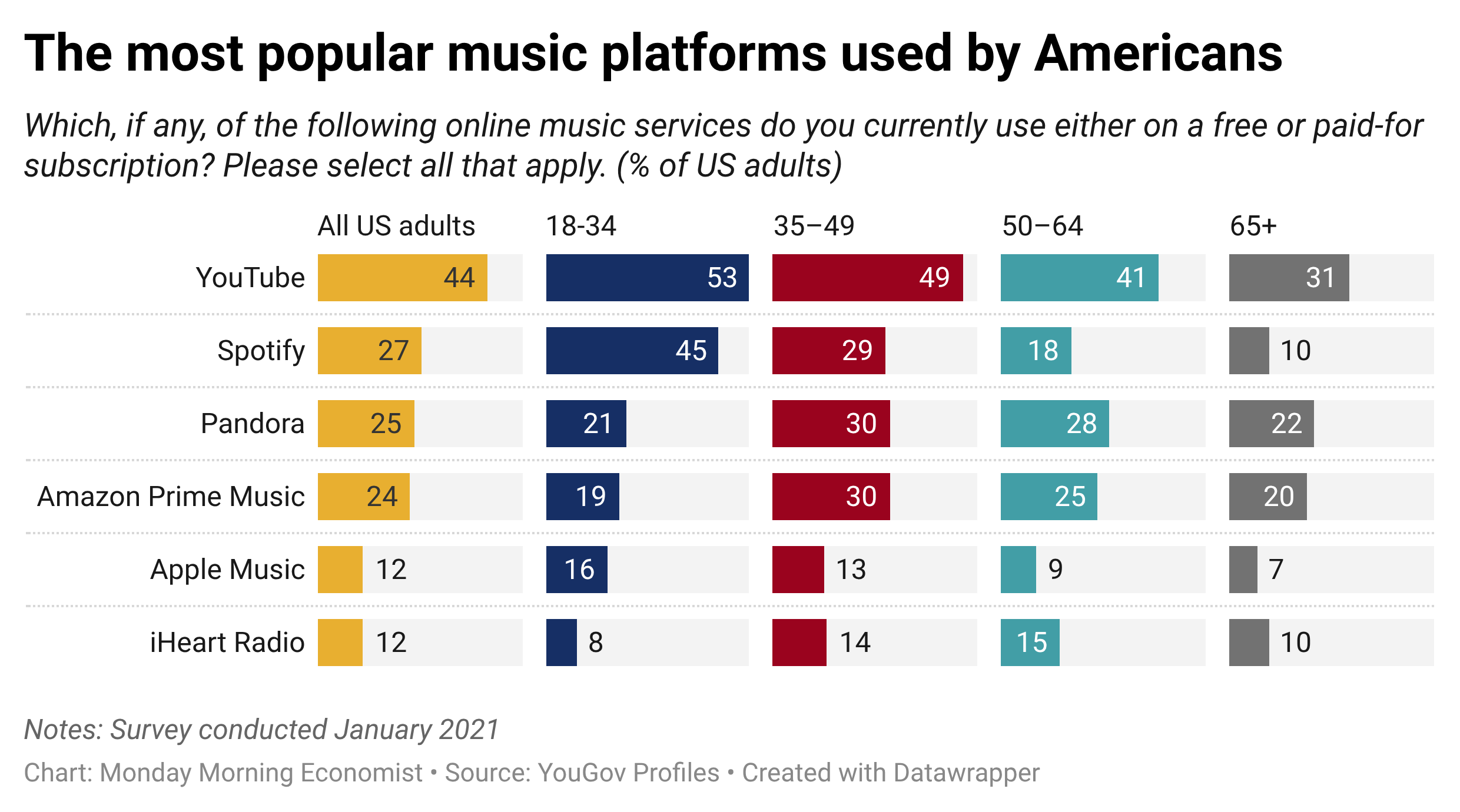
Here’s the thing about Spotify: you can leave whenever you want. There’s no cancellation fee, no early termination penalty, and no contract locking you in for two years. Apple Music, YouTube Music, Tidal, and Amazon Music are all right there, offering roughly the same catalog of over 100 million songs. On paper, switching should be the easiest thing in the world.
So why haven’t you?
Start by thinking about the research alone. Each platform has its own mix of features, and you probably don’t know which ones match what you actually use. Maybe you rely on Spotify’s AI DJ to queue up music while you cook. Maybe New Music Friday is the only reason you hear anything new. Maybe you’ve organized your entire library around Spotify’s playlist folders. Does Apple Music have an equivalent for all of that? Does YouTube Music? You’d have to investigate each one just to figure out where to go.
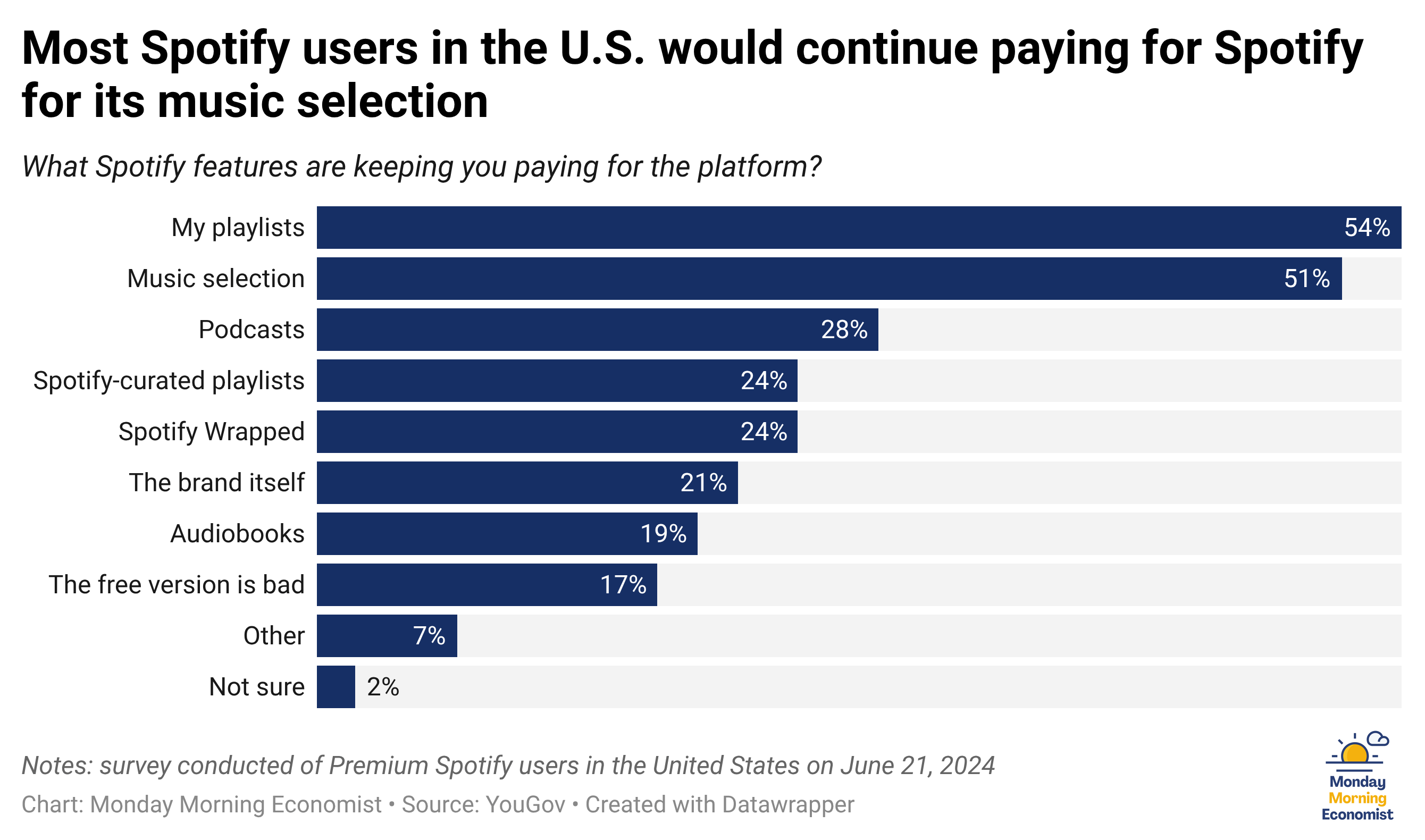
Then there’s the rebuild. You’ve got playlists you made for road trips, for studying, for getting pumped right before you hop on the treadmill. Some tools will transfer those track lists over, but they can’t transfer the hundreds of weeks you spent training Discover Weekly to learn whether you’re in a folk-punk phase or a hyperpop phase. Every skip, every replay, every guilty-pleasure listen at 1 a.m. was data. Thousands of tiny decisions, made over years, taught Spotify’s algorithm what you like before you even know you like it. On a new platform, that education starts over from scratch.
And then there’s everything you don’t think about until you’re mid-switch. Spotify is probably connected to your phone, your car, your smart speaker, your running tracker, and maybe even your TV. Each one is another thing to disconnect, reconfigure, and hope works the same way on the new service.
The Price You Don’t See on Your Statement
What you just read about has a name. Economists call it a switching cost, and it’s a measure of the money, time, effort, or frustration of moving from one product to another. It’s one of the oldest concepts in competitive strategy, and you’ve almost certainly encountered the financial version before.
Try closing a bank account sometime: you’ll spend an afternoon updating every autopay, rerouting direct deposits, and ordering new checks if you’re the kind of person who still writes checks. Gyms are notorious for making you come in to cancel, which they know is tough for you to do because you’re probably canceling precisely because you don’t come in. Phone carriers used to charge early termination fees of $300 or more, specifically to make leaving painful.
Spotify won’t charge you a termination fee to leave, but it will still cost you to switch services. That cost is in your data, your history, and the sense that it could take months to train the new algorithm. The financial kind of switching cost makes you angry. This kind makes you loyal.
And Spotify isn’t alone. Think about your Google account, your iCloud storage, your Instagram archive, or your notes app. Anywhere you’ve spent years feeding a system your preferences and your decisions, you’ve been quietly building up a switching cost without realizing it.
Final Thoughts
Here’s a final question worth sitting with for the rest of the day: did Spotify design it this way intentionally?
Spotify didn’t invent playlists to trap you. Discover Weekly exists because personalized recommendations are a genuinely better product. Wrapped exists because people love looking back at their year. These features make Spotify good, but they also, conveniently, make Spotify very hard to leave.
Good product design and strategic lock-in are often the same thing.
This is how platforms quietly accumulate power. Not through contracts or penalties, but by becoming the place where your data lives, where your preferences are understood, where starting over feels like a loss. No one forced you to build 47 playlists, and no one penalizes you for leaving. But every playlist, every thumbs-up, every hour of listening raised the costs a little higher.
There is a fine line between a product that’s hard to leave because it’s good and one that’s hard to leave because the company made it that way on purpose. That’s essentially what the Department of Justice argued when it sued Apple in 2024, alleging the company deliberately built its ecosystem to lock consumers in and make switching to a competitor prohibitively difficult. Spotify isn’t facing that kind of scrutiny, but the underlying economics are the same. The question is always whether the wall exists because the product is great or because someone designed it to keep you inside.
So pull up that first song one more time. When you looked it up earlier, it was just a fun trip down memory lane. Now you know what else it is. It’s a reminder of how much of yourself is woven into this platform and how much it would cost to start over somewhere else.
So, how long have you been listening? And why haven’t you switched?
If this made you look at your Spotify account a little differently, share it with a friend who needs to see their own switching costs in action. And if someone sent this to you, be sure to subscribe. We break down the economics hiding in everyday life, one story at a time.
When faced with another price hike, 61% of paid Spotify users say they’d keep their subscription, but only 4% say they’d definitely cancel [YouGov]
Since its launch, Spotify users have streamed over 1.2 trillion hours of audio [Spotify Newsroom]
Spotify’s all-time most-streamed artist is Taylor Swift, most-streamed album is Bad Bunny’s Un Verano Sin Ti, and most-streamed song is The Weeknd’s “Blinding Lights” [Variety]
The average American makes 47 payments per month, including 31 by card, 6 in cash, and 1 by check [Federal Reserve]
In March 2024, the DOJ and 16 state attorneys general sued Apple for allegedly monopolizing smartphone markets by locking consumers into its ecosystem [Department of Justice]
My first song was Break on Through by The Doors. I was living in Paris in 2011 and loved listening to the musical ghosts of Paris while I walked everywhere.
I'm on the cusp of leaving Spotify. It is sheer laziness that I haven't yet, and yes, nostalgia. It's not just the low royalty payout, but also the ethics behind the CEO and promotion of AI music. There's a service called Tune My Music that'll map over your favorite artists and playlists to Tidal. I'll go straight to NPR or Crooked Media for my podcasts and to the library for audiobooks. But my whole job is getting people to switch, so maybe I'm less averse than most? :)
Seeing this makes me miss the physical medium days. Owning tangibles really made a difference