


You’re reading Monday Morning Economist, a free weekly newsletter that explores the economics behind pop culture and current events. Each issue reaches thousands of readers who want to understand the world a little differently. If you enjoy this post, you can support the newsletter by sharing it or by becoming a paid subscriber to help it grow:
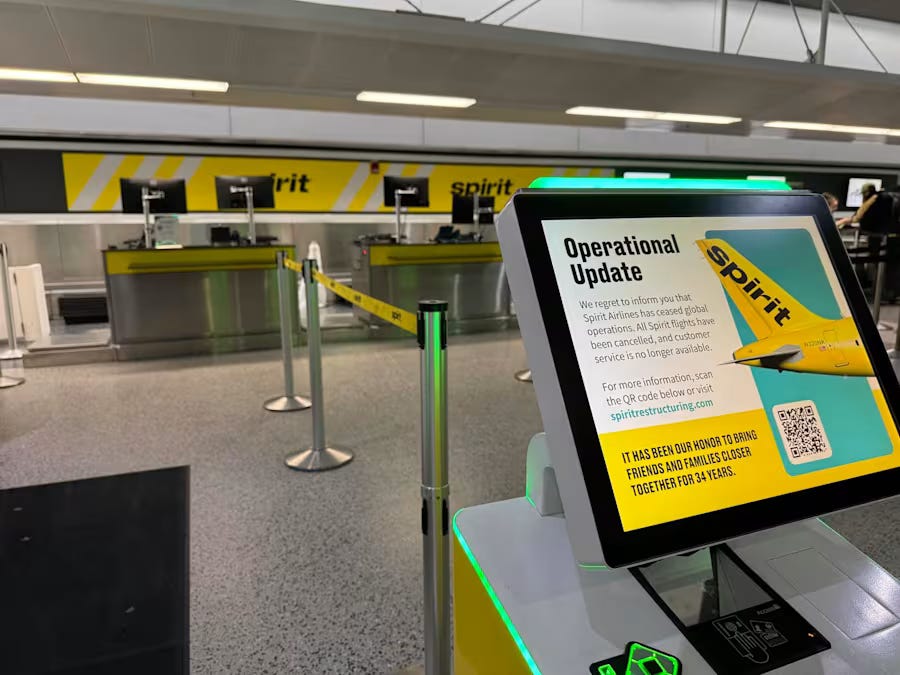
Angela Moreno had a wedding to get to. She’d booked her Spirit Airlines flight from Fort Lauderdale to Nashville months ago. Gas was cheaper, the Middle East was quieter, and Spirit’s bright yellow planes were still a reliable way to get somewhere on a budget.
She woke up Saturday morning, started packing, and checked her phone. Her flight didn’t exist anymore. Neither did the airline.
Spirit Airlines officially ceased operations in the early hours of May 2, 2026. There was no farewell tour nor countdown clock. Just a website update, a notification to stranded passengers, and empty check-in counters across the country. It was the largest U.S. airline failure in 25 years.
The failure itself wasn’t a surprise. The airline had been losing money for six straight years, surviving on fumes and restructuring deals while the rest of the industry moved on. What surprised the thousands of passengers left stranded was how suddenly it ended.
As it turns out, that part makes perfect economic sense, too.
A Business Model That Was Already Limping
Spirit wasn’t an innocent victim, exactly. It had filed for bankruptcy twice over the past few years. Its ultra-low-cost model was built around bare-bones fares and fees for everything else, and it has struggled to find its footing after the pandemic.
But “struggling” and “should shut down” are two different things in economics, and that distinction is the whole point of this story.
Imagine you’re in charge of Spirit Airlines. Your company is losing money. Your first instinct may be to shut it down and stop the bleeding. But before you do, your CFO asks you a crucial question: what happens to our costs if we stop flying?
Some costs disappear immediately. Fuel, crew wages, and airport landing fees only exist when planes are in the air. Stop flying, and you stop paying them. These are known as variable costs.
But other costs don’t depend on whether your planes are flying or not. Most commercial airlines, including Spirit, lease their fleet. That means monthly payments were due whether a single seat was sold or not. Debt payments, maintenance contracts, and administrative overhead keep coming in even if the planes are parked in a hangar. These are categorized as fixed costs, and grounding flights doesn’t make them disappear.
So here’s the calculation your CFO is really asking you to make: are we collecting enough money per ticket to at least cover what it costs to operate each flight? If the answer is yes, you keep flying. Grounding the fleet saves you nothing on fixed costs while guaranteeing you collect zero revenue. It’s better to lose a little than to lose everything.
Economists call this the shutdown rule: only stop producing when the price you’re receiving falls below your average variable cost. Until that moment, you keep the planes in the air.
For years, that’s exactly what Spirit did. Losing money on paper, but covering the cost of actually flying each plane. So the planes kept flying. That was until one of the most important variable costs in the airline business stopped behaving the way anyone expected.
Then Came February 28th
On February 28, 2026, U.S. and Israeli forces struck Iran. Within days, traffic through the Strait of Hormuz was severely disrupted, choking off roughly 20% of the world’s oil supply. Jet fuel prices had been stable around $2.30 per gallon, but then started climbing.
By the end of April, jet fuel cost $4.51 a gallon.
That change was devastating for the airline industry, but it hit Spirit particularly hard. Spirit had already sold millions of tickets for passengers heading off for spring break trips, summer weddings, or work conferences at jet fuel prices hovering around $2.30 a gallon. Passengers had already paid. Spirit couldn’t go back and charge them more.
But the cost of actually flying those passengers had just doubled.
That’s the critical sequence that explains Spirit’s overnight shutdown. The airfare was set back when jet fuel prices were stable. Then the cost of fulfilling that obligation exploded. Spirit wasn’t dealing with falling ticket prices like back in 2020. Demand has been fine. The problem was that their average variable cost had risen above the price passengers had already paid. Every flight they operated was now losing money as soon as they got the plane off the ground.
The shutdown rule had kept Spirit flying through years of losses, but it now pointed in the other direction. As long as the average variable cost stays below the price, you keep flying. The moment it crosses above, you stop.
For Spirit, that moment had arrived.
Final Thoughts
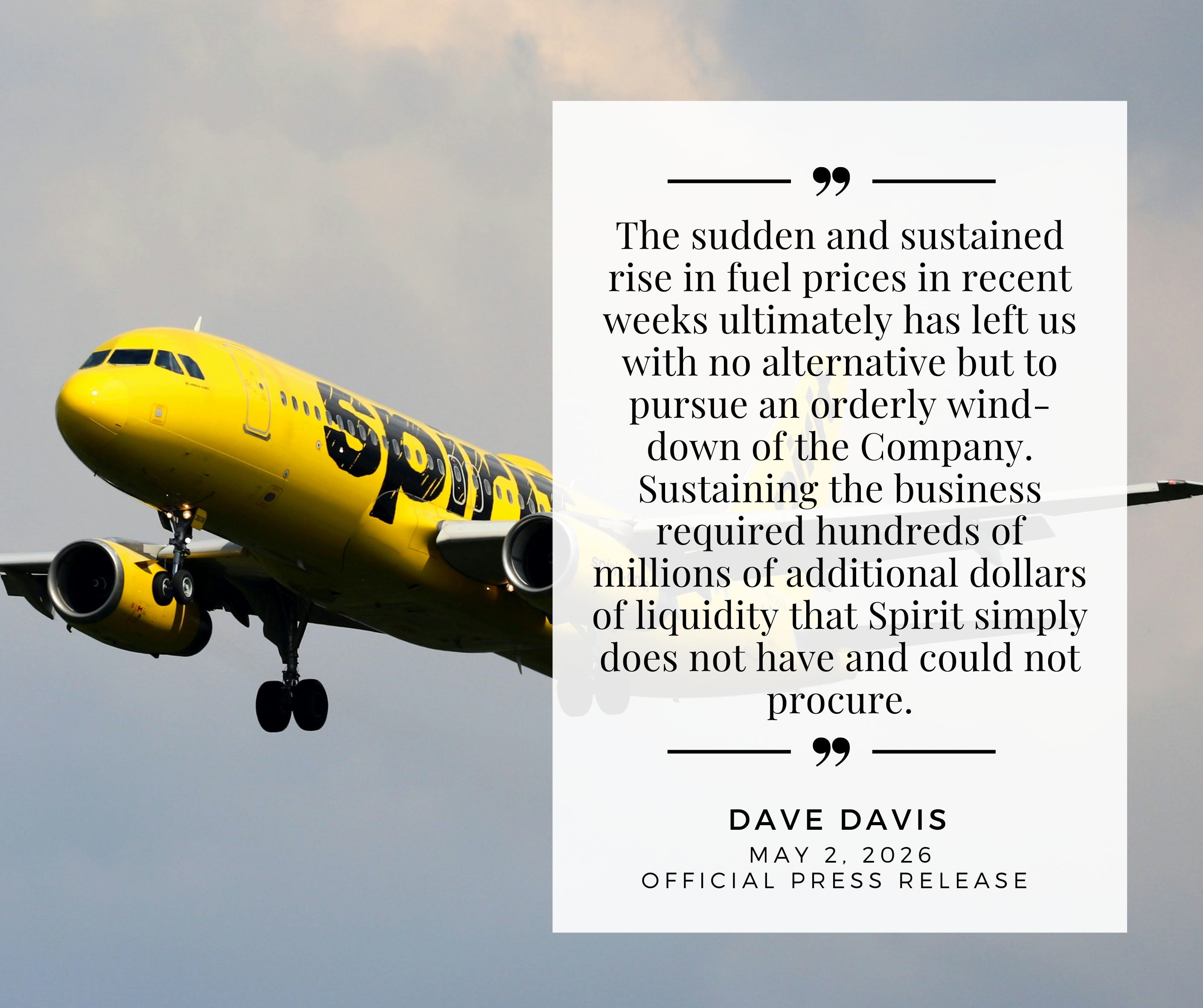
Before the planes were fully grounded, Spirit tried to avoid it. The airline went to Washington looking for a lifeline, and the Trump administration floated a $500 million rescue package. But Republican and Democratic lawmakers questioned whether a single airline bailout was a good use of public money, a key group of creditors balked, and by Friday night the deal was dead.
That left Spirit with one final decision: how to exit. The 3 AM announcement with no warning looks cruel from the outside, but it reflects a classic problem of asymmetric information. Spirit knew exactly how bad things were, but its customers had no idea how close to the edge it really was. Had Spirit announced an end date a few weeks out, revenue likely would have collapsed immediately while they were still losing money on each flight during that time. Keeping that information internal until the last possible moment was the only profitable move left.
By Saturday afternoon, the market had already started filling the void. JetBlue announced it would significantly expand service from Fort Lauderdale, one of Spirit’s key hubs. American and Frontier began adding capacity on Spirit’s former routes. This is what Joseph Schumpeter called creative destruction. Markets don’t mourn exits; they respond to them. The gates, the routes, and the pilots and flight attendants suddenly out of work are now raw material for whatever comes next.
So far, Spirit’s collapse is the only major U.S. airline casualty of the Iran war’s fuel shock. But airlines around the world are facing the same problem. Each of them is checking whether what passengers are paying still covers the cost of getting the plane off the ground. The day it can’t will be the day their planes stop flying, too.
Markets reward good information, and so does this newsletter. If someone in your life would have benefited from reading this before their Spirit flight was canceled, send it their way.

Spirit ranked as the eighth-largest US airline in 2025 by the number of seats offered [CNN]
A typical aircraft lease period will be from 6-10 years for a new single-aisle narrowbody aircraft and up to 12 years for a new, twin-aisle widebody aircraft [flightradar24]
The Strait of Hormuz is a narrow waterway that carries roughly 20% of the world’s oil supply [US Energy Information Agency]
A commercial jet typically burns between 750 and 4,600 gallons (2,800–17,400 liters) of fuel per hour, depending on the aircraft size [How Stuff Works]
The Trump administration offered a $500 million loan that could have given the government up to a 90% stake in Spirit [CNBC]
Some experts are projecting a 15–23% rise in ticket prices on routes Spirit formerly served [CBS News]
I’m currently a student in an economics class, and I was struggling to fully understand this because I thought so many people flocked to the low cost airline model. This article explained it really well. Great job, and thank you!
The asymmetric information argument here is the cleanest version of the shutdown logic I've seen. The piece worth pairing with it is the operational layer underneath. The reason Spirit's leadership couldn't announce ahead is that even an internal warning leaks within minutes, and the moment the leak hits credit-card processors, they demand cash collateral against future refunds. That collateral comes out of the same operating account that pays fuel suppliers. The honest email doesn't predict the death — it causes it, faster and messier than any controlled exit.
The shutdown rule explains why the math forced an exit. The leak dynamic explains why the exit had to happen at 3 AM with no warning. Both true. Different layers of the same system. The bankruptcy bar has a name for the choreography: "orderly process." The order is for the creditors. The process is for everyone else.