


You’re reading Monday Morning Economist, a free weekly newsletter that explores the economics behind pop culture and current events. Each issue reaches thousands of readers who want to understand the world a little differently. If you enjoy this post, you can support the newsletter by sharing it or by becoming a paid subscriber to help it grow:
You know the feeling. You pick up your phone to check one thing, and forty-five minutes later, you’re still doomscrolling through Instagram, watching videos of people you’ve never met. Now imagine a friend calls you out on it. They challenge you to set a timer of thirty minutes a day, max. That’s it.
What would you do with all that extra time?
Most people would probably say they’d just switch to a different social media app. More TikTok. More Snapchat. Social media competes with social media, right?
But a group of researchers recently ran an experiment that may suggest otherwise. They paid thousands of people real money to stop using Facebook and Instagram, then tracked exactly where all that freed-up time went using phone tracking data.
It didn’t go to other social networks. It went to gaming apps. To YouTube. And in a result that feels almost quaint, some of it went outside.
Gary Becker’s Theory of Time
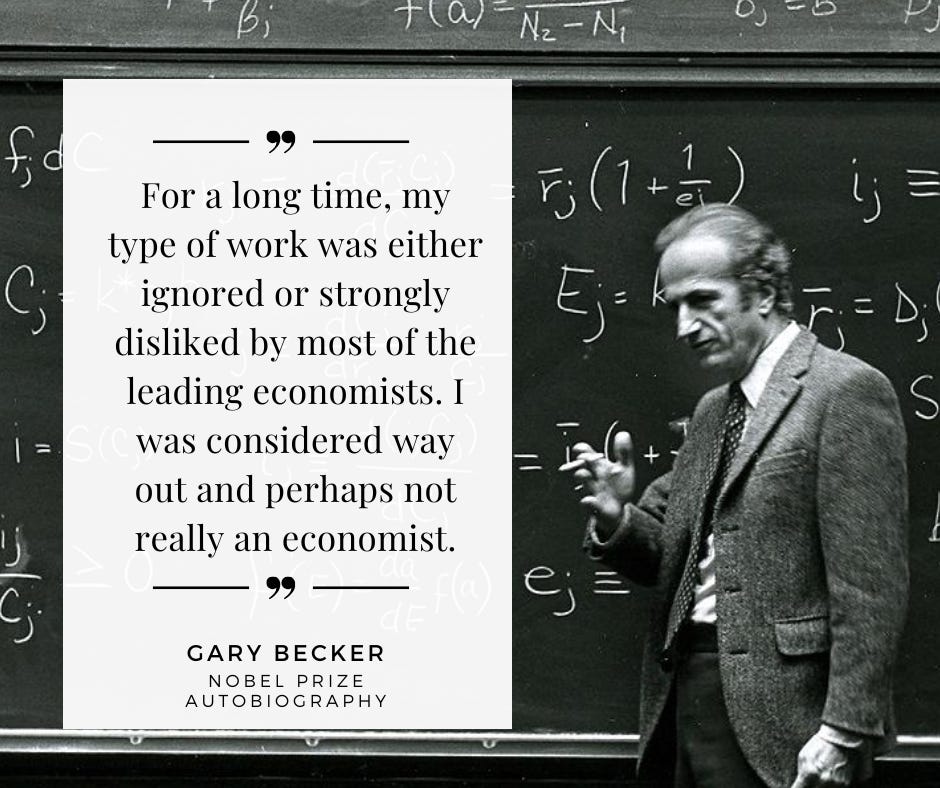
Before we talk about their study, you first have to meet Gary Becker. He was a University of Chicago economist who won the Nobel Prize in 1992, and he had a habit that drove some of his colleagues a little crazy. He applied the economic way of thinking to things economists weren’t used to thinking about. We’re talking about topics like crime, marriage, addiction, and discrimination. He treated human behavior like a set of optimization problems.
He published a paper in 1965 that sounds obvious in hindsight but was actually kind of radical for economists at the time. He argued that money isn’t the only scarce resource people have to allocate. Time is too. And people trade off how they spend their hours the same way they trade off how they spend their dollars.
After all, we’ve all got 24 hours each day. Some of those hours go to work. Some go to sleep. The rest gets divided across everything else you want to do with your day. But when two activities compete for the same block of time, they become substitutes. Even if they don’t always look alike.
A Field Experiment on Social Media
The researchers behind the experiment were, in a sense, updating Becker for the modern era. They wanted to know: in the attention economy, who’s actually competing with whom?
The setup was straightforward. Participants were paid to reduce their time on Facebook or Instagram. They were paid a dollar for every quarter-hour reduction in average daily screen time, benchmarked against their past month of usage, and capped at $125 a week. A control group received payments between $15 and $25 each week just for sharing their usage data. Then the researchers watched where all that free time went.
Let me pause here and note that the team included researchers from the University of Chicago, the University of Michigan, UC San Diego, and an economic consulting firm that had done consulting work on behalf of Meta in active antitrust litigation. They disclose it in the paper, but I want to make sure you know it too.
What they found is hard to dismiss. When participants cut back on Facebook, only about 6% of that new free time went toward other personal social networks. For those in the Instagram group, about 16% shifted to other personal social networks. The rest scattered to other apps on their phone, and in some cases, some of them went offline entirely.
Substitutes Don’t Have to Look Alike
Economists have a word for products that people swap in and out for each other: substitutes. The classic examples tend to look a lot alike. Think Coke and Pepsi, butter and margarine, or Lyft and Uber.
But Becker’s framework pushes us to think broader. Since time is also a scarce resource, substitutes don’t have to look alike at all. The results from the experiment make that case clearly:
Browsers. Texting. Games. When Facebook or Instagram disappeared from someone’s daily routine, that’s where the hours went. For the Instagram group specifically, YouTube was the single biggest beneficiary.
Think about what that means. Instagram and YouTube don’t look like competitors. One is photos and short videos from people you know in real life. The other is long videos from creators you’ve probably never met. Different formats, different content, an entirely different feel. And yet they’re fishing in the same pond for you and your attention.
Most of these apps are free. You don’t hand over a credit card to open Instagram. YouTube doesn’t bill you by the hour. But free doesn’t mean costless. The price is just paid in a different currency: the minutes and hours of your day that you can’t get back.
Final Thoughts
This research matters for at least two reasons, and both of them are ending up in court.
The first is about competition. When regulators evaluate whether companies compete with each other, they typically want to know how similar their products are. That determination shapes everything from merger approvals to antitrust cases. The central fight in cases involving social media is over how broadly to draw the market. Is Facebook competing mainly with Instagram and Snapchat? Or is it competing with anything that wants a slice of your attention? The experiment suggests the second view is closer to the truth.
The second reason follows naturally from the first. If the competition for your time extends far beyond social media, that raises an uncomfortable question: what exactly are these companies doing to make sure you stay on their platform instead of wandering off to YouTube or a game or a walk outside? A Los Angeles jury recently answered that question harshly, finding Meta and Google liable for a teenager’s mental distress and ruling that the companies had willfully made their products addictive while knowing the harm they could cause. It was one of the first verdicts in a wave of hundreds of similar suits from schools, attorneys general, and families. Both companies said they disagreed with the verdict and plan to appeal.
The antitrust cases and the addiction cases look different on the surface. But they’re really asking the same question. In a world where everything competes for your time, how far will these companies go to win? The courts are now starting to also ask who’s responsible when those companies go too far.
You could send this to a friend. Or you could open Instagram. Your call.
About 7-in-10 U.S. teens say they visit YouTube every day, while 57% say they visit TikTok daily [Pew Research Center]
About half of U.S. adults say they visit Facebook and YouTube at least once a day [Pew Research Center]
Gary Becker received the United States Presidential Medal of Freedom in 2007 [The Chicago Maroon]
Meta (formerly Facebook) generated a total revenue of approximately $201 billion in 2025 [Investopedia]
A California jury found that Meta and Google were to blame for the depression and anxiety of a woman who compulsively used social media as a small child, and concluded that they pay her $3 million in compensatory damages and an additional $3 million in punitive damages [NPR]
Very interesting article although YouTube also developed the “reel function” which mirrors more or less what we all see on Facebook and instagram. Probably an interesting question would be what was the average time the user had on each single video to check whether he was just “simulating” the instagram environment or if he rather switched behavior completely.
Why is Substack not an option? I left Meta and most of that time goes to Substack now. And reading books.