


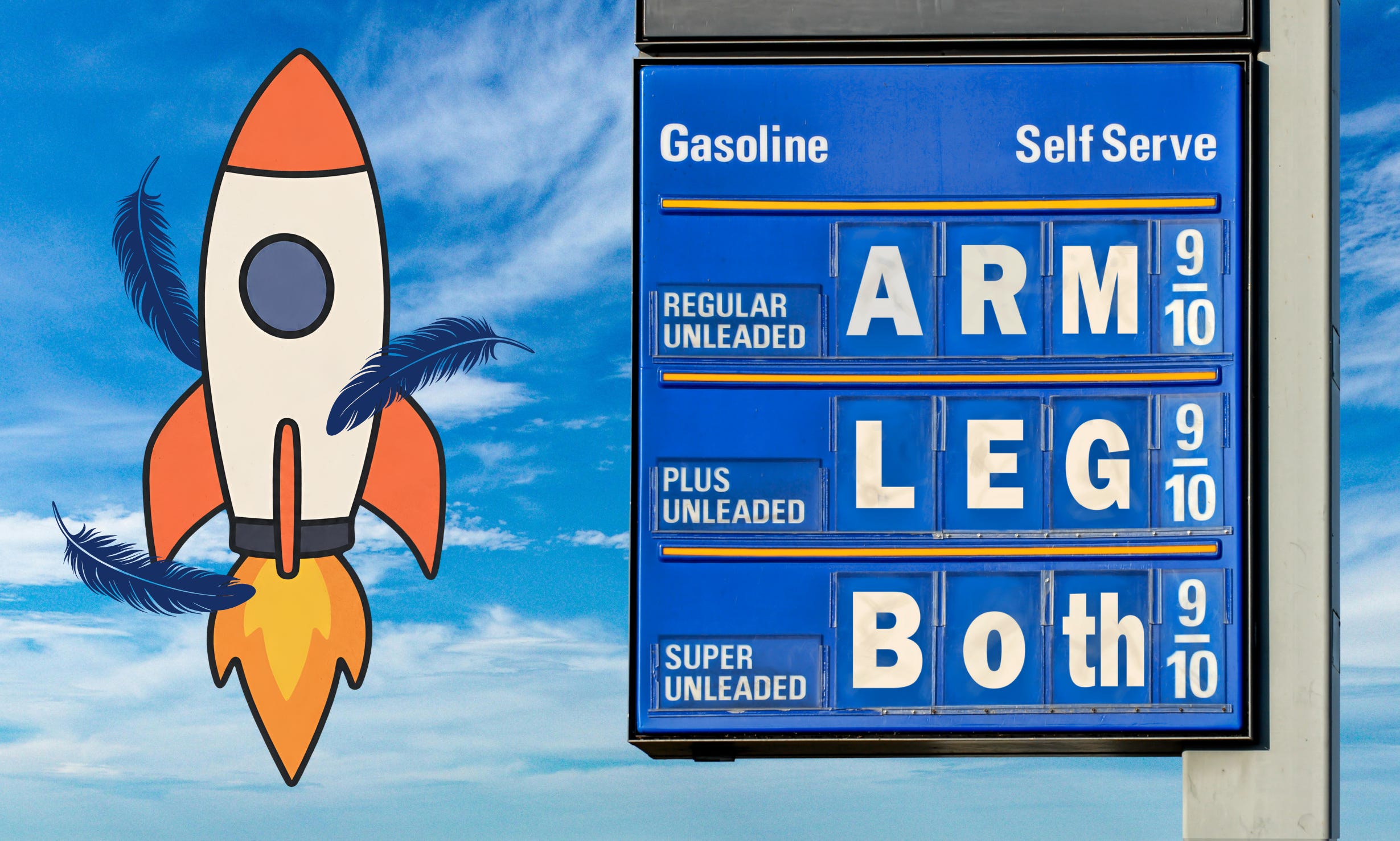
If you’ve got a long commute to school or work, the past few months have been a real challenge. Fuel prices have surged globally, while actual rockets continue to fly over the Middle East. Just last week, a drone strike hit Saudi Arabia’s East-West oil pipeline, the backup route the kingdom had been using since the Strait of Hormuz got tangled up in the ongoing U.S.-Iran war. Brent crude rocketed above $100 a barrel, and diesel hit a record $6 a gallon in the United States.
Politicians want us to “hang in there,” but no one can say for sure whether the pain at the pump will last a few more weeks or several more months. It’s a familiar story any time there’s a conflict in the Middle East: prices shoot up fast, but then take their sweet time coming back down. That lopsidedness response isn’t random. It also isn’t new. There’s a technical name for this phenomenon, but its nickname is a whole lot more memorable.
From a Saudi Pipeline to Main Street
You may not think the price of diesel matters if you aren’t filling up your tank, but you should still care that it’s hit a record high. Diesel powers almost everything we own before we own it. It fuels the farm equipment harvesting the food you’ll put on your table in a few weeks, as well as the semi-trailer trucks that get it to the store alongside everything else in your cart at Walmart and Target. When diesel gets more expensive, those costs will eventually show up in the price of everything else you do purchase.
But the fuel we’re buying to fill up our tanks gets more expensive long before the oil even arrives at the refinery to be processed and shipped out to your neighborhood fueling station. So how does a pipeline explosion 7,000 miles away increase the price we pay at our hometown pump within a few days?
The United States is the world’s largest oil producer, accounting for nearly 22% of global output. Saudi Arabia comes in second, drilling nearly 11%. But oil doesn’t trade like a local product. The U.S. may produce the most barrels per day, but it still imports about 8.51 million barrels of petroleum every day from 86 countries.
Oil trades on a global market, priced on crude futures markets that run nearly around the clock. Those futures markets can reprice within minutes, even if a single barrel has actually failed to arrive where it’s supposed to. A disruption to Saudi supply will remove Saudi barrels from Saudi customers, but it will also tighten the entire pool everyone in the world draws from, U.S. drivers included.
Prices Shoot Up Like a Rocket
This behavior is the rocket in our analogy. When crude spikes, retail gas and diesel respond almost instantly. That spike could come from a pipeline strike, a Strait of Hormuz closure, an OPEC cut, or a hurricane through the Gulf Coast. The triggers may all be different, but the speed of the response is pretty much the same. It’s all about expectations. A gas station owner knows their next delivery will cost more, so they raise today’s price to protect the margin on tomorrow’s inventory. It doesn’t matter that the fuel sitting in the ground was bought last week at a lower price. All they care about is what it will cost them to fill the tanks back up.
We can see this play out clearly in the most recent data we have: Brent went from roughly $91 a barrel in August to above $108 within days of the strike, an 18% jump. U.S. diesel followed within about 72 hours, crossing $6 a gallon nationally for the first time ever.
Of course, it’s not just station owners feeling the squeeze. Truckers, farmers, and everyone else further down the supply chain are watching the same numbers, with a little more flexibility but the same question: how long can they absorb the higher cost before they have to pass it along?
Prices Fall Like a Feather
Now, for the back half of our story that we haven’t seen yet. We’re still living in the rocket phase, but we can predict what will come next. This has happened plenty of times before. There’s no reason to believe this time will be different.
Let’s go back just a few years to 2022, when gas prices rose sharply following Russia’s invasion of Ukraine. As the cost of oil started coming down, President Biden publicly called out gas station owners, urging them to lower their prices to match the lower costs they were now paying for crude. It was a moment of real public frustration, but it also nicely captured the back half of our analogy. Crude prices had started falling, but the price at the pump wasn’t falling as fast as it had increased. No tweet from the president was going to speed that up.

That’s the pattern gas and diesel are likely to follow. Saudi Arabia has already begun rerouting exports through its eastern Persian Gulf ports, and diplomatic signals suggest the worst may be behind us. Brent has already come off its $108 peak and is currently down to around $95. But we won’t see diesel prices fall nearly as fast as they rose. Those will drift downward almost reluctantly over the coming weeks. A lot like a feather.
Retailers may shoot prices up in anticipation of rising costs, but they have no matching incentive to rush prices back down. They’ll keep prices elevated until competition forces their hand and drivers stop pulling up to the pump to pay.
Why the Asymmetry Exists
This rocket-and-feather phenomenon is more formally known as asymmetric price transmission. I think the colorful nickname is a lot easier to remember. It was coined by Robert Bacon in the 1990s, and has been confirmed by dozens of studies since.
We’ve touched on some of the causes for the feather-like return, but none of them are conspiratorial in nautre. Economists have broadly identified three forces that are driving the asymmetric response, and they reinforce each other:
Inventory repricing: a fuel station that bought fuel at a high price won’t sell it at a loss just because crude prices have dropped. It will wait for that inventory to turn over before passing savings along to customers.
Search costs: rising prices frustrate drivers, which causes them to start hunting for the lowest price. This initially limits how high any single station can push prices up, but that vigilance disappears once prices start falling. As a result, the competitive pressure to cut prices quickly also disappears.
Margin recovery: fuel station owners that got squeezed during the spike may not be able to raise prices as quickly as their wholesale costs climbed. The decline period is a chance to quietly rebuild what they lost, but that means prices are held a little higher than strictly necessary.
At first blush, this seems to contradict the notion that market dynamics are beyond the control of a handful of companies or the Commander in Chief. You wouldn’t be the first to question the feather-like response. However, a team of economists confirmed the pattern in U.S. gasoline markets in a landmark 1997 study, and it’s since shown up in heating oil, airline fuel surcharges, and even grocery products with commodity inputs.
Final Thoughts
Lately, more people are asking whether these are predictable patterns retailers fall into or whether they’ve become patterns retailers learn to lean on. Some believe there are signs that companies have simply stopped cutting prices when costs fall, choosing wider margins instead.
Just a few years ago, prices climbed as the U.S. and countries around the world experienced some of the highest inflation in decades. Some companies discovered they could raise prices sharply and lose only a little volume in return. Some people called that profiteering, or “greedflation.” Others just called it good business.
Consumers complained about the price increases during that stretch, but kept buying for the most part. Whether companies can hold onto wider margins now that costs are easing will depend, in part, on whether consumers start to push back. Politicians are asking us to hold out a little longer, and I’m willing to bet that oil and gas companies are quietly hoping we do exactly that. Hopefully, the feathers start falling, but we will inevitably all have to wait and see how long it takes to land.
Next time a headline sends oil prices flying, you’ll already know the script. Share this post with your friends so that they’re ready for the next one. There’s always a next one.

The United States is the world’s largest oil producer, extracting 21.91 million barrels of oil each day [U.S. Energy Information Administration]
Diesel engines power approximately 75% of all farm equipment and heavy agricultural machinery, including tractors, harvesters, and irrigation pumps [Pickens Technical College]
About 97% of all heavy-duty semi-trucks (Class 8) in the United States operate on diesel fuel [Food Logistics]
Canada is by far the largest source of oil imports for the United States, providing over 50% to 60% of total foreign petroleum and crude oil [U.S. Energy Information Administration]
oil import 2022 end data seems rather stale.