



Somewhere in New York City, a young barber is looking to open their own shop. They’ve been cutting hair for years for family and friends, slowly building their client list one fade at a time. They’re ready to be their own boss.
There’s just one problem. To legally run a barbershop in New York City, that entrepreneur needs three separate approvals: a license to work as a barber, a license for the shop itself, and one more from the city on top of both. Three different pieces of paperwork, three different fees, and three different timelines.
Mayor Zohran Mamdani has dubbed this the “anti-fade” problem. Last week, as part of a package of more than 50 changes aimed at making it easier to operate a small business in the city, he proposed streamlining the licenses barbers need just to do their job.
At some point in our history, someone decided that cutting hair required three layers of government sign-off. It’s a small example, but it’s a stand-in for something much bigger that touches everything from hairstyling to home health aides. It’s also a lot more common than most people realize.
What Counts as an Occupational License?
An occupational license makes it illegal for a person to work in a given profession until they meet minimum requirements set by the government. This is typically some combination of fees, education, training hours, and exams. It may sometimes be more vague and include a minimum age or “good moral character.” It’s essentially a license for a person’s right to do a particular job, not a business’s right to operate.
That distinction matters, because not everything in our barber’s stack of paperwork is actually an occupational license. The license to cut hair is, but the license to run the shop as a business is a different kind of rule entirely. It attaches to the location and the business, not to the person behind the chair.
Several dozen professions are licensed this way in all 50 states. Physicians, dentists, barbers, and cosmetologists among them. Many more, like massage therapists and funeral directors, are licensed in most states but not all.
The Case for Licensing
The commonly stated objective of occupational licensing is to limit harm to consumers from poor-quality service. In the case of surgeons and electricians, that objective is a lot easier to defend. This rationale is based on combatting information asymmetry: the seller knows things about the quality of what they’re selling that the buyer can’t easily find out in advance. You only find out after, and results could be costly.
Licensing solves this problem by putting a floor under quality before you ever hire someone. A license confirms that someone else has checked their credentials. It isn’t a guarantee of quality, but it’s supposed to decrease the size of your gamble. The same logic gets applied far beyond doctors and electricians, and can stretch a lot further than “you might get hurt.” A haircut is a good place to test how far.
The Cost of Licensing
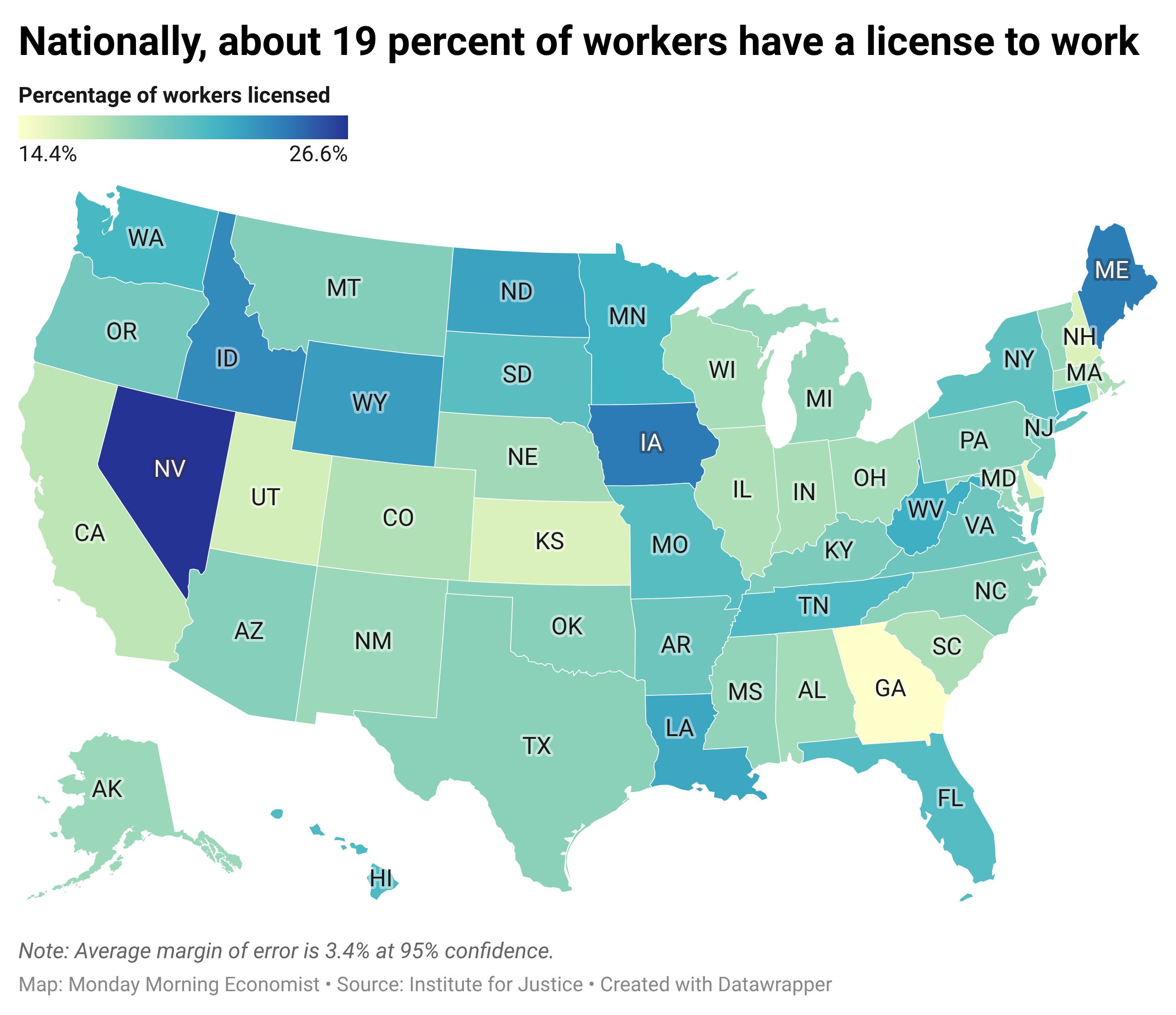
Licensing has quietly become a much bigger part of the economy than most people realize. In the 1950s, roughly 5% of U.S. workers needed a government license to do their job. Today, estimates put that figure around 25%. Barbers are one small piece of a very large trend.
The basic mechanism is just a supply and demand story. A license requirement makes it harder to become a barber, which shrinks the number of people qualified to cut hair. Fewer barbers means each one can charge more for their labor. If you’re a licensed barber, you’re going to see this as a real benefit of licensing.
But the customers are paying for that benefit. Fewer providers and higher wages get passed straight through to the price of a haircut. Research on licensed occupations broadly finds licensing raises consumer prices by somewhere in the range of 3 to 13%, depending on the profession. You may think that premium is the result of better quality, but the evidence on quality is a lot murkier than the evidence on price.
Of course, once prices are higher, some people who would have bought the service simply can’t afford to anymore. Those license fees also prevent some businesses from opening at all. These costs don’t show up cleanly in economic data since there’s no tracking for “the haircut that didn’t happen” or “the barbershop that never opened.”
How Does a Useless Permit Survive for Decades?
If the costs of licensing are real and the benefits mostly accrue to a small group, why does it take decades to undo a rule like this? Public choice economics has a name for the pattern: concentrated benefits, dispersed costs.
Let’s revisit the barbershop again. Right now, cutting hair in New York City legally requires three separate approvals, and clearing all three is exactly what makes each existing barber’s business a little safer from new competition. Fewer people can afford the time and money to get through all three, so the ones who already have all three face less competition otherwise. That’s a concentrated benefit. The people receiving it know exactly what they’d lose if the rules loosened.
But the costs of this process are spread across the city. Everyone pays slightly higher prices for a haircut, and there are slightly fewer barbershops than the neighborhood could otherwise support. No single group feels that cost sharply enough to show up at a City Council hearing about it. It’s a few extra dollars here and there, which makes the costs diffuse and easy to ignore.
And it’s that imbalance that explains the staying power of these permits. Once an occupation gets licensed, it tends to stay that way. It also helps explain why Mamdani’s reform is just a proposal at this point. Undoing an embedded rule takes real coordination, and the people who benefit from the status quo aren’t likely to just disappear following a speech.
Final Thoughts
Licensing may be appropriate for occupations where health and safety are seriously on the line, but a lot of the restrictions on licensed work look more like friction that has outlived its purpose. A bad haircut is a minor inconvenience, but an untrained surgeon is not. It’s worth asking, case by case, which one you’re actually looking at.
We’ll likely never live in a society where licenses cease to exist, so it’s worth figuring out what thresholds we want to preserve and which ones are just exclusionary. One idea could be to extend the “two-out, one-in” rule for occupational licensing. Every time a state adds a new licensing requirement, it has to remove two existing ones elsewhere. It wouldn’t tell you which requirements are the good ones and which are just friction, but it would force the question to actually get asked instead of letting rules pile up by default.
The next time a friend tells you they’re headed out for a haircut, send them this to read while they wait. They’ll walk out with a fresh cut and a lot more to think about why the price seems so high, and their options seemed so limited.
All 50 states plus Washington, D.C. require a license to work as a cosmetologist, but the requirements vary from 233 days in New York to 963 days in Massachusetts [Institute for Justice]
Occupational licensing restrictions may cost the economy up to 2.85 million jobs nationwide with an annual cost to consumers of $203 billion. [The Hamilton Project]
An occupation was licensed in any given year from 1950 to 2020 remained licensed 99.9% of the time in the next year [Federal Reserve Bank of Minneapolis]
The states with the highest occupational licensing burden in 2025 were Oregon, Tennessee, Texas, Kentucky, and Florida [Archbridge Institute]
Shifting an occupation from unlicensed to licensed reduces employment in that occupation by 29% [CATO Institute]
nice post do doctors next, specifically the cartel-like behavior of the AMA 👀
Licensing is so much more complex than most people realize! It actually affects nearly twice as many Americans than the federal minimum wage and unions *combined*! Even more confusing is that each state gets to define the occupation [what the occupation is called] and the scope of occupation [what people in that occupation do]. Some states have natural hair braiding licenses and some states require hair braiders to get barber licenses and some states have no license if all you do is braid hair. You may also need to get multiple licenses if your job overlaps multiple occupations' scopes. So your local CrossFit coach may need a personal trainer license to coach a class, a nutritionist or dietician license if they give meal/nutrition/diet advice, and a massage therapy, chiropractic, or physical therapy license if they are helping you with an injury.
Some states also just like to license more than others. Some harmless self-promotion: Check out the State Occupational Licensing Index to see who https://www.archbridgeinstitute.org/state-occupational-licensing-index/ and keep your eyes out for our 2026 edition releasing next month.