


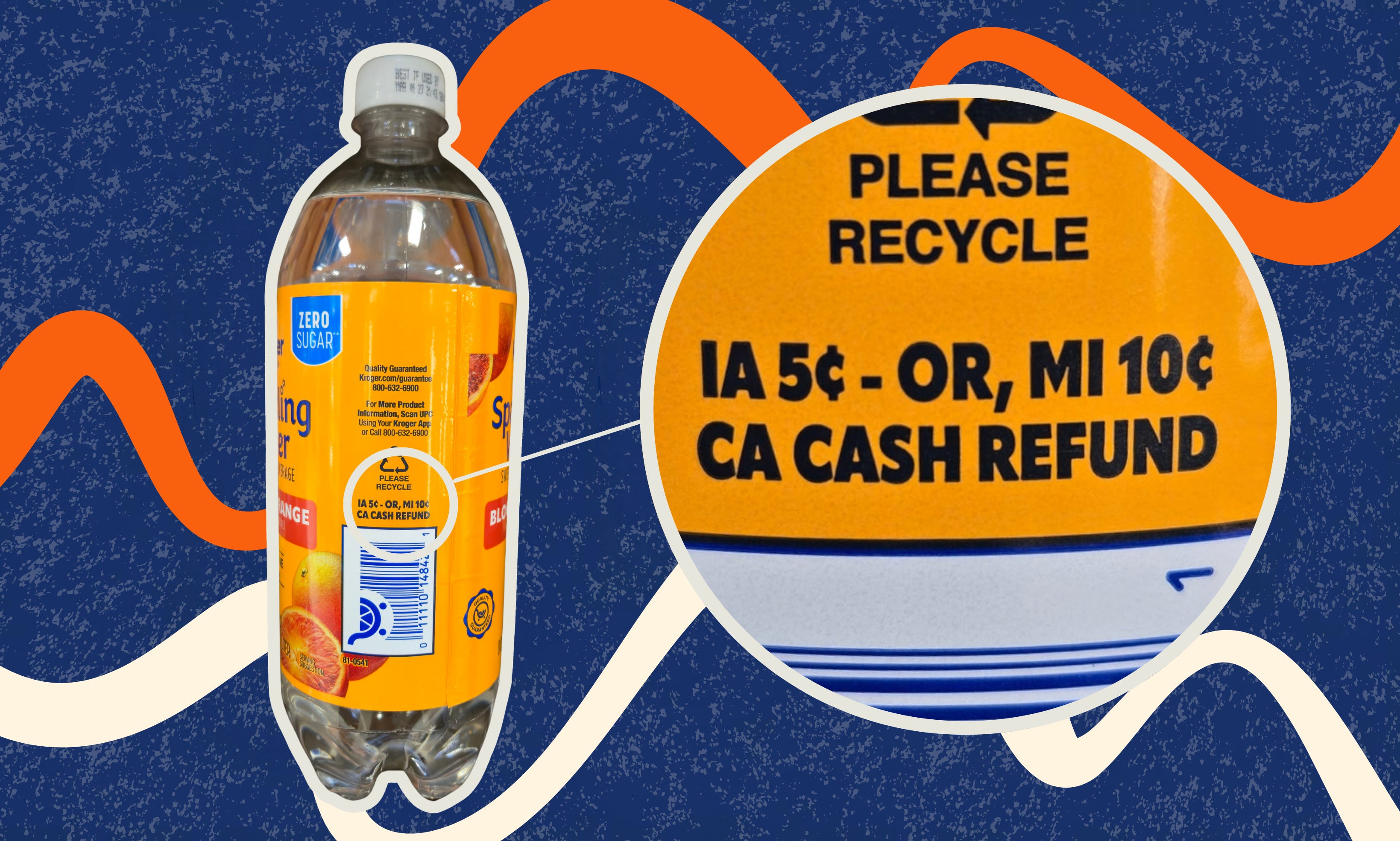
I was bored last week and stumbled onto one of my favorite Seinfeld episodes: “The Bottle Deposit.” If you’re not familiar with the premise, two neighbors hatch a plan to round up bottles and cans around New York City and haul them over to Michigan to cash in on the ten-cent refund.
Before you get any smart ideas, you should know it’s illegal to collect a refund on a bottle or can purchased in another state. Of course, that hasn’t stopped some people from cashing in millions of dollars’ worth of bottles and cans.
But as I watched, my first thought was different. This episode first aired about thirty years ago, and the deposit rates haven’t really changed since. In most states with bottle deposit laws, the deposit has been a nickel since the early 1980s. In case your memory is a little foggy (or nonexistent), a gallon of gas at the time cost about $1.25, and the average home was selling for around $83,000. Those prices have exploded since, but the nickel deposit hasn’t budged in most states.
So what happens to a market when a price gets frozen for four decades?
 Tiktok failed to load.
Enable 3rd party cookies or use another browser
Why Bottle Deposits Even Exist
Only 10 states and 1 territory have bottle deposit programs, but it’s easy to see why they adopted them. Throwing away a bottle instead of recycling it imposes a cost on society. If you toss it out your car window, it becomes litter someone else has to pick up. Throw it in the trash, and it eventually takes up valuable landfill space. Economists call this a negative externality: those costs don’t fall on you, but instead fall on others.
Because the person making the disposal decision doesn’t bear the full cost, people in places without deposits will throw away too many bottles and recycle too few.
The classic fix for a negative externality is a Pigouvian tax. These taxes increase the cost of a harmful behavior until it more closely matches the social cost. Carbon taxes and congestion fees work in a similar manner, but bottle deposits have a nice twist. The same nickel penalizes the bad behavior and rewards the good one.
The mechanics vary by state, but they’re all fairly similar. Buy a bottle and pay an extra 5 cents at the store. Return it to a redemption center and get your 5 cents back. You forfeit your deposit if you toss it, which effectively becomes a tax on littering. One small fee ends up working as both a tax on disposal and a subsidy for recycling.
Of course, the whole system depends on the deposit being large enough to actually change behavior. If it isn’t meaningful, the incentive quietly dies. Which brings us back to that nickel that seems stuck in time.
When a Nickel Stopped Mattering
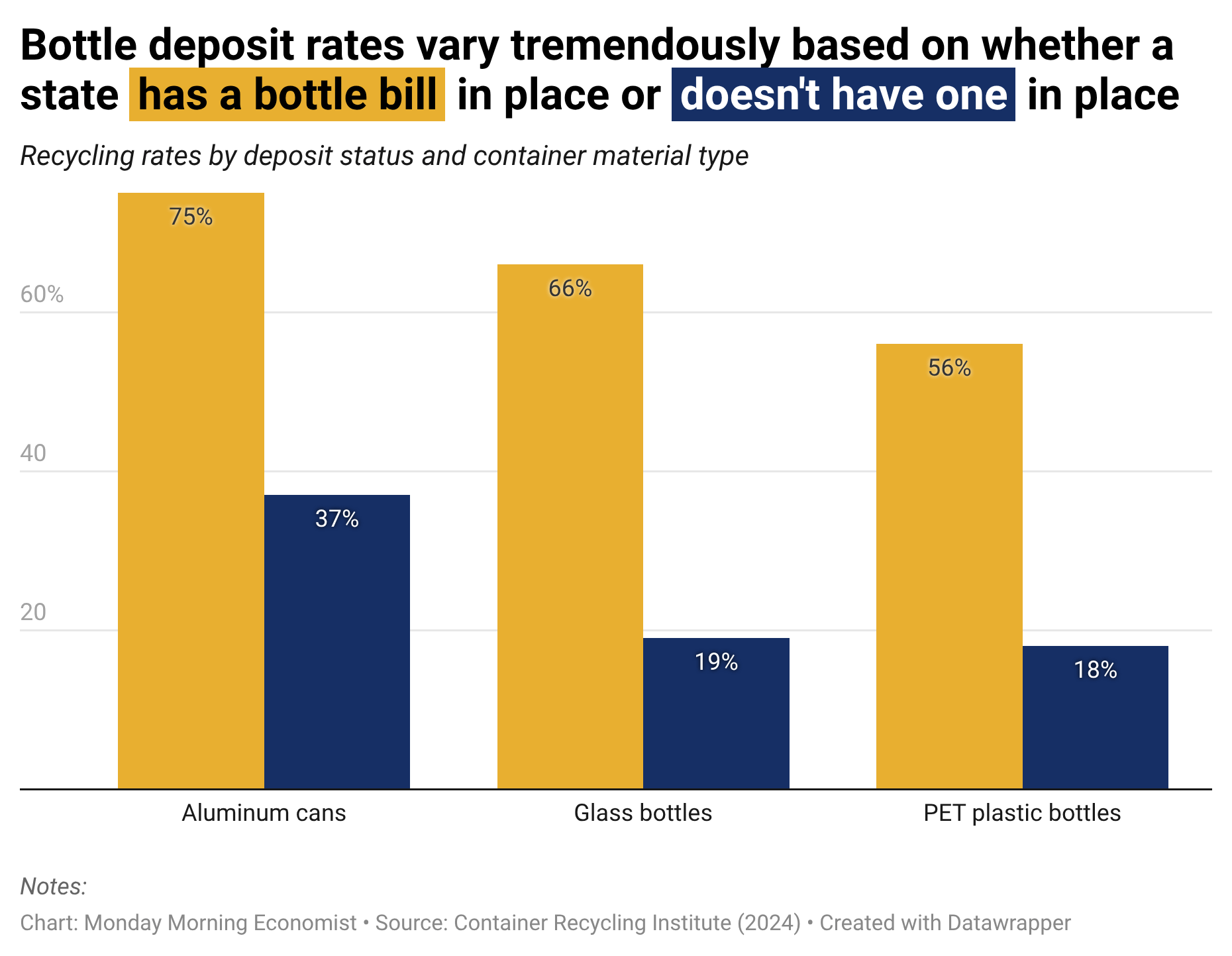
Massachusetts is a good place to see what that looks like. The state went from an 87% bottle redemption rate in 1995 to just 33% last year. That’s the worst rate among the states with bottle deposit laws. Fewer people are returning their bottles, but it’s probably not because they stopped caring about the environment.
The state’s 5-cent deposit took effect in 1983, and inflation has been eating away at it ever since. Adjusted for inflation, a nickel from the early 1980s is equivalent to about 16 cents today. In the early 1980s, a nickel was a meaningful chunk of what a bottle of soda cost. Today, a 5-cent deposit is just 2% of the price of a 20-ounce Coke at a convenience store.
Meanwhile, the effort of returning a bottle hasn’t gotten any easier and your time hasn’t gotten any cheaper. On a 6-pack of sodas, a 5-cent deposit means an extra 30 cents at checkout. That’s easier to ignore when everything else in your shopping cart is getting more expensive. The mental math of rinsing the bottles, bagging them, and driving them to a redemption center for 30 cents increasingly doesn’t make much sense. It’s no surprise that two out of three Massachusetts bottles never make it back.
So, what would happen if the deposit doubled to 10 cents? Would that really change anyone’s behavior? Economic theory says yes, and thankfully a state has already run the experiment.
The Connecticut Experiment
That state is Connecticut. Its deposit sat at 5 cents from 1978 until 2024, and its redemption rate slid below 50%. During a 2021 debate to raise the deposit, one state senator called it “the worst redemption rate of any bottle-bill state in the nation.” Their solution was to double the deposit to 10 cents, which they said would give shoppers a bigger reason to bring bottles back. Oregon had already doubled its rate back in 2017 and saw its returns increase by more than 15 percentage points.
The new rate took effect in 2024, and the results were dramatic. Connecticut’s redemption rate climbed from 44% in 2023 to 65% in 2024 to 92% in 2025. It’s now the highest of any deposit state and nearly triple Massachusetts’s 33%. The nickel doesn’t deserve all the credit, since Connecticut also added about 300 new redemption sites. Still, a rate that had sagged for years more than doubled in two.
But remember our two neighbors from the Seinfeld episode? If the show were filmed today, their road trip would be a whole lot easier. New York’s deposit is still a nickel, and Connecticut now pays back a dime. Instead of hauling a mail truck of bottles roughly 600 miles to Michigan, they could take a short drive up I-95.
Connecticut officials say they were caught off guard by a flood of out-of-state returns, which means the 92% redemption rate may be overstated. It’s not clear by how much, because Connecticut has no record of where redeemed bottles were originally purchased. Lawmakers have responded with a crackdown law, and the debate over rolling back to 5 cents has already resurfaced.
Final Thoughts
One way to shrink the gap is for neighbors to match, and New York is weighing exactly that. The proposal is called the “Bigger Better Bottle Bill,” and it would double New York’s deposit to 10 cents, the state’s first increase since 1983. It has been introduced before, but it hasn’t become law yet.
The bottle deposit isn’t the only policy stuck in a time capsule. Minimum wages, fines, fees, and penalties set at one moment and never revisited lose their real-world bite while looking identical on paper. The fix is unglamorous: index the amount to inflation so it adjusts on its own. Without that, no one has to repeal a policy for it to stop working.
If you learned something here, pass it on. Share this article with a friend or family member, and let them know there’s a new economics lesson hiding in every recycling bin.

Oregon passed the first modern bottle bill on July 2, 1971, which instituted a 5-cent refundable deposit on beer and soft drink containers to combat roadside litter [Bottle Beer Resource Guide]
Connecticut’s beverage container redemption rate hit 92% in 2025, rising significantly from its 65% rate in 2024 [Waste Dive]
Municipal solid waste landfills are the third-largest source of human-related methane emissions in the United States, accounting for approximately 14.4% of these emissions in 2022 [Environmental Protection Agency]
The New York Department of Taxation and Finance collected $102.7 million in unclaimed 5-cent deposits from the state’s container redemption program in 2016 [Waste Dive]
I agree on the inflation adjustments, assuming it is worth our time and effort to recycle at all.
I question your assumption that landfill space is all that valuable (or scarce). Modern practices make for great future golf courses.
Pretty sure plastic and glass bottles don’t produce significant methane in landfills.
I think we need to consider the wasted time people spend collecting and sorting for refunds.
Seems that this deposit trend preceded the sorting of garbage movements, which greatly replace the need to collect deposits. IOW the problem has been solved more efficiently.
I think it is even more reasonable to have centralized sorting at dedicated facilities, especially of glass, aluminum and cardboard.
> Only 10 states and 1 territory have bottle deposit programs, but it’s easy to see why they adopted them.
Because they're money-grubbing, authoritarian busybody states that never pass up a chance to extort their citizens or meddle in their lives?
*checks list*
Yup.
Recycling is a largely wasteful and pointless activity on every front -- financially, temporally, and, yes, even environmentally. If there were good reasons to recycle a material, market forces would create a recycling economy for it even absent a regulatory compulsion, as evidenced by bulk metal recycling scrapyards existing everywhere.